
SEO & GEO Readiness
Structured data for SEO in 2026: Article, Organization, Product
Structured data SEO in 2026: FAQ rich results are gone and schema did not lift AI citations. What Article, Organization and Product still earn.

Summarize with AI
Short on time? Open this article in your AI assistant with a ready-made prompt.
- ChatGPT (opens in a new tab with a summary prompt)
- Perplexity (opens in a new tab with a summary prompt)
- Grok (opens in a new tab with a summary prompt)
Claude and Gemini open with the prompt copied: paste it to start.
On this page
- What is structured data, and what does it do for SEO?
- Which structured data did Google drop, and why does it matter?
- Does structured data help you get cited by AI search engines?
- Which structured data types still matter in 2026?
- How do you add and test structured data without breaking the rules?
- How does ContentMas help with structured data?
- Key takeaways
- Frequently asked questions
Short answer
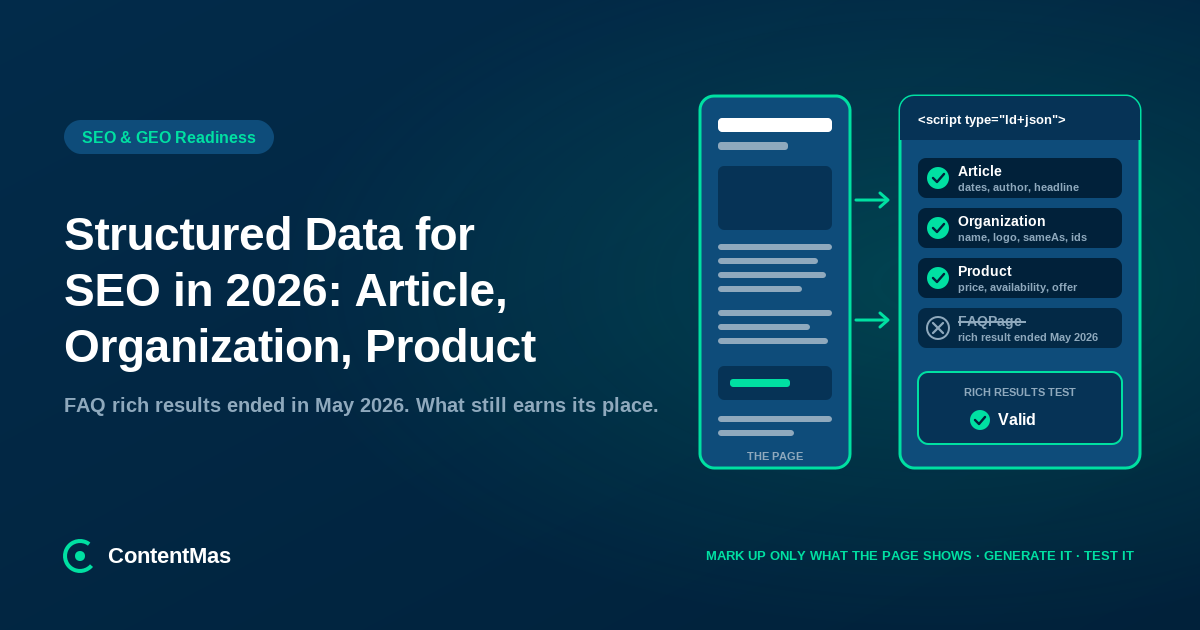
In short: structured data SEO in 2026 is narrower and more honest than it was. Google stopped showing FAQ rich results on May 7, 2026 and removed the FAQ documentation in June, after dropping seven other rich result types in 2025 and the HowTo result in 2023.123 What is left is markup that describes the page truthfully: Article for dates and authorship, Organization for who you are, and Product for what you sell.456 Google's own guide to its generative AI features says "Structured data isn't required for generative AI search, and there's no special schema.org markup you need to add," and an Ahrefs study of 1,885 pages that added JSON-LD found that it "didn't boost citations on any platform."78 So add it for the display and trust it still earns in Google, keep it identical to what the page shows, and do not expect it to buy a place in AI answers on its own.97
A marketing team asks its developer to "add schema" because an agency slide said structured data is how AI assistants read a website. The developer installs a plugin that stamps FAQPage, HowTo and Article markup on every page, including pages with no FAQ, no steps and no author. Search Console reports no errors. Nothing changes in the rankings, and nothing changes in the AI answers either.
Structured data has had a strange few years. Between 2023 and 2026 Google removed more rich result types than it added, and in 2026 it published guidance saying no special markup is needed for its AI features. At the same time, half of all home pages now carry some structured data, and the types that describe real things (the organization, the article, the product) keep gaining ground.10
This guide separates what structured data still does from what it is sold as doing. It covers what Google dropped and why, what the evidence says about markup and AI citations, which four types earn their place on most sites, and how to add them without breaking Google's rules.
What is structured data, and what does it do for SEO?
Structured data is a block of labeled facts about a page, written in a vocabulary (schema.org) that search engines agree on, so a machine can read "this is an article, by this author, published on this date" without guessing. Google uses it for two things: to understand the page better, and to show richer search results when the page qualifies.
Google's general guidelines are direct about the limits. The markup "must be a true representation of the page content," you should not "mark up content that is not visible to readers of the page," and "Google does not guarantee that your structured data will show up in search results" even when the Rich Results Test passes.9 Items "that are missing required properties are not eligible for rich results," and "the more recommended properties that you provide, the higher quality the result is to users."9 Of the three formats Google reads, JSON-LD is the one it marks "(recommended)".9
The second half of the definition matters as much as the first. Structured data is not a ranking signal, and Google's enforcement is built around that: a structured data manual action "means that a page loses eligibility for appearance as a rich result; it doesn't affect how the page ranks in Google web search."9 What markup wins is display (dates, logos, prices, breadcrumbs) and disambiguation (which company, which author, which product). What it does not win is position.
Which structured data did Google drop, and why does it matter?
Google has spent three years removing rich results that it judged unused or unhelpful, and the removals tell you which markup is worth maintaining. The pattern is that types tied to a page's real content survive and types that were mainly ways to take up more space in the results do not.
| Markup | What happened | When |
|---|---|---|
| HowTo | Rich result removed on mobile, then on desktop; the type is deprecated | August and September 20233 |
| FAQPage | Rich result limited to "well-known, authoritative government and health websites," then stopped for everyone; documentation removed | August 2023, May 7 and June 15, 202613 |
| Book Actions, Course Info, Claim Review, Estimated Salary, Learning Video, Special Announcement, Vehicle Listing | Seven rich result types phased out because, Google said, they were not commonly used in Search | June 20252 |
| Practice Problem (and Dataset) | Phased out of search results; Practice Problem documentation removed | November 2025 and January 20261 |
| Sitelinks search box (WebSite with SearchAction) | The visible search box was retired | November 202410 |
| Review snippets | Still supported; a new guideline added against fake and undisclosed incentivized reviews | July 20261 |
| Merchant listing (Product) | Still supported and expanding: category, sale price dates and hasAdultConsideration added | May and July 20261 |
| VideoObject | Still supported; creator property documented | September 20261 |
Sources: compiled from the Google Search Central changelog and blog posts cited in each row.
The FAQ story is the one most sites still have to clean up. In August 2023, Google announced that FAQ rich results would "only be shown for well-known, authoritative government and health websites," which removed them from almost every commercial site.3 On May 8, 2026, its documentation changelog added a deprecation notice: "This feature will no longer appear in Google Search starting May 7, 2026." On June 15 it removed the FAQ documentation altogether, "as announced in the changelog entry in May 2026."1 Three years after the restriction, plugins are still writing FAQPage markup to pages that gain nothing from it.
The June 2025 removals are instructive for a different reason. Google said the change would not affect how pages are ranked, which is the same point its guidelines make about manual actions: structured data decides what a result looks like, not where it appears.92 A site that loses a rich result loses a visual, nothing more. A site that keeps writing markup for a rich result that no longer exists spends developer time on a visual nobody will see.
Does structured data help you get cited by AI search engines?
Not measurably, on the evidence available in 2026. Google says no special markup is needed for its generative AI features, and the one controlled study that tested adding schema found no lift in citations.
Google's guide to optimizing for its generative AI features, published in May 2026, lists "overfocusing on structured data" among the things site owners can ignore: "Structured data isn't required for generative AI search, and there's no special schema.org markup you need to add," followed by the reason to keep it anyway, "it's a good idea to continue using it as part of your overall SEO strategy, as it helps with being eligible for rich results on Google Search."7 The same page says you "don't need to create new machine readable files, AI text files, markup, or Markdown to appear in Google Search (including its generative AI capabilities)," and sets the actual bar: a page "must be indexed and eligible to be shown in Google Search with a snippet."7
The Ahrefs result also explains why the claim that "AI loves schema" persists. An earlier Ahrefs analysis of 6 million URLs found that pages cited by AI assistants were "almost three times more likely to have JSON-LD than non-cited pages," and that 53% of AI-cited pages carry schema.8 That is a correlation: well-maintained sites both add markup and get cited. When the same team tested the markup on its own, with everything else held constant, the effect disappeared. Their conclusion is the one to work from: "If you're already doing the rest of the SEO work well, JSON-LD isn't going to be the unlock."8
None of this makes structured data useless for AI search engines. Google's AI features draw on the same index as its search results, so the eligibility rules (indexed, snippet allowed, crawlable) are the real requirement, and the guide to optimizing content for ChatGPT, Perplexity and AI Overviews covers those. Markup that keeps the dates, author and company facts consistent helps those same facts survive into any system that reads the page. It just is not the lever.
Which structured data types still matter in 2026?
Four types do most of the useful work on a typical company website: Article on anything with a byline and a date, Organization on the home page, Product on pages that sell, and BreadcrumbList on deeper pages. Each describes something the page already shows, which is why they survived.
| Type | Where | What it earns | Properties that matter |
|---|---|---|---|
| Article, BlogPosting, NewsArticle | Every dated article | Correct title, image and date in results; clearer authorship | headline, image, datePublished, dateModified, author with url or sameAs4 |
| Organization | Home page or one about page | Logo and details in Search and the knowledge panel; disambiguation from similarly named companies | name, url, logo (at least 112 by 112 px), sameAs, address, contactPoint, vatID or other registry ids5 |
| Product (merchant listing) | Pages where a shopper can buy | Price, availability, shipping and returns in results, Images and Lens | name, image, offers with price and currency, availability, return and shipping policy6 |
| Product (product snippet) | Product pages that do not sell directly (reviews, comparisons) | Rating and price information in results | name, review or aggregateRating, offers6 |
| BreadcrumbList | Any page below the home page | The breadcrumb trail shown in place of the URL | Each ListItem matching the visible trail9 |
| FAQPage | Nowhere, for Google rich results | Nothing since May 2026 | Keep only if another system you serve reads it; the visible FAQ stays1 |
Sources: Google Search Central documentation for each type, cited in the rows.
Article: dates and authorship that machines can trust
Google says Article markup "can help Google understand more about the web page and show better title text, images, and date information."4 The type has no required properties ("instead, add the properties that apply to your content"), and the recommended set is short: headline, image, datePublished, dateModified and author.4 For the author, Google "strongly recommend[s] using the type and url (or sameAs) properties" so the name resolves to a person with a page, not a string.4
The practical rule is that the markup must agree with what readers see: the visible date and the dateModified value should be the same date, and the schedule for updating website content explains why a date that moves without a content change does more harm than good. Markup that disagrees with the page is the kind of thing a scanner catches in seconds and a reader never forgives.
Organization: who is behind the site
Organization markup, placed once, "can help Google better understand your organization's administrative details."5 Google's documentation is unusually plain about the two jobs it does: "Some properties are used behind the scenes to disambiguate your organization from other organizations," and "others can influence visual elements in Search results (such as which logo is shown in Search results and your knowledge panel)."5 There are no required properties; Google recommends "adding as many properties that are relevant to your organization," on "your home page, or a single page that describes your organization," not on every page.5
The properties worth the effort are the identifying ones: the exact legal name, the canonical URL, a logo that is at least 112 by 112 pixels on a crawlable URL, sameAs links to the profiles you actually maintain, a postal address, a contact point, and registry identifiers (vatID, iso6523Code, duns, leiCode), which Google describes as a trust signal for users.5 This is the same evidence an E-E-A-T checklist for a company website asks for in visible form; the markup repeats it in a form machines can match against other sources.
Product: the type that is still growing
Product is the one area where Google's structured data support expanded in 2026 rather than shrank, with category, sale price effective dates and hasAdultConsideration added to the merchant listing documentation to match the Merchant Center feed.1 Google separates two experiences: "Product snippets: For product pages where people can't directly purchase the product," and "Merchant listings: For pages where customers can purchase products from you."6 Adding the merchant listing properties also makes a page eligible for product snippets, and "providing both structured data on web pages and a Merchant Center feed maximizes your eligibility."6
For a shop, this is the markup with the most visible payoff: price, availability, shipping and return details in results, Google Images and Google Lens.6 It also has the strictest honesty requirement, because a price in the markup that differs from the price on the page is a misleading markup problem, not a formatting one.9 Keep the markup generated from the same data as the page, and treat the July 2026 review snippet guideline on fake and undisclosed incentivized reviews as applying to aggregateRating too.1
FAQPage: keep the questions, drop the expectation
The questions and answers on a page are still valuable: they are visible content that answers what people ask, and they are exactly the kind of self-contained passage an AI answer quotes. The markup around them no longer earns a Google rich result, and Google has removed the documentation that described one.1 If the plugin that writes FAQPage markup costs nothing to keep, keeping it is harmless as long as the questions it marks up are actually on the page. If it writes FAQPage to pages without an FAQ, remove it: that is markup for content "not visible to readers of the page," the thing Google's guidelines name first.9
How do you add and test structured data without breaking the rules?
Generate it from the page's own data, use JSON-LD, add the required properties, and test it before and after it ships. Five steps cover most sites.
Step 1: Start from what the page shows
List the facts a visitor can read: the article's title, author, dates and image; the company's name, logo, address and profiles; the product's name, price and stock. Those facts become the markup. Nothing else does. Google's guidelines put it as "put the structured data on the page that it describes," and "don't mark up irrelevant or misleading content, such as fake reviews or content unrelated to the focus of a page."9
Step 2: Use JSON-LD, generated, not hand-typed
JSON-LD is the format Google recommends, and it is the one that content systems can generate from the same fields that render the page, which is how the markup stays identical to the content.9 On the 2025 web, JSON-LD is on 43% of home pages and Microdata on 17%, a gap that widens each year.10 A plugin that fills templates is fine; a plugin that invents properties (a rating with no reviews, an author on a page with none) is not.
Step 3: Add every required property, then the useful recommended ones
Required properties decide eligibility; recommended ones improve the result.9 For merchant listings that means name, image and an offer with price and currency; for Organization it means the identifying details above; for Article it means dates and a linked author.456 Google's advice on completeness is that "it is more important to supply fewer but complete and accurate recommended properties" than many half-filled ones.11
Step 4: Test with Google's tools, then watch Search Console
Run new pages through the Rich Results Test before release, then watch the rich result status reports in Search Console after it, which is the sequence Google's documentation asks for.11 A warning is a missing recommended property; an error is a missing required one or a type Google no longer reads. After May 2026, an FAQ report in Search Console going quiet is expected, not a bug.1
Step 5: Keep the markup crawlable and in sync
Google reads structured data only on pages it can fetch: "don't block your structured data pages to Googlebot using robots.txt, noindex, or any other access control methods," and "all image URLs specified in structured data must be crawlable and indexable."9 Since March 2026, Google also uses "both schema.org markup and the og:image meta tag as sources" for image thumbnails, so the two should name the same image.1 The 10-minute check that AI crawlers can read your website covers the robots and rendering side.
How does ContentMas help with structured data?
ContentMas is an AI-powered SEO tool that audits your website for Google and AI search engines, and shows exactly what to fix to rank higher and get cited. Its SEO & GEO Readiness (visibility in Google and AI search engines; GEO means Generative Engine Optimization) and Technical Readiness pillars read each page's JSON-LD the way this guide does: whether the structured data matches what the page shows, whether the page-type schema fits the page, whether Article markup carries both datePublished and dateModified and whether those dates agree with the visible date, the Open Graph tags and the sitemap, whether Organization markup has a name, URL, a 112 px or larger logo, sameAs links and business details, whether deeper pages show a breadcrumb trail with matching BreadcrumbList markup, whether authors carry sameAs links, and whether the whole graph is connected through @id.
Each finding names the page, the property and the fix, so an audit turns "add schema" into a short list of markup to correct and markup to remove. The two pillars run alongside Content Freshness, Content Quality, Trust & Authenticity and Security, across 700+ KPIs. The free plan reads up to 10 pages per scan, 3 scans per 24 hours; paid plans read 100, 200 or 500 pages. See how we score or run an audit.
Key takeaways
- FAQ rich results stopped on May 7, 2026 and the documentation was removed on June 15; HowTo went in 2023 and seven more types in June 2025. Markup for those results now earns nothing in Google.123
- Structured data affects display and understanding, not rank: Google says a structured data manual action "doesn't affect how the page ranks," and said the 2025 removals would not change how pages rank.92
- For AI answers, Google says no special schema.org markup is needed, and Ahrefs found that adding JSON-LD to 1,885 already-cited pages "didn't boost citations on any platform."78
- Article (dates and a linked author), Organization (identity on the home page) and Product (price and availability where people buy) still earn visible results and disambiguation, and Product support grew in 2026.1456
- The rule that decides everything is truth: mark up only what readers can see, generate it from the same data as the page, add the required properties, and test it.9
- Half of home pages now carry structured data (50% in 2025), JSON-LD is on 43% of them, and Organization has overtaken WebPage as a top type: the web is converging on the same few honest types.10
Structured data was never a trick, and in 2026 it is harder than ever to use it as one. Treated as a plain description of what the page already says, it still does its job: the right date, the right logo, the right price, attached to the right company.
Related reading: How to Optimize Your Content for ChatGPT, Perplexity, and AI Overviews and Can AI Crawlers Read Your Website? A 10-Minute Technical Check
The six-pillar guides: Technical · Content quality · Trust · Freshness · Security · SEO and GEO · How ContentMas scores each pillar
Frequently asked questions
Does structured data improve Google rankings?
No. Google's guidelines say a structured data manual action "doesn't affect how the page ranks in Google web search," and when it removed seven rich result types in June 2025 it said the change would not affect how pages are ranked.92 Structured data changes how a result is displayed and how well Google understands the page's facts; position comes from relevance, quality and links.
Should I remove FAQ schema from my website?
Remove it where the page has no visible FAQ, because markup for content readers cannot see breaks Google's guidelines.9 Where the questions and answers are on the page, the markup is harmless but earns nothing: Google stopped showing FAQ rich results on May 7, 2026 and removed the documentation in June.1 Keep the visible questions and answers either way; they are the content, and the content is what gets quoted.
Does schema markup help with ChatGPT, Perplexity or AI Overviews?
Not measurably. Google's guide to its generative AI features says "there's no special schema.org markup you need to add," and an Ahrefs study of 1,885 pages that added JSON-LD found no lift in citations in AI Overviews, AI Mode or ChatGPT against matched controls.78 Cited pages are more likely to carry schema (53% do), but that reflects well-maintained sites, not the markup itself.8
Which structured data should a small business website have?
Organization on the home page with the legal name, logo, address, contact point, sameAs profiles and any registry id; Article on every dated post with datePublished, dateModified and an author linked by url or sameAs; BreadcrumbList on deeper pages; and Product with an offer on any page where a customer can buy.456 All of it in JSON-LD, generated from the same data the page displays.9
How do I check whether my structured data is valid?
Run the page through Google's Rich Results Test during development and watch the rich result status reports in Search Console after release, which is the order Google's documentation recommends.11 Then check the part a validator cannot: that every value in the markup (date, price, author, address) matches what a visitor reads on the page.
References
Each numbered marker in the article links to its source below.
-
Google Search Central — Latest documentation updates (opens in a new tab), November 2026. ↩
-
Google Search Central Blog — Simplifying the search results page (opens in a new tab), June 2025. ↩
-
Google Search Central Blog — Changes to HowTo and FAQ rich results (opens in a new tab), August 2023. ↩
-
Google Search Central — Article (Article, NewsArticle, BlogPosting) structured data (opens in a new tab), November 2026. ↩
-
Google Search Central — Organization (Organization) structured data (opens in a new tab), November 2026. ↩
-
Google Search Central — Intro to product structured data (opens in a new tab), December 2025. ↩
-
Google Search Central — Optimizing your website for generative AI features on Google Search (opens in a new tab), May 2026. ↩
-
Ahrefs — We Tracked 1,885 Pages Adding Schema. AI Citations Barely Moved. (opens in a new tab), May 2026. ↩
-
Google Search Central — General structured data guidelines (opens in a new tab), July 2026. ↩
-
HTTP Archive Web Almanac — SEO (2025 edition) (opens in a new tab), January 2026. ↩
-
Google Search Central — Intro to how structured data markup works (opens in a new tab), December 2025. ↩
About this article
Written by Nasir Ali Joiya. Nasir Ali Joiya is a software engineer and the CEO and Co-Founder of ZAPTA Technologies, an AI-native software company in Lahore whose group has more than 150 engineers. Reviewed by the ContentMas Team, who build ContentMas, an AI-powered SEO audit tool that checks sites across six pillars for Google and AI search engines. Facts and figures link to their original sources in the References. Spotted something out of date? Tell us and we will correct it.
Free website audit
See how your site scores for search engines and AI assistants.
One score, six pillar scores and a ranked fix list in a few minutes. No credit card.
Start free audit