
SEO & GEO Readiness
How people search in 2026: Google, AI, voice and social
Google still takes about 3 of every 4 desktop searches, AI tools about 3%, and AI answers cut clicks in half. The numbers on how people search in 2026.

Summarize with AI
Short on time? Open this article in your AI assistant with a ready-made prompt.
- ChatGPT (opens in a new tab with a summary prompt)
- Perplexity (opens in a new tab with a summary prompt)
- Grok (opens in a new tab with a summary prompt)
Claude and Gemini open with the prompt copied: paste it to start.
On this page
- Where do people search in 2026?
- How has Google itself changed?
- How many people search with AI assistants instead?
- Do people search by voice and camera?
- Do people search on social media?
- What should a website do about how people search in 2026?
- How does ContentMas help with how people search in 2026?
- Key takeaways
- Frequently asked questions
Short answer
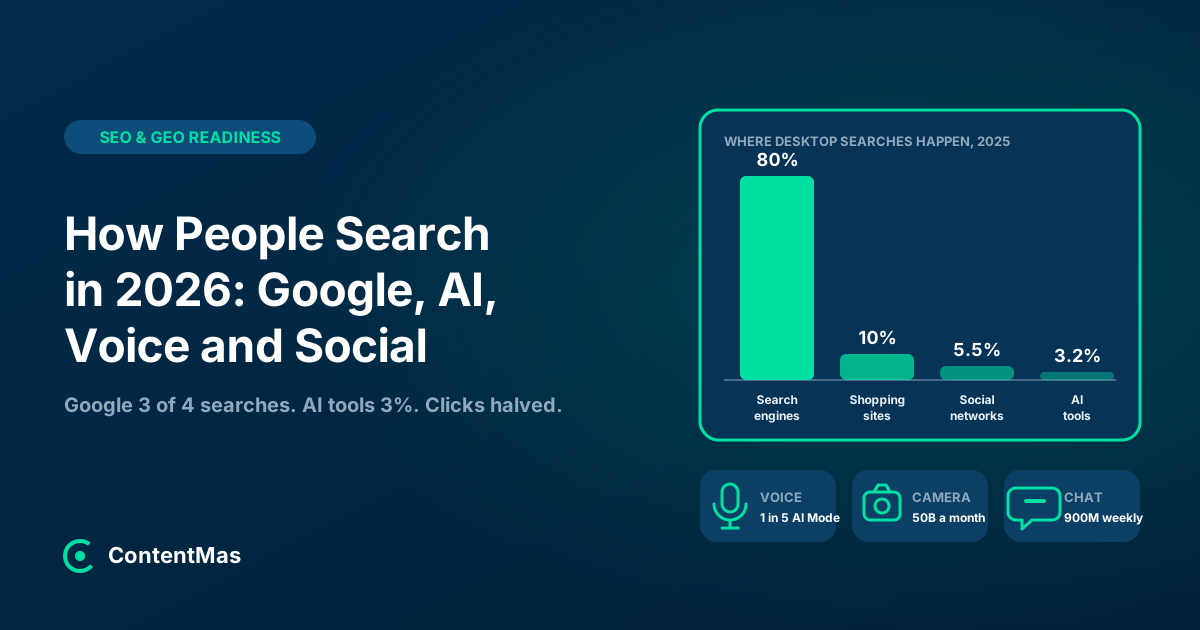
In short: people still search mostly on Google, but the search itself has changed shape. Across 41 high-traffic sites studied by SparkToro and Datos, Google handled 73.7% of US desktop searches in late 2025, traditional search engines about 80%, shopping sites about 10%, social networks about 5.5% and AI tools 3.2%.1 Google says its query growth is the highest in 5 years, AI Mode has passed 1 billion monthly users and AI Overviews 2.5 billion, and 1 in 5 AI Mode searches uses voice, images or documents.23 The cost falls on websites: when an AI summary appears, Google users click a result in 8% of visits instead of 15%.4 ChatGPT has 900 million weekly users and turns on web search for about a third of prompts,56 and 10% of people worldwide now use an AI chatbot for news each week.7 For a website, the task is no longer only to rank; it is to be the page an engine or an assistant picks when it answers.
You have probably felt it in your own analytics. Impressions in Search Console are up, clicks are flat or down, and a new row has appeared in your referral report with names like chatgpt.com or perplexity.ai. Everyone on your team has a theory: "nobody uses Google anymore," "it is all TikTok now," "AI killed the click."
The data tells a more specific story, and it is worth knowing before you change a content plan or a budget. This guide collects the current numbers on where people search, how Google's results have changed, how many people ask AI assistants instead, how much searching happens by voice and camera, and what social platforms really account for. Every figure is footnoted to a page you can open.
Where do people search in 2026?
Mostly on Google, then on shopping sites, YouTube and Bing, with social networks and AI tools far behind. Which number you hear depends on what the study counted.
The most careful recent attempt to count searches everywhere comes from SparkToro and Datos (a Semrush company), published in March 2026. Instead of looking only at search engines, they measured search activity on 41 of the most-visited US domains, "across numerous verticals (traditional search, e-commerce, AI tools, reference sites, travel, real estate, classifieds, and more)," using a desktop clickstream panel for all of 2025.1 The headline: "Google alone was responsible for 73.7% of all desktop searches across the 41 domains we analyzed in the US in Q4 2025."1 Grouped by type, about 80% of searches happened on traditional search engines, about 10% on commerce sites, about 5.5% on social networks and 3.2% on AI tools, and "Amazon, Bing, and YouTube still receive more desktop search activity than ChatGPT."1
The other number you will see quoted is Statcounter's: Google at 91.05% of worldwide search engine market share in October 2026, with Bing at 4.8%, Yahoo at 1.18%, Yandex at 1.14% and DuckDuckGo at 0.64%.8 Both figures are right. Statcounter counts search engines only, so Google's share of that smaller pie is larger. SparkToro counts every search box on the 41 sites, so Amazon, YouTube and ChatGPT take slices too.
| Where the search happens | Share of US desktop searches, Q4 20251 | What it means for a website |
|---|---|---|
| Search engines (Google, Bing, others) | about 80% | Still the main source of visits; Google alone 73.7% |
| Commerce sites (Amazon and others) | about 10% | Product searches that never reach a search engine |
| Social networks | about 5.5% | Discovery, mostly watched rather than clicked |
| AI tools (ChatGPT and others) | 3.2% | Longer prompts, answers with few links |
Source: SparkToro and Datos, 41 domains, desktop only; "A huge percent of search takes place in mobile browsers and apps, which were not included in this study."1 In the EU and UK, Google is "more dominant (with an additional 5% of all searches vs. the US)."1
How has Google itself changed?
Google is handling more queries than ever, more of them longer and conversational, and more of them answered on the results page. The result is more searching and fewer clicks to websites.
On its Q3 2026 earnings call, Google said "our year-over-year query growth rate is the highest it's been in the last five years" and credited its AI features.2 The two features doing the work are AI Overviews, the summary at the top of many results pages, and AI Mode, the chat-style tab. In June 2026 Google reported that "AI Overviews now has over 2.5 billion monthly active users, while AI Mode has surpassed one billion monthly users."3 AI Mode searches are a different kind of search: "Queries in AI Mode are on average three times longer than traditional searches, and one in five AI Mode searches globally use voice, images, or documents."2
How often does the summary appear? Pew Research Center tracked the real browsing of 900 US adults in March 2025, covering 68,879 unique Google searches, and found that about 18% produced an AI summary.4 Summaries were rare on short queries and common on questions: 8% of one- or two-word searches, 53% of searches with 10 or more words, and 60% of searches that began with a question word.4 SparkToro's panel saw AI Overviews on about 16% of Google results pages, while fewer than 0.1% of searchers clicked through to AI Mode.1
Publishers see the same thing from the other side. The Reuters Institute's 2026 Digital News Report cites Chartbeat data showing Google organic traffic to more than 2,500 news sites fell 33% globally between November 2024 and November 2025, and 38% in the US.7 Google's position is that the features are "designed to help people find and visit great websites," and since August 2026 every site has a Search Console control to opt out, with the warning that "Sites that opt out will not receive traffic or impressions from our generative AI features."3
So the Google half of "how people search" in 2026 looks like this: more queries, longer queries, a summary on roughly 1 in 6 results pages, and about half as many clicks when it shows.
How many people search with AI assistants instead?
A large and growing minority use AI assistants every week, but as a share of all searching they are still small, and a big part of what they do leads back to Google.
The scale is real. OpenAI announced in February 2026 that "ChatGPT has reached 900 million weekly active users," up from 800 million in October 2025.5 Google says the Gemini app "is now at one billion users."2 In the Reuters Institute's survey of 97,520 people across 48 markets, weekly use of AI chatbots for news "increased year-on-year from 7% to 10%," and "16% of under-35s report using AI chatbots for news."7
The share of searching is another matter. AI tools took 3.2% of US desktop searches, and only about half of the people who visited ChatGPT typed a prompt at all.1 A prompt is also not always a search. Semrush analyzed more than 1 billion lines of US clickstream data from October 2024 to February 2026 and found that "ChatGPT enables web search on roughly one-third of queries": 34.5% in February 2026, down from 46% in late 2024.6 Prompts that do trigger a search average 8.7 words, far longer than a typical Google query.6
Where do those searches send people? ChatGPT's referral traffic grew 206% between January 2025 and January 2026, but the single biggest destination is Google: 21.6% of its outbound referrals in February 2026 went to google.com.6 People ask the assistant, then go to Google to check, buy or browse. Trust explains part of that: "Trust in answers from AI chatbots is 20% globally (relative to trust in news overall at 37%)," and "42% of AI chatbot users for news say they always or often click through" to the original sources.7 Low trust in the answer is good news for the page the answer cites, if the link is there and the page holds up on arrival. The SEO vs GEO guide covers what changes when the answer, rather than the ranking, is the product.
Do people search by voice and camera?
Yes, and in 2026 the measurable growth is in the camera and in AI conversations rather than in the smart speaker.
Google's clearest figure is from its Q3 2026 call: "one in five AI Mode searches globally use voice, images, or documents," and "We've now crossed over 50 billion visual searches per month" through Lens.2 AI Mode queries are on average 3 times longer than typed searches, which is what you would expect when people speak or show something instead of typing keywords.2
For a website, voice and visual search rarely appear as a separate channel in analytics. A spoken question becomes a long, conversational query that triggers an AI Overview or an AI Mode answer; a photo becomes a product or place lookup. Both are answered from the same index as text search,9 so the pages that do well answer a full question clearly, name products and places precisely, and carry images with accurate alt text.
Do people search on social media?
Some do, especially younger people looking for ideas and recommendations, but social accounts for a small share of search activity and a smaller share of clicks to websites.
Reach is not in doubt. Pew's 2025 survey of 5,022 US adults found that 84% use YouTube, 71% use Facebook, half use Instagram and 37% use TikTok, with roughly half of 18- to 29-year-olds on TikTok at least once a day.10 For news, the Reuters Institute reports that social media and video networks were "used by 54% of all respondents," ahead of news websites and apps at 51%, and "for the first time the single most widely used way of accessing online news."7
Searching is a smaller part of that time. Social networks accounted for about 5.5% of desktop searches, third behind search engines and commerce sites.1 People search inside TikTok, Instagram and YouTube for how-to videos, restaurant and product ideas, and what other people think. The result is usually watched, not clicked. If your audience is under 35, social is where they first hear of you; your website is still where search engines and AI assistants send them to confirm it.
What should a website do about how people search in 2026?
Keep doing the things that make a page rank, and add the things that make it the page an answer is built from. Google's own guidance says there is no separate trick: "There are no additional requirements to appear in AI Overviews or AI Mode, nor other special optimizations necessary," and "There's also no special schema.org structured data that you need to add."9
What has changed is how a page is found. Google says its AI features "may use a 'query fan-out' technique," issuing "multiple related searches across subtopics and data sources" before writing one answer, and that they show "a wider and more diverse set of helpful links" than classic search.9 That rewards pages that cover a subtopic fully and clearly, so they are retrieved for one of those sub-queries; see what type of content really matters for AI search engines. Three practical steps follow from the numbers.
Step 1: Write for the question, not the keyword
AI Mode queries are 3 times longer than typed searches,2 ChatGPT search prompts average 8.7 words,6 and Google's summaries appear on 60% of question-word searches.4 Pages that open with a direct answer to a full question, then give the detail, match how people now ask.
Step 2: Measure the new paths
Google counts AI Overviews and AI Mode traffic inside the Search Console Performance report under the "Web" search type,9 so rising impressions with flat clicks is the expected pattern, not a bug. Add chatgpt.com, perplexity.ai, copilot.microsoft.com and gemini.google.com as a referral group in your analytics.
Step 3: Make the page worth the click it gets
Fewer clicks means each one is worth more. The 42% of chatbot users who click through to sources7 arrive with a question already half-answered. A page with a visible author, current facts, working sources and fast loading keeps that visitor; a page that fails any of those sends them back.
How does ContentMas help with how people search in 2026?
ContentMas is an AI-powered SEO tool that audits your website for Google and AI search engines, and shows exactly what to fix to rank higher and get cited. It reads your key pages the way Google and AI search engines such as ChatGPT, Gemini and Perplexity read them, and reports on six pillars: Content Freshness, Content Quality, Trust & Authenticity, SEO & GEO Readiness (visibility in Google and AI search engines; GEO means Generative Engine Optimization), Technical Readiness and Security. The checks cover the three steps above: whether a page answers its question in the first paragraph, whether its facts and dates are current, whether an author and sources are visible, and whether AI crawlers can reach it at all.
The free plan reads up to 10 pages per scan, 3 scans per 24 hours; paid plans read 100, 200 or 500 pages. See how we score or run an audit.
Key takeaways
- Google is still where most searching happens: 73.7% of US desktop searches across 41 high-traffic sites, about 80% on search engines in total.1 Statcounter's 91% counts search engines only.8
- Google's results page has changed more than its share: query growth at a 5-year high, AI Overviews at 2.5 billion monthly users, AI Mode at 1 billion, and AI Mode queries 3 times longer.23
- When an AI summary shows, clicks to results fall from 15% to 8% of visits, and links inside the summary are clicked in 1%.4 Google organic traffic to news sites fell 33% in a year.7
- AI assistants are big but still a small slice of search: 900 million weekly ChatGPT users,5 3.2% of desktop searches,1 web search on about a third of prompts, and 21.6% of ChatGPT's referrals going to Google.6
- Voice and camera searching is growing inside AI features: 1 in 5 AI Mode searches uses voice, images or documents, and Lens handles 50 billion visual searches a month.2
- Social is where younger audiences discover and get news,7 but only about 5.5% of desktop searches happen there.1
The picture is not "Google is dead" and not "nothing has changed." People search more, in more places, with longer questions, and they click less. The pages that win answer a whole question, can be trusted on arrival, and are easy for both a crawler and an AI assistant to read.
Related reading: SEO vs GEO: What Changes When AI Answers Instead of Google and What Type of Content Really Matters for AI Search Engines?
The six-pillar guides: Technical · Content quality · Trust · Freshness · Security · SEO and GEO · How ContentMas scores each pillar
Frequently asked questions
Is Google losing search share to ChatGPT?
Not by much so far. In the SparkToro and Datos study of 41 high-traffic US sites, Google handled 73.7% of desktop searches in late 2025 and AI tools 3.2%, with Amazon, Bing and YouTube each ahead of ChatGPT.1 Google also reports its highest query growth in 5 years.2 What is changing is the results page, where AI Overviews and AI Mode answer more questions directly and send fewer clicks to websites.4
How often do Google searches show an AI Overview?
In Pew Research Center's tracking of 900 US adults in March 2025, about 18% of unique Google searches produced an AI summary: 8% of one- or two-word searches, 53% of searches with 10 or more words, and 60% of searches that began with a question word.4 SparkToro's 2025 panel saw AI Overviews on about 16% of results pages.1
Do people click the links in AI answers?
Rarely in Google's AI Overviews: Pew found a click on a cited source in just 1% of visits with a summary, and a click on any result in 8% of visits versus 15% without one.4 Chatbot users behave differently: 42% of people who use AI chatbots for news say they always or often click through to the original source, partly because trust in chatbot answers is only 20%.7
How much searching is done by voice?
Google does not publish a standalone voice figure, but it said in October 2026 that 1 in 5 AI Mode searches globally uses voice, images or documents, and that Lens handles over 50 billion visual searches a month.2 Spoken and visual searches are answered from the same index as typed ones, so the same pages benefit.9
Do I need to optimize separately for AI search engines?
Not according to Google. Its documentation says there are no additional requirements to appear in AI Overviews or AI Mode and no special structured data to add; a page needs to be indexed and eligible for a snippet.9 What helps is covering a question fully, since AI features fan out into several related sub-searches before answering, and keeping the page current and trustworthy for the reader who does click.97
References
Each numbered marker in the article links to its source below.
-
SparkToro — New Research: Search Happens Everywhere; an Analysis of 41 Websites with Significant Search Activity (opens in a new tab), March 2026. ↩
-
Google — Q3 2026 earnings call: Remarks from our CEO (opens in a new tab), October 2026. ↩
-
Google — New opportunities, control and insights for website owners (opens in a new tab), June 2026. ↩
-
Pew Research Center — Google users are less likely to click on links when an AI summary appears in the results (opens in a new tab), July 2025. ↩
-
TechCrunch — ChatGPT reaches 900M weekly active users (opens in a new tab), February 2026. ↩
-
Semrush — ChatGPT traffic analysis: Insights from 17 months of clickstream data (opens in a new tab), April 2026. ↩
-
Reuters Institute for the Study of Journalism — Overview and key findings of the 2026 Digital News Report (opens in a new tab), June 2026. ↩
-
Statcounter Global Stats — Search Engine Market Share Worldwide (opens in a new tab), October 2026. ↩
-
Google Search Central — AI features and your website (opens in a new tab), December 2025. ↩
-
Pew Research Center — Americans' Social Media Use 2025 (opens in a new tab), November 2025. ↩
About this article
Written by Nasir Ali Joiya. Nasir Ali Joiya is a software engineer and the CEO and Co-Founder of ZAPTA Technologies, an AI-native software company in Lahore whose group has more than 150 engineers. Reviewed by the ContentMas Team, who build ContentMas, an AI-powered SEO audit tool that checks sites across six pillars for Google and AI search engines. Facts and figures link to their original sources in the References. Spotted something out of date? Tell us and we will correct it.
Free website audit
See how your site scores for search engines and AI assistants.
One score, six pillar scores and a ranked fix list in a few minutes. No credit card.
Start free audit