
Content Quality
Content relevance: match the question, not just the keyword
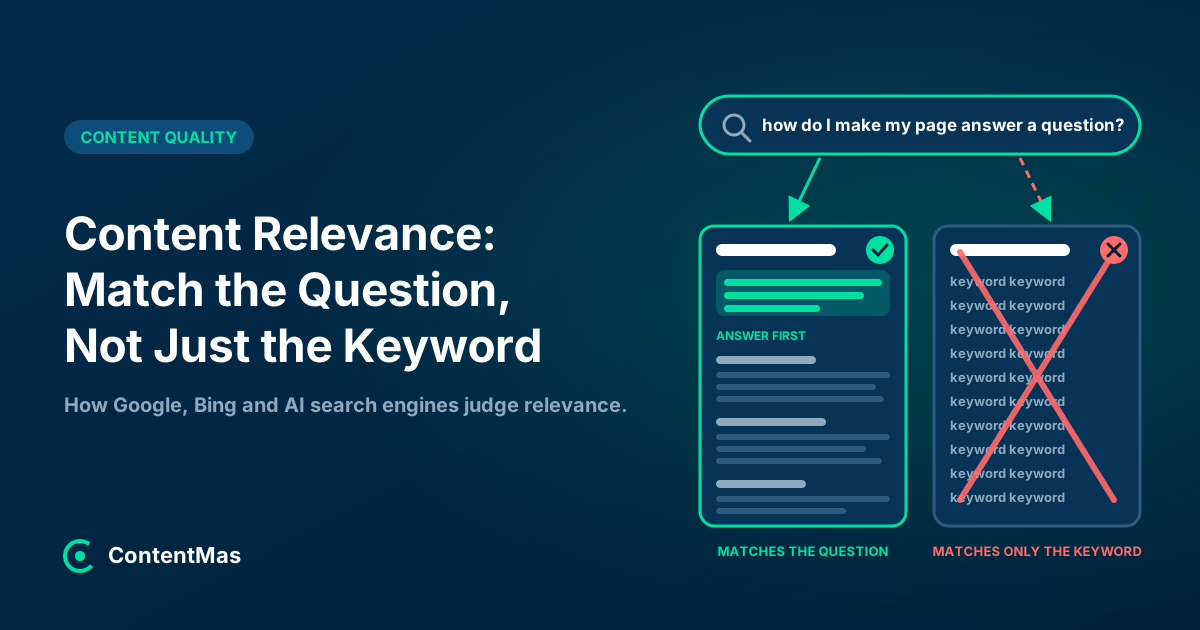
Content relevance is how well a page answers the intent behind a search, not how often it repeats the keyword. How Google, Bing and AI search engines judge it.

Summarize with AI
Short on time? Open this article in your AI assistant with a ready-made prompt.
- ChatGPT (opens in a new tab with a summary prompt)
- Perplexity (opens in a new tab with a summary prompt)
- Grok (opens in a new tab with a summary prompt)
Claude and Gemini open with the prompt copied: paste it to start.
On this page
- What is content relevance?
- How does Google decide whether a page is relevant?
- Why is keyword matching not enough anymore?
- How do AI search engines judge content relevance?
- How do you write a page that matches the question?
- How do you check content relevance on your own site?
- How does ContentMas help with content relevance?
- Key takeaways
- Frequently asked questions
Short answer
In short: content relevance is how closely a page matches what the searcher is trying to do, not how often it contains the words they typed. Google calls the keyword match only "the most basic signal that information is relevant," and says it first works out "the intent behind your query" with a synonym system that finds pages "even if they don't contain the exact words you used."1 Bing defines relevance as "how closely the content on the landing page matches a user's intent behind a search query."2 AI search engines go further and split one question into several related searches before choosing which pages to cite,3 so a page is picked for how well it answers a sub-question, not for a keyword. The way to write for all three is the same: name the question, answer it in the first paragraph, cover the questions that follow, and use the words readers use.
Most website owners have a page like this. It targets the right keyword, which is in the title, the first heading, the URL and a dozen sentences. It does not rank, and no AI assistant ever quotes it.
The usual diagnosis is "more keywords" or "more words." The real problem is relevance in the sense search engines now use the word: the page talks about the topic, but does not answer the question the searcher had.
What is content relevance?
Content relevance is the match between a page and the need behind a search. A page is relevant when the person who typed that query leaves with what they came for: a fact, a how-to, a comparison or a decision. It is not a count of keyword occurrences, and the same page can be highly relevant to one query and useless for another.
Google's description of ranking makes the order explicit. The first step is "Meaning of your query": "To return relevant results, we first need to establish what you're looking for - the intent behind your query."1 Only then come the content checks.1 Bing's ranking parameters, which it says are "listed in general order of importance," start with relevance, ahead of quality and credibility, user engagement, freshness, location and page load time.2 Google's search quality raters apply the same test: their "Needs Met" rating "concerns the intent of the user, as interpreted from the query, and how fully the result satisfies this intent," and a result that "Fails to Meet" "may be off-topic for the query or address a no-chance interpretation of the query."4
How does Google decide whether a page is relevant?
In layers: it reads the query for meaning, checks whether the page has content that serves that meaning, then uses "aggregated and anonymized interaction data" to confirm the match.1 Keyword matching is the first and weakest layer.
Google says the match is a starting point: "The most basic signal that information is relevant is when content contains the same keywords as your search query."1 It then explains why that is not enough: "when you search for "dogs," you likely don't want a page with the word "dogs" on it hundreds of times," so its systems "assess if a page contains other relevant content beyond the keyword "dogs" such as pictures of dogs, videos, or even a list of breeds."1
The ranking systems that do this have names. Google's guide to its ranking systems, updated in December 2025, describes RankBrain as "an AI system that helps us understand how words are related to concepts," so Google "can better return relevant content even if it doesn't contain all the exact words used in a search."5 BERT "allows us to understand how combinations of words express different meanings and intent," and passage ranking identifies "individual sections or "passages" of a web page to better understand how relevant a page is to a search."5 One section that answers the question can carry a long page; a page that mentions the topic everywhere but answers it nowhere gives passage ranking nothing to find.
Deduplication closes the loop: when matching pages are "very similar to each other," Google shows "only the most relevant results to avoid unhelpful duplication."5 A page that matches the keyword like a hundred others is competing for one slot.
Why is keyword matching not enough anymore?
Because searchers stopped writing in keywords, and search engines stopped reading them that way.
Google expects different words for the same need. Its SEO starter guide tells writers to "Think about the words that a user might search for to find a piece of your content," warns that "Users who know a lot about the topic might use different keywords in their search queries than someone who is new to the topic," and gives "charcuterie" versus "cheese board" as the example.6 Bing says the same: term matching counts, but "Bing also considers semantic equivalents, including synonyms or abbreviations, which may not be exact matches of the query terms but are understood to have the same meaning."2
The shape of queries has changed too. Pew Research Center's study of 900 U.S. adults in March 2025 found that Google showed an AI summary on "just 8% of one- or two-word searches," but on 53% of searches "with 10 words or more," and on 60% of searches that "began with question words such as "who," "what," "when" or "why.""7 Long, question-shaped searches are the ones where a keyword-stuffed page has the least chance: the searcher has stated a need in a full sentence. Repeating the keyword to compensate makes it worse: "Excessively repeating the same words over and over (even in variations) is tiring for users and keyword stuffing is against Google's spam policies."6
How do AI search engines judge content relevance?
By breaking the question into parts and looking for the best page for each part, which makes relevance to a sub-question worth more than rank for a head keyword.
Google explains that "Both AI Overviews and AI Mode may use a "query fan-out" technique," which means "issuing multiple related searches across subtopics and data sources" to develop a response, and that "While responses are being generated, our advanced models identify more supporting web pages."3 There are "no additional requirements to appear in AI Overviews or AI Mode," only "creating helpful, reliable, people-first content."3
The effect is measurable. Ahrefs analyzed 863,000 keyword SERPs and 4 million AI Overview URLs in early 2026 and found that only 37.9% of cited pages "also appeared within the first 10 blocks" of the organic results, down from about 76% in its July 2025 study; the rest were split almost evenly between positions 11 to 100 and beyond the top 100.8 Its explanation is the fan-out: "The pages that appear most often within those sub-query SERPs then get cited in the AI Overview."8 A page that answers one sub-question precisely can be cited without ranking for the original keyword at all.
Research agrees. The GEO (Generative Engine Optimization) study by Aggarwal, Murahari and colleagues at Princeton and IIT Delhi, presented at KDD 2024, tested content changes on a benchmark of 10,000 queries. Adding citations, quotations and statistics "achieved a relative improvement of 30-40%" in visibility, while "simple methods like Keyword Stuffing traditionally used in SEO don't perform well," scoring below the unoptimized baseline on Perplexity.9 Substance that answered the question made pages visible; repetition of its words did not.
How do you write a page that matches the question?
Start from the question, not the keyword. The five steps work for a blog post, a service page or a product page.
1. Write down the question and the intent behind it
State in one line what the reader is trying to do when they type the keyword: learn about a topic, get one quick fact, do a task, compare options, buy, or reach a specific site. Google's raters grade a result by "how fully the result satisfies this intent,"4 and Bing notes that "Many queries may have more than one possible intent."2 A page built for the wrong intent, such as a 2,000-word guide for a one-line factual question, is irrelevant however well it is written.
2. Answer in the first paragraph
Put the direct answer at the top, in two to four sentences that stand on their own. This is the passage that passage ranking can lift,5 the sentence an AI answer can quote, and the test Google's helpful content guidance applies: "After reading your content, will someone leave feeling they've learned enough about a topic to help achieve their goal?"10
3. Cover the questions that follow
List the sub-questions a reader asks next (what it costs, how long it takes, what the alternatives are, what goes wrong) and give each its own heading written as the question. Each section is then a candidate for one of the "multiple related searches across subtopics" that AI search engines run.3 Google's self-assessment asks whether the content gives "a substantial, complete, or comprehensive description of the topic" and whether readers leave "feeling like they need to search again."10 Completeness means covering the reader's questions, not reaching a word count.10
4. Use the words readers use, in all their forms
Write the keyword naturally where it belongs, then use the synonyms, abbreviations and plain-language versions readers actually type. Google's synonym system1 and Bing's "semantic equivalents"2 connect them; your job is to serve both the expert who searches "charcuterie" and the beginner who searches "cheese board."6 Titles should be "unique to the page, clear and concise," and "accurately describe the contents of the page."6
5. Give each page one purpose
Google asks, "Does your site have a primary purpose or focus?" and warns against "producing lots of content on many different topics in hopes that some of it might perform well in search results."10 At page level the rule is one page, one question, answered fully. Two pages that answer the same question compete with each other and risk deduplication,5 so merge them.
| Keyword-matched page | Question-matched page |
|---|---|
| Keyword in the title, URL and every other paragraph | Keyword in the title once, then the reader's own words and synonyms |
| Opens with background on the topic | Opens with the answer in two to four sentences |
| Headings are topic labels ("Pricing", "Features") | Headings are the questions readers ask next |
| Written to a target word count | Written until the reader does not need to search again |
| Covers several intents to catch more searches | Serves one intent completely |
How do you check content relevance on your own site?
Read each important page against the query it should serve and test the five steps above: the intent matches, the answer is at the top, the follow-up questions are covered, the vocabulary matches the reader, and no other page answers the same question. Start with the pages that earn visits or money today (the which pages to audit first guide explains the order), and check Search Console: if most queries a page is shown for are phrasings it never addresses, the gap is relevance, not authority.
How does ContentMas help with content relevance?
ContentMas is an AI-powered SEO tool that audits your website for Google and AI search engines, and shows exactly what to fix to rank higher and get cited. Its Content Quality checks look at whether a page's title, first paragraph and headings serve one clear question, whether the answer is stated early in quotable form, and whether the page carries sources and specifics rather than repetition. Its SEO & GEO Readiness pillar (visibility in Google and AI search engines; GEO means Generative Engine Optimization) checks that the page can be found and quoted for the sub-questions AI search engines fan out into.
Every finding comes with its evidence and a fix, ranked by impact, across six pillars and 600+ KPIs. The free plan reads up to 10 pages per scan, 3 scans per 24 hours. See how we score or run an audit.
Key takeaways
- Content relevance is the match between a page and the intent behind a query. Google treats keyword matching as only "the most basic signal";1 Bing defines relevance as matching "a user's intent behind a search query" and lists it first.2
- Google's synonym system improves "over 30% of searches,"1 and RankBrain, BERT and passage ranking match concepts and passages, not exact strings.5
- AI search engines fan one question out into several related searches,3 and only 37.9% of AI Overview citations now come from the top 10 organic results.8
- Keyword stuffing is against Google's spam policies6 and scored below the baseline in the GEO study, while citations, quotations and statistics raised visibility by 30 to 40%.9
- Write from the question: state the intent, answer in the first paragraph, cover the follow-up questions as headings, use the reader's vocabulary, and give each page one purpose.10
The keyword is how a reader found you. The question is why they came. Pages built around the second keep ranking as search engines and AI assistants get better at telling the two apart.
Related reading: Why Thin Pages Don't Rank or Get Cited by AI (and How to Fix Them) and How to Optimize Your Content for ChatGPT, Perplexity, and AI Overviews
The six-pillar guides: Technical · Content quality · Trust · Freshness · Security · SEO and GEO · How ContentMas scores each pillar
Frequently asked questions
What is the difference between content relevance and keyword density?
Keyword density is how often a term appears on a page; content relevance is whether the page meets the need behind the search. Google calls the keyword match only "the most basic signal that information is relevant"1 and treats repeating a term "over and over (even in variations)" as keyword stuffing, which is against its spam policies.6
Can a page rank for a query if it does not contain the exact keyword?
Yes. Google's synonym system finds documents "even if they don't contain the exact words you used,"1 RankBrain returns "relevant content even if it doesn't contain all the exact words used in a search,"5 and Bing considers "semantic equivalents, including synonyms or abbreviations."2 The page still has to serve the intent; it does not have to echo the phrasing.
How do AI search engines decide which pages are relevant?
Google's AI Overviews and AI Mode use "query fan-out," issuing "multiple related searches across subtopics and data sources" before picking supporting pages.3 In Ahrefs' 2026 analysis of 4 million AI Overview citations, only 37.9% of cited pages were in the top 10 organic results for the original query,8 so relevance to a sub-question, not rank for the head keyword, gets a page cited.
Does page length affect content relevance?
Not directly. Google asks whether you are "writing to a particular word count because you've heard or read that Google has a preferred word count," and the test it applies instead is whether readers leave "feeling they've learned enough about a topic to help achieve their goal."10 A short page that answers a simple question completely is more relevant than a long page that circles it.
References
Each numbered marker in the article links to its source below.
-
Google — How results are automatically generated (opens in a new tab), accessed November 2026. ↩
-
Microsoft — How Bing delivers search results (opens in a new tab), March 2025. ↩
-
Google Search Central — AI features and your website (opens in a new tab), December 2025. ↩
-
Google — Search Quality Rater Guidelines: An Overview (opens in a new tab), November 2023. ↩
-
Google Search Central — A guide to Google Search ranking systems (opens in a new tab), December 2025. ↩
-
Google Search Central — SEO Starter Guide: The Basics (opens in a new tab), December 2025. ↩
-
Pew Research Center — Google users are less likely to click on links when an AI summary appears in the results (opens in a new tab), July 2025. ↩
-
Ahrefs — Update: 38% of AI Overview Citations Pull From The Top 10 (opens in a new tab), March 2026. ↩
-
Aggarwal, Murahari et al., Princeton University and IIT Delhi — GEO: Generative Engine Optimization (opens in a new tab), arXiv, June 2024. ↩
-
Google Search Central — Creating helpful, reliable, people-first content (opens in a new tab), October 2026. ↩
About this article
Written by Nasir Ali Joiya. Nasir Ali Joiya is a software engineer and the CEO and Co-Founder of ZAPTA Technologies, an AI-native software company in Lahore whose group has more than 150 engineers. Reviewed by the ContentMas Team, who build ContentMas, an AI-powered SEO audit tool that checks sites across six pillars for Google and AI search engines. Facts and figures link to their original sources in the References. Spotted something out of date? Tell us and we will correct it.
Free website audit
See how your site scores for search engines and AI assistants.
One score, six pillar scores and a ranked fix list in a few minutes. No credit card.
Start free audit