
Content Quality
Why Thin Pages Don't Rank or Get Cited by AI (and How to Fix Them)
Thin pages add nothing new, so Google ranks better pages and AI tools quote better passages. Fix them with original evidence, clear authors and specific answers.
On this page
- What is thin content?
- Is longer content better for SEO?
- Why do thin pages stop ranking?
- Does Google penalize AI-generated content?
- Why do AI assistants skip thin pages?
- Thin page vs helpful page: what's the difference?
- What does a content quality audit find?
- How do you fix thin content? A checklist
- How ContentMas checks this
- Frequently asked questions
Short answer
In short: Thin pages don't rank because they add nothing that better pages don't already offer, and Google's systems are built to reward original, people-first content over copies and filler.1 AI assistants pass them over for the same reason: a page with no specific facts, sources or clear answers has no passage worth quoting. The fix is not more words. It is original evidence, a named author and answers that stand on their own.
Many teams know this problem well: "We publish every week, but nothing ranks." The pages look fine. They are on-brand, keyword-targeted and long enough. But they say what every other page says, often from a template or an AI draft that nobody added to.
This guide explains what Google actually means by thin content, how to tell if your pages are thin, and what to change first.
What is thin content?
Thin content is a page that gives visitors little or no value beyond what they can already find elsewhere. Google doesn't use "thin" as a word count. Its spam policies describe the patterns that make content thin at scale:2
- Scaled content abuse: many pages generated mainly to manipulate rankings, producing unoriginal content with little or no value for users.2
- Doorway abuse: sites or pages made to rank for specific, similar queries that lead users to pages less useful than the final destination.2 In practice, these are often near-identical city or service pages.
- Thin affiliation: affiliate pages that reuse the merchant's product descriptions and reviews without adding anything original.2
Most thin pages are not spam. They are just weak: a service page that repeats the home page, a blog post that rewrites the top three results, or a location page with only the city name swapped. Google's guidance on helpful content asks whether a page avoids "simply copying or rewriting" its sources and provides "insightful analysis or interesting information that is beyond the obvious."1 Thin pages fail both questions.
Is longer content better for SEO?
No. Google says plainly that it has no preferred word count. Its self-assessment asks, "Are you writing to a particular word count because you've heard or read that Google has a preferred word count?" and answers "(No, we don't.)"1
Length can even hurt. Nielsen Norman Group found that on an average web page, users have time to read at most 28% of the words, and about 20% is more realistic.3 Padding a page to 2,000 words pushes the useful part further from the reader. In our experience, the strongest pages are as long as the topic needs and no longer, with the answer near the top.
Why do thin pages stop ranking?
Thin pages stop ranking because Google's ranking systems are designed to show the most helpful result, and a page that repeats others is rarely that result. Google's helpful-content guidance asks whether content "provide[s] substantial value when compared to other pages in search results."1
Google has also acted on this directly. With its March 2024 core update, Google said it expected to cut low-quality, unoriginal content in results by 40%. After the rollout finished, it reported 45% less of that content in search results.4 At the same time, Google widened its scaled content policy to cover mass-produced content "whether automation, humans or a combination are involved."4
So publishing often is not the problem. Publishing many pages that add nothing new is.
Does Google penalize AI-generated content?
No, Google does not penalize content just because AI helped write it. In February 2023, Google said it focuses on the quality of content rather than how it is produced, and rewards high-quality content however it is made.5 The same post says that using automation, including AI, mainly to manipulate rankings violates its spam policies.5
Google's current guidance on generative AI adds practical limits:6
- Generating many pages without adding value for users may violate the scaled content abuse policy.
- Publishers should "manually factcheck and review all AI-generated content for accuracy and trustworthiness before publishing."
- The same review applies to titles, meta descriptions, structured data and image alt text.
Google's helpful-content guidance also asks whether the use of automation is self-evident to visitors, through disclosures or in other ways.1 We recommend treating an AI draft as a first draft: useful for structure, never the final word on facts.
Why do AI assistants skip thin pages?
AI assistants skip thin pages because they build answers from specific, quotable passages, and thin pages don't have any. A generic paragraph like "quality content is important for SEO" can't support a claim. A sentence with a number, a source and a clear subject can.
Research supports this. The GEO paper tested ways to raise a source's visibility in generative engine answers and found that adding citations, quotations from relevant sources and statistics "can significantly boost source visibility."7 The authors report that GEO methods can boost visibility by up to 40% in generative engine responses, while keyword stuffing performed poorly.7
For Google's own AI features, there is no separate trick. Google says there are no extra requirements or special optimizations for AI Overviews or AI Mode; a page must be indexed and eligible to show with a snippet to appear as a supporting link.8 That brings you back to the basics: helpful, specific, well-sourced pages.
Thin page vs helpful page: what's the difference?
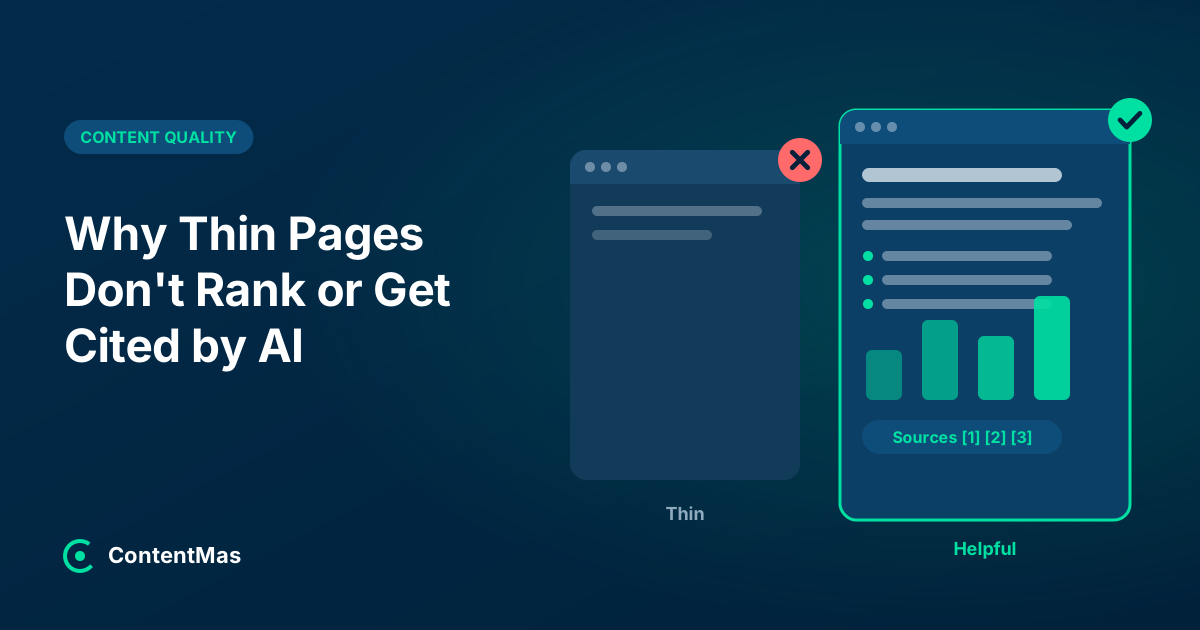
The difference is not length; it is what the page adds. Use this table to compare a page you're unsure about.
| Attribute | Thin page | Helpful page |
|---|---|---|
| Word focus | Written to a word count, with padding and repeated keywords | As long as the topic needs; Google has no preferred word count1 |
| Originality | Rewrites other pages or swaps a city name in a template2 | Adds original information, analysis or first-hand experience1 |
| Evidence | Vague claims, no numbers, no sources | Specific facts with cited sources, which the GEO study linked to higher AI visibility7 |
| Author | No byline, or "Admin" | Named author with relevant experience; Google asks whether authorship is clear1 |
| Structure | Long intro, answer buried halfway down | Answer first, clear headings, passages that make sense when quoted alone |
| Intent | Made mainly to attract search visits1 | Made to help a reader who came to the site directly1 |
What does a content quality audit find?
A content quality audit usually finds the same few patterns across a site: duplicated service pages, posts with no author, claims with no sources, and key answers buried under long intros. These issues are easy to miss one page at a time and obvious when you see them side by side.
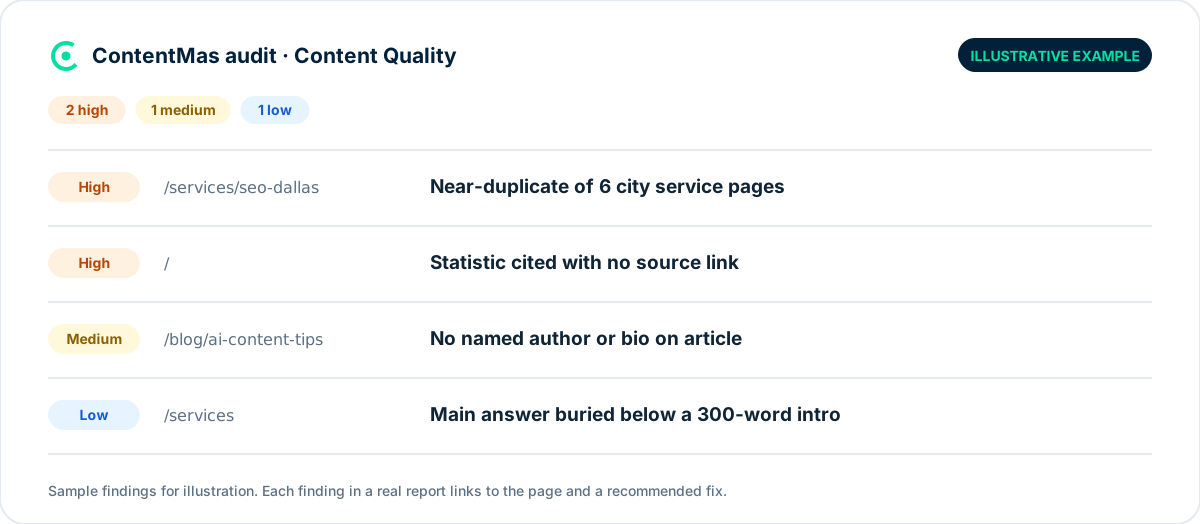
The useful part is the ranking. A home page that repeats a competitor's pitch matters more than an old tag archive. Fix the pages people and AI tools meet first. Our guide on which pages to audit first explains how to choose them.
How do you fix thin content? A checklist
You fix thin content by improving, merging or removing it, one page at a time, starting with your most important pages. Here is the process we recommend:
Time needed: about 1 to 2 hours per page. What you need: a list of your pages with their traffic (Google Search Console works), your own data or examples for each topic, and access to your CMS.
- List your near-duplicates. Find service, location or product pages that differ only by a name. Merge them into one strong page, or give each one real local or specific detail.
- Put the answer first. Rewrite the opening of each key page so the first two sentences answer the main question directly.
- Add one thing nobody else has. A customer example, your own data, a photo of real work, a pricing detail or a lesson learned. Google's guidance asks for original information, reporting, research or analysis.1
- Cite your numbers. Every statistic should link to its primary source. Remove any figure you can't verify.
- Name the author. Add a byline and a short bio showing why this person knows the topic.1
- Fact-check AI drafts. Review facts, titles, meta descriptions and alt text before publishing, as Google recommends.6
- Cut the padding. Delete intros that restate the title, repeated keywords and generic conclusions.
- Retire what can't be saved. If a page has no unique purpose, redirect it to the closest helpful page.
Once quality is fixed, keep it fixed. Pages decay over time; see why content decay is silently killing your SEO rankings.
How ContentMas checks this
ContentMas audits your key pages against 600+ KPIs, and the Content Quality pillar is one of six. It looks at the signals covered in this article in general terms: whether pages are original or near-duplicates, whether they answer clearly and early, whether claims carry evidence, whether authorship is visible, and how the page is structured for readers and AI tools.
Each finding gets a priority (critical, high, medium or low) and a fix recommendation, so you know what to change first. ContentMas measures your site's readiness; it does not track how often AI tools mention you. The How we score page explains how results are reported.
The free plan covers up to 50 pages per scan with no credit card. Run a free audit to see which of your pages are thin.
Related reading: How to optimize your content for ChatGPT, Perplexity, and AI Overviews · How trust signals affect AI recommendations
Frequently asked questions
What counts as thin content in Google's eyes?
Google's spam policies describe scaled content abuse, doorway pages and thin affiliate pages as forms of low-value content.2 More broadly, any page that copies or rewrites other sources without adding original information or analysis falls short of Google's helpful-content questions.1
How many words should a page have to rank?
There is no target. Google says it does not have a preferred word count.1 Write enough to answer the question fully and stop there.
Can AI-written content rank on Google?
Yes, if it is helpful. Google says it rewards high-quality content however it is produced, but using automation mainly to manipulate rankings breaks its spam policies.5 Google also recommends fact-checking all AI-generated content before publishing.6
Should I delete thin pages or improve them?
Improve pages that serve a real purpose, merge near-duplicates into one stronger page, and redirect pages with no unique value. We recommend starting with pages that get traffic or sit in your main navigation, since they matter most to visitors.
How do I get my content cited in AI Overviews?
There is no special markup or file for it. Google says AI Overviews and AI Mode need no extra optimization; a page must be indexed and eligible for a snippet.8 Specific, sourced passages also help: the GEO study found that adding statistics, quotations and citations raised visibility in AI answers.7
References
Each numbered marker in the article links to its source below.
-
Google Search Central — Creating helpful, reliable, people-first content (opens in a new tab), October 2026. ↩
-
Google Search Central — Spam policies for Google web search (opens in a new tab), August 2026. ↩
-
Nielsen Norman Group — How Little Do Users Read? (opens in a new tab), May 2008. ↩
-
Google — New ways we're tackling spammy, low-quality content on Search (opens in a new tab), March 2024, April 2024. ↩
-
Google Search Central Blog — Google Search's guidance about AI-generated content (opens in a new tab), February 2023. ↩
-
Google Search Central — Google Search's guidance on using generative AI content on your website (opens in a new tab), October 2026. ↩
-
Aggarwal et al., arXiv — GEO: Generative Engine Optimization (opens in a new tab), June 2024. ↩
-
Google Search Central — AI features and your website (opens in a new tab), December 2025. ↩
About this article
Written by the ContentMas Team, the people who build ContentMas, a website audit tool that checks sites across six pillars for search engines and AI assistants. Facts and figures link to their original sources in the References. Spotted something out of date? Tell us and we will correct it.
Free website audit
See how your site scores for search engines and AI assistants.
One score, six pillar scores and a ranked fix list in a few minutes. No credit card.
Start free audit