
Trust & Authenticity
Why AI Assistants Don't Recommend Your Business: The Trust Signals You're Missing
AI assistants can only point to what they can verify. Show named people, a real address, honest reviews and matching Organization schema on your pages.
On this page
- What are website trust signals?
- What does E-E-A-T mean for AI search?
- Why do AI assistants seem to skip some businesses?
- Which trust signals matter most, and where should they live?
- Are reviews on your own site enough?
- What does a trust audit usually find?
- How do you add trust signals to your website today?
- How ContentMas checks this
- Frequently asked questions
Short answer
In short: Nobody outside OpenAI, Google or Perplexity knows exactly how their assistants choose which businesses to name. What you can control is whether your site makes trust easy to check: named people with bios, a clear about and contact page, a real address that matches everywhere, honest reviews, sources for your claims, and Organization structured data that agrees with the page. Google says trust is the most important part of E-E-A-T, and the same visible facts are what any AI tool reading your pages can pick up.1
You asked ChatGPT for the best provider in your city, and it named three competitors. Look at your site as a stranger would. Is there a person's name anywhere? A street address? A review your team didn't write?
If the answer is "not really," your site gives a machine, and a careful human, very little to verify.
What are website trust signals?
Website trust signals are the visible, checkable facts on a site that show a real, accountable organization stands behind it. They include named authors, an about page, contact details, a physical address, reviews, sources and legal pages. Stanford's Web Credibility guidelines, written back in 2002, already listed "show that there's a real organization behind your site" and "make it easy to contact you" among their 10 rules, and suggested a physical address as the easiest proof.2
What does E-E-A-T mean for AI search?
E-E-A-T stands for experience, expertise, authoritativeness and trust, and Google says that "of these aspects, trust is most important."1 Google is also clear that E-E-A-T is not a single ranking factor; its systems use a mix of signals that tend to line up with it.1
For AI search, Google gives no separate rulebook. Its guidance on AI features says SEO best practices still apply to AI Overviews and AI Mode, with "no additional requirements" to appear there.3 So the trust work you do for Google Search is the same work that shows up in Google's AI answers.
Google frames this as three questions: Who made the content, How it was made and Why it exists. On "who," it asks: "Is it self-evident to your visitors who authored your content?"1 It also warns that fake creator profiles, such as made-up names, AI-generated headshots or false credentials, are a sign of a low-quality page.1
Why do AI assistants seem to skip some businesses?
We can't tell you how any assistant ranks businesses, and you should be wary of anyone who claims to. What we can say is what is on the record. OpenAI says its OAI-SearchBot crawler is used "to surface websites in search results" in ChatGPT's search features, and recommends allowing it in robots.txt.4 That means at least part of what ChatGPT search sees is your public website. If that site never states who you are, where you are or who vouches for you, there is less there to work with.
Customers are moving in that direction too. BrightLocal's 2026 Local Consumer Review Survey found that the share of consumers using ChatGPT and other AI tools for local business recommendations jumped from 6% to 45% in one year.5 In the same survey, 40% said they trust AI platforms for business recommendations.5
Trust in general is not something people hand out freely. The 2026 Edelman Trust Barometer found business is trusted by 64% of people, yet seven in 10 are unwilling or hesitant to trust people with different values.6 In our view, that is a good reason to show your proof rather than assume it.
Which trust signals matter most, and where should they live?
The signals that matter most are the ones a stranger can check in under a minute: who you are, how to reach you, what others say about you and where your facts come from. This table maps each one to its home on your site.
| Trust signal | Where it lives | What Google says | What it shows AI tools |
|---|---|---|---|
| Named author with bio | Byline on articles, author page | Bylines are "strongly" encouraged where readers expect them.1 | A real person is accountable for the content |
| About page | /about, linked in navigation | An About page is listed as background that builds trust.1 | Who the company is, its history and people |
| Contact details and address | /contact, footer | Organization markup supports address, telephone and contact point.7 | The business is real and reachable |
| Organization structured data | Home page JSON-LD | Helps Google understand and disambiguate your organization; sameAs links your other profiles.7 | A machine-readable summary that ties the site to your other profiles |
| Consistent name, address, phone | Every page, profile and listing | Structured data should match the visible text.3 | One business, not three slightly different ones |
| Real customer reviews | Review pages, third-party profiles | Self-serving reviews are not shown in review rich results for businesses.8 | What independent customers say |
| Sources and citations | Next to claims in articles | "Clear sourcing" is one of Google's trust questions.1 | Claims that can be checked |
Are reviews on your own site enough?
No. Reviews you collect and display yourself help visitors, but they are the weakest kind of proof, and Google treats them that way. Since 2019, Google has not shown review stars for businesses and organizations "when the entity being reviewed controls the reviews themselves."8
Fake reviews are now a legal risk as well. The US Federal Trade Commission announced its rule on consumer reviews and testimonials on August 14, 2024, and it took effect on October 21, 2024.9 It bans fake reviews and testimonials, buying reviews tied to a positive or negative sentiment, undisclosed insider reviews and suppressing negative reviews, with civil penalties of up to $51,744 per violation.9
Customers notice too. In BrightLocal's 2026 survey, 97% of consumers said they read reviews for local businesses, and 74% only consider reviews from the last three months.5 We recommend linking to your Google Business Profile and other independent review sites from your site, and keeping a steady flow of fresh, honest reviews.
What does a trust audit usually find?
A trust audit usually finds that the proof exists somewhere but is not on the website, or not in the same words. The team has real names, but articles say "Admin." The office has an address, but only a contact form shows. The company has a LinkedIn page, but nothing links to it.
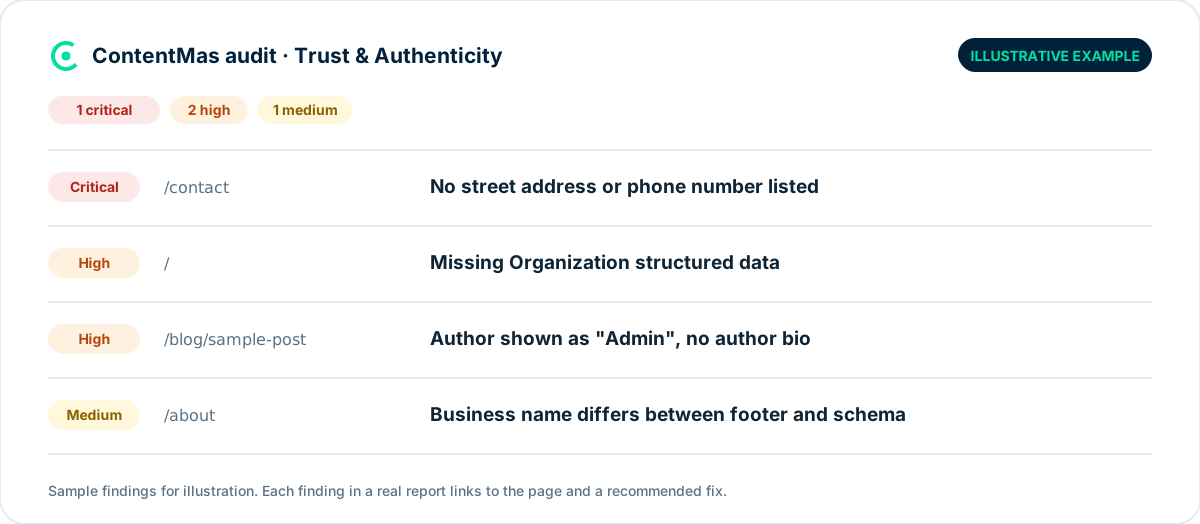
In our experience, other common gaps are a thin about page with no people or location, no Organization schema (or schema that disagrees with the page), "Acme Ltd" in the footer but "Acme Digital" in the schema, and claims like "trusted by 10,000 clients" with nothing behind them.
How do you add trust signals to your website today?
Start with the pages strangers open first, then make the machine-readable version match. Here is a checklist you can work through this week.
- Name your people. Put a real byline on every article and link it to an author page with role, experience and a photo.
- Rewrite the about page. Say who founded the company, when, where you are based and who runs it today.
- Publish full contact details. Street address (if you serve customers there), phone, business email and hours on the contact page and in the footer.
- Pick one version of your business details. Use the exact same name, address and phone on your site, Google Business Profile and directories.
- Add Organization structured data to the home page. Include
name,url,logo,address,telephone,contactPointandsameAslinks to your official profiles, all matching the visible page.7 - Link to independent reviews. Point to your Google Business Profile and industry review sites. Never buy, write or filter reviews.9
- Cite your claims. Link every statistic to where it came from, and remove claims you can't back up.
- Check the basics. Make sure privacy and terms pages exist and are linked, and that robots.txt doesn't block search crawlers you want to reach you.4
If your content has been sitting untouched for years, pair this with a freshness pass; see signs your website is out of date.
How ContentMas checks this
The Trust & Authenticity pillar in ContentMas reads your key pages for the signals above: whether content names its authors, whether about and contact information is present and complete, whether organization details and structured data are present and consistent, and whether claims are backed by sources. Legal pages are checked separately. Each finding gets a priority (critical, high, medium or low) and a recommended fix, so you know what to do first.
ContentMas measures your site's readiness. It does not track how often AI assistants mention you. To see your own gaps, run a free audit: the free plan covers up to 50 pages per scan, and How we score explains how findings become a score.
Related reading: How to optimize your content for ChatGPT, Perplexity, and AI Overviews · SEO vs GEO
Frequently asked questions
How do I get ChatGPT to recommend my business?
There is no published way to make ChatGPT recommend a business, and no one can promise it. You can make sure OpenAI's search crawler can reach your site and that your pages clearly state who you are, where you are and what independent customers say.4
Is E-E-A-T a ranking factor?
Not as a single factor. Google says E-E-A-T itself isn't a specific ranking factor, but its systems use a mix of signals that help identify content with good E-E-A-T, and trust matters most.1
Does Organization schema help with AI search?
Google says Organization markup on your home page can help it understand your organization and tell it apart from others with similar names.7 Google's AI features use the same SEO foundations, and its guidance asks that structured data match the visible text.3 It is not a guarantee of being cited, but it removes ambiguity.
Can I mark up reviews on my own site to get stars?
For your own business or organization, generally no. Google stopped showing review rich results for businesses and organizations when the business controls the reviews itself.8 Reviews on independent platforms carry more weight with customers and search engines alike.
Are AI-generated or paid reviews illegal?
In the US, the FTC rule that took effect in October 2024 bans fake reviews and testimonials, including reviews that misrepresent who the reviewer is or their experience, and buying reviews tied to a particular sentiment.9 Violations can lead to civil penalties of up to $51,744 each.9
References
Each numbered marker in the article links to its source below.
-
Google Search Central — Creating helpful, reliable, people-first content (opens in a new tab), October 2026. ↩
-
Stanford Persuasive Technology Lab — Stanford Guidelines for Web Credibility (opens in a new tab), June 2002. ↩
-
Google Search Central — AI features and your website (opens in a new tab), December 2025. ↩
-
OpenAI — Overview of OpenAI Crawlers (opens in a new tab). ↩
-
BrightLocal — Local Consumer Review Survey 2026 (opens in a new tab), February 2026. ↩
-
Edelman — 2026 Edelman Trust Barometer: Society Slides Into Insularity (opens in a new tab), January 2026. ↩
-
Google Search Central — Organization (Organization) structured data (opens in a new tab), September 2026. ↩
-
Google Search Central Blog — Making Review Rich Results more helpful (opens in a new tab), September 2019. ↩
-
Morgan Lewis — FTC Issues Final Rule on Consumer Reviews and Testimonials (opens in a new tab), August 2024. ↩
About this article
Written by the ContentMas Team, the people who build ContentMas, a website audit tool that checks sites across six pillars for search engines and AI assistants. Facts and figures link to their original sources in the References. Spotted something out of date? Tell us and we will correct it.
Free website audit
See how your site scores for search engines and AI assistants.
One score, six pillar scores and a ranked fix list in a few minutes. No credit card.
Start free audit