
SEO & GEO Visibility
SEO vs GEO: What Changes When AI Answers Instead of Google
GEO builds on SEO, it does not replace it. The basics stay the same; what changes is that success means being cited, and fewer answers lead to a click.
On this page
- What is the difference between SEO and GEO?
- What stays the same?
- What actually changes with GEO?
- SEO vs GEO: a side-by-side comparison
- Why does GEO matter now?
- How do you measure GEO results?
- A GEO checklist you can start today
- What does an SEO & GEO audit find?
- How ContentMas checks this
- Frequently asked questions
Short answer
In short: you don't need to start over. Generative engine optimization (GEO) builds on SEO. The same crawlable, helpful pages are the entry ticket, and Google says its AI features need no special optimization.1 What changes is the goal: you want to be cited in an AI answer, not just ranked, and you need new ways to measure it because fewer searches end in a click.
You have probably heard that "SEO is dead" and you need a GEO strategy now. Then Google's own guidance says the old rules still apply. Both can't be fully true. This guide starts with definitions, then compares the two side by side so you can decide what to change and what to leave alone.
What is the difference between SEO and GEO?
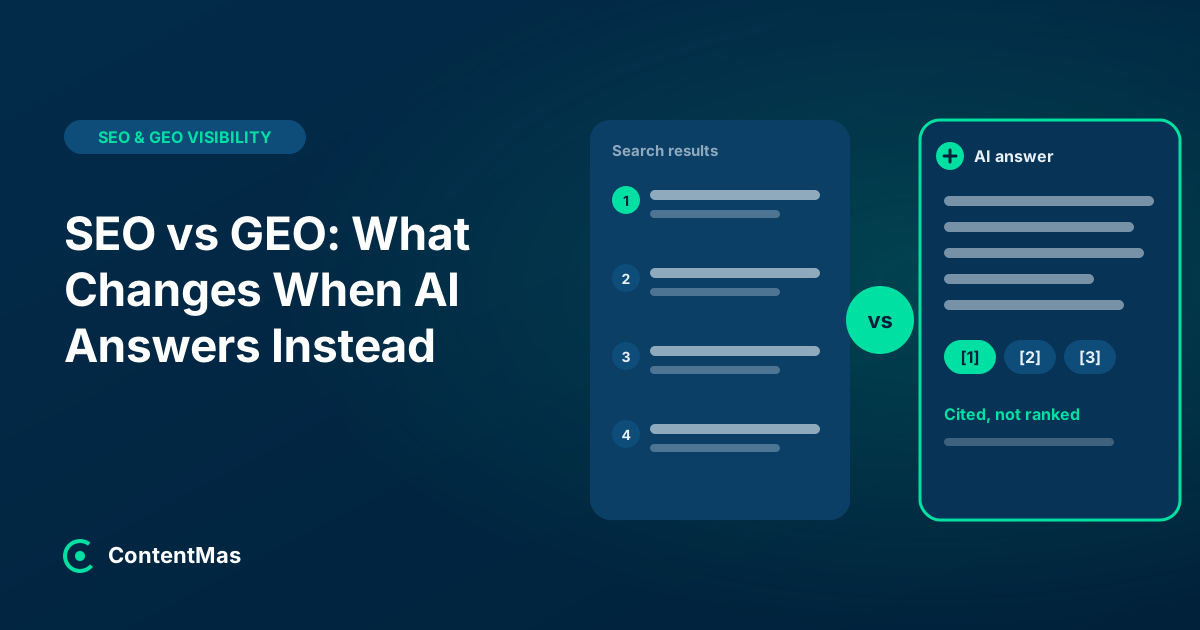
SEO (search engine optimization) is the work of helping pages rank in search results and earn clicks. GEO (generative engine optimization) is the work of helping pages get used and cited as sources in AI-generated answers, such as Google AI Overviews, ChatGPT search and Perplexity.
The term GEO comes from a 2023 research paper by Aggarwal and colleagues, which framed it as a way for creators to improve how visible their content is in generative engine responses.2 SEO asks, "Where do I rank?" GEO asks, "Am I one of the sources the answer was built from?"
What stays the same?
Most of the foundations stay the same: a page has to be crawlable, indexable and genuinely useful before any engine, classic or generative, can use it.
Google is direct about this. It says there are "no additional requirements" to appear in AI Overviews or AI Mode, and that a page only needs to be indexed and eligible to show in Search with a snippet.1 It also says SEO best practices "remain relevant" for its AI features.1
The content standard is the same too. Google's ranking systems are designed to prioritize helpful, reliable information "created to benefit people," and its guidance warns that mass-producing text with generative AI without oversight shows little to no effort.3
So if your SEO basics are weak, fix those first. In our experience, a GEO plan on top of pages that can't be indexed is wasted effort.
What actually changes with GEO?
Four things change: what counts as success, how often people click, how much of a page gets used, and how you measure results.
Citations instead of rankings. In an AI answer there is no "position 3." Your page is either one of the linked sources or it isn't. Google says its AI features can run several related searches across subtopics and then show "a wider and more diverse set of helpful links" than a classic search.1 That gives more pages a chance to appear, but the prize is a citation, not a rank.
Zero-click answers. People often get what they need without leaving the results page. In a Pew Research Center study of 900 US adults' browsing in March 2025, users clicked a traditional result on 8% of visits when an AI summary appeared, versus 15% when none did. They clicked a link inside the summary on just 1% of visits.4 Zero-click behavior was common even before that: SparkToro's 2024 study, based on Datos clickstream data, found that 58.5% of US Google searches ended without a click.5
Passages, not whole pages. An AI answer is assembled from pieces of several sources. In our experience, the parts that get used are short, self-contained passages: a clear definition, a sourced number, a step in a list. A page that buries its answer in paragraph six is harder to use, even if it ranks.
New measurement. Rank tracking alone no longer tells the full story. You also need to watch referrals from AI tools and track which questions you are cited for. More on that below.
SEO vs GEO: a side-by-side comparison
The table below compares the two on the points that matter when you plan your work.
| SEO | GEO | |
|---|---|---|
| Goal | Rank in search results and earn clicks | Be used and cited as a source in AI answers |
| Unit of success | A ranking position and a click | A citation (a linked or named source) in an answer |
| Where you appear | Classic results pages: blue links, snippets, rich results | AI Overviews and AI Mode,1 ChatGPT search, Perplexity and other assistants |
| How it's measured | Search Console clicks and impressions, rankings, organic sessions | Search Console (AI features are counted in the "Web" search type1), referrals from AI tools, manual answer checks |
| Key signals | Crawlability, relevance, helpful content,3 links, page experience | The same foundations, plus clear self-contained answers, sources next to claims, visible freshness |
| Tools | Search Console, analytics, rank trackers, site audits | Search Console, analytics with an AI-referral segment, prompt testing, site audits for readiness |
The overlap is the point. GEO is not a second website or a separate team. It is the same pages, judged by an extra standard: can an AI system lift a clear, trustworthy answer out of them?
Why does GEO matter now?
GEO matters because the audience for AI answers is already huge. At Google I/O in May 2026, Google said AI Overviews has over 2.5 billion monthly active users, and that AI Mode passed 1 billion monthly active users within about a year of launch.6 OpenAI said in February 2026 that ChatGPT has more than 900 million weekly active users.7
The research also suggests content changes can move the needle. The GEO paper tested methods such as adding statistics, quotations and citations, and reported that GEO "can boost visibility by up to 40%" in generative engine responses.2 That was a controlled study, not a guarantee for any one site. We cover those content tactics in detail in How to Optimize Your Content for ChatGPT, Perplexity, and AI Overviews, including which crawlers to allow.
How do you measure GEO results?
You measure GEO by combining three signals, since no single dashboard shows AI citations across every platform.
- Search Console. Google says traffic from its AI features is included in your overall Search Console traffic, in the Performance report under the "Web" search type.1 It isn't broken out separately, so watch trends on the pages and queries that matter to you.
- AI referral traffic. We recommend a saved segment in your analytics for visits referred by
chatgpt.com,perplexity.aiand other assistants you care about. Watch which landing pages they reach. - Answer checks. Each month, ask the AI tools the 10 to 20 questions your pages should answer. Note whether you are cited and, if not, which sources are.
Keep expectations honest. Google reports that clicks from results pages with AI Overviews are "higher quality," with users more likely to spend more time on the site.1 Pew's data shows there may be fewer of them.4 A common approach is to judge AI traffic on engagement and conversions, not on volume alone.
A GEO checklist you can start today
These steps build on SEO rather than replacing it. They are our recommendations, not platform requirements.
- Confirm the basics. Check that your key pages are indexed and not blocked by
noindexornosnippetby mistake. Google lists these as the controls that limit what it shows from your pages.1 - List your questions. Write down the 10 to 20 questions customers ask before they buy.
- Map one page to each question. If no page answers a question clearly, that is your first piece of new content.
- Put the answer first. Open each page with a two- or three-sentence direct answer, then add detail.
- Make passages stand alone. Each H2 should answer one question in its first sentence, so it still makes sense when quoted on its own.
- Source your numbers. Link the original source next to every statistic.
- Set up measurement. Create the AI-referral segment and run your first round of answer checks so you have a baseline.
What does an SEO & GEO audit find?
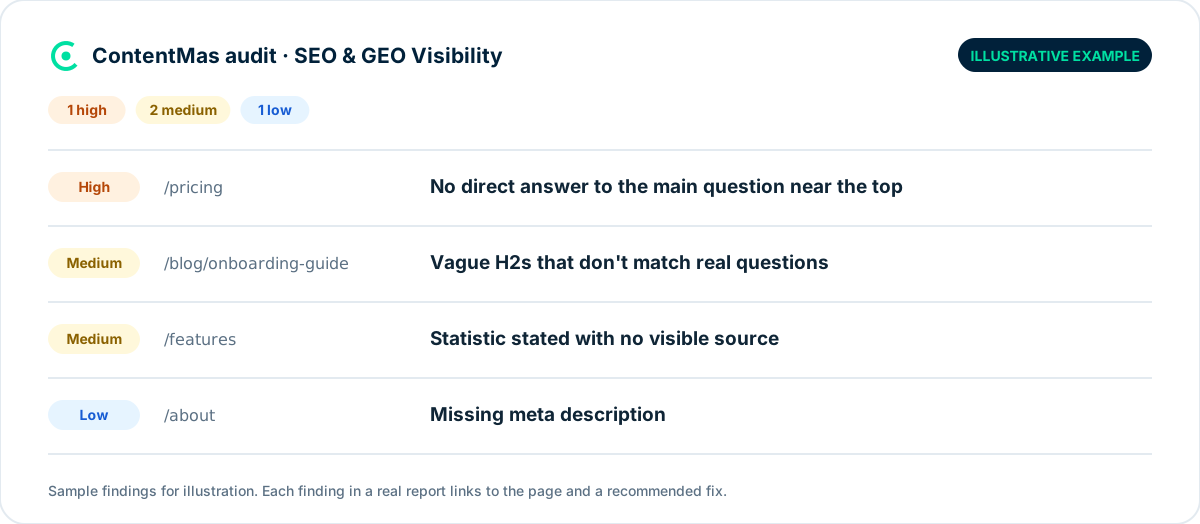
An SEO & GEO audit usually finds pages that are fine for classic search but hard for AI tools to use: answers buried deep in the page, missing or vague headings, and claims with no visible source.
How ContentMas checks this
The ContentMas SEO & GEO Visibility pillar checks whether your key pages are ready to be found, understood and quoted: titles and descriptions, heading structure, answer-first content, structured data and how clearly each page answers its main question. It measures the readiness of your site itself, not how often AI tools mention you.
Each finding gets a priority (critical, high, medium or low) and a fix recommendation, so you know where to start. It sits alongside five other pillars, from Content Freshness to Security, across 600+ KPIs. Read How we score, or run a free audit to check up to 50 pages, with no credit card.
Related reading: How to Optimize Your Content for ChatGPT, Perplexity, and AI Overviews · Can AI crawlers read your website? · Thin content and AI search
Frequently asked questions
Is GEO replacing SEO?
No. GEO builds on SEO. Google says there are no additional requirements to appear in AI Overviews or AI Mode beyond being indexed and eligible to show with a snippet, and that SEO best practices still apply.1 What GEO adds is a focus on being cited and on new ways to measure results.
What does generative engine optimization mean?
Generative engine optimization means making your content easy for AI systems to find, understand and cite in their answers. The term comes from a 2023 research paper that studied how content changes affect visibility in generative engine responses.2
Do AI Overviews reduce clicks to websites?
The evidence so far says they can. Pew Research Center found that users clicked a traditional search result on 8% of visits when an AI summary appeared, compared with 15% when it didn't.4 Google says the clicks that do happen from pages with AI Overviews are higher quality.1
How can I see traffic from ChatGPT and Perplexity?
Check your analytics for referral visits from domains such as chatgpt.com and perplexity.ai, and save them as a segment. We recommend tracking which landing pages they reach and how those visitors engage, not just how many arrive.
Does Search Console show AI Overviews traffic?
Yes, but not separately. Google says traffic from its AI features is included in the overall Search Console data, reported in the Performance report under the "Web" search type.1
References
Each numbered marker in the article links to its source below.
-
Google Search Central — AI features and your website (opens in a new tab), December 2025. ↩
-
Aggarwal et al., arXiv — GEO: Generative Engine Optimization (opens in a new tab), June 2024. ↩
-
Google Search Central — Creating helpful, reliable, people-first content (opens in a new tab), October 2026. ↩
-
Pew Research Center — Google users are less likely to click on links when an AI summary appears in the results (opens in a new tab), July 2025. ↩
-
SparkToro — 2024 Zero-Click Search Study: For every 1,000 EU Google Searches, only 374 clicks go to the Open Web. In the US, it's 360. (opens in a new tab), July 2024. ↩
-
Google — Google I/O 2026: Sundar Pichai's opening keynote (opens in a new tab), May 2026. ↩
-
OpenAI — Scaling AI for everyone (opens in a new tab), February 2026. ↩
About this article
Written by the ContentMas Team, the people who build ContentMas, a website audit tool that checks sites across six pillars for search engines and AI assistants. Facts and figures link to their original sources in the References. Spotted something out of date? Tell us and we will correct it.
Free website audit
See how your site scores for search engines and AI assistants.
One score, six pillar scores and a ranked fix list in a few minutes. No credit card.
Start free audit