
AI Visibility
How to get cited in Google AI Overviews: what the data shows
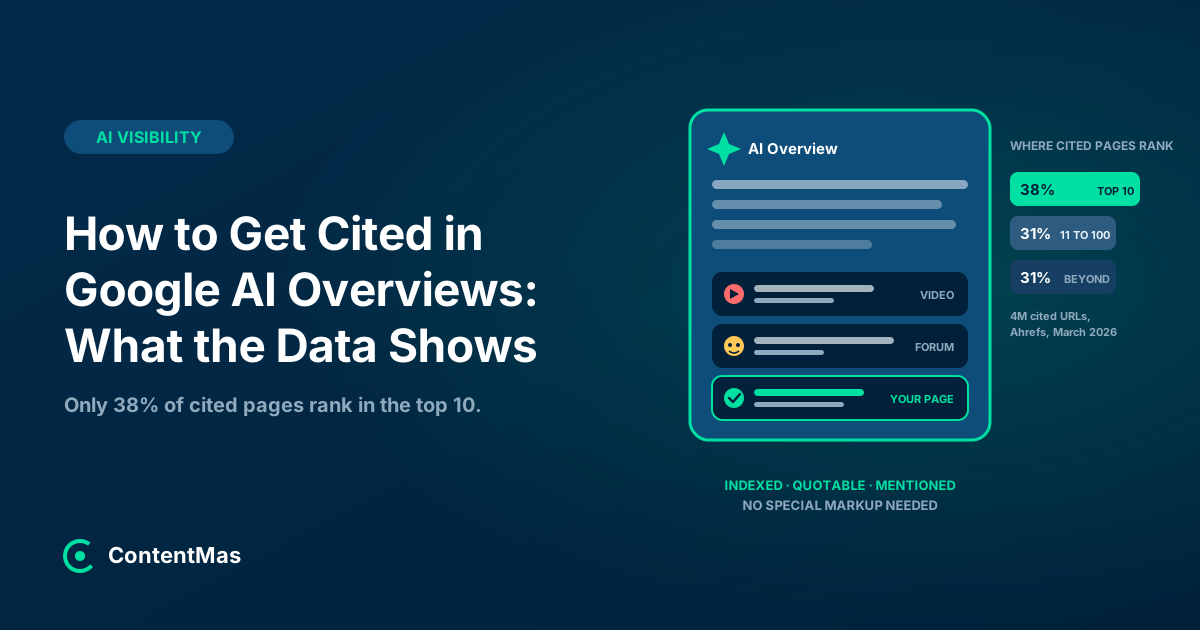
AI Overviews citations go to pages that are indexed and snippet-eligible, answer the sub-questions behind a search and are named elsewhere; only 38% rank in the top 10.

Summarize with AI
Short on time? Open this article in your AI assistant with a ready-made prompt.
- ChatGPT (opens in a new tab with a summary prompt)
- Perplexity (opens in a new tab with a summary prompt)
- Grok (opens in a new tab with a summary prompt)
Claude and Gemini open with the prompt copied: paste it to start.
On this page
- What does Google say it takes to be cited in AI Overviews?
- Does an AI Overviews citation bring any traffic?
- Do you need to rank in the top 10 to be cited?
- What do the cited pages look like?
- Why do mentions on other sites matter more than backlinks?
- How stable are AI Overviews citations?
- How do you get cited in AI Overviews?
- How does ContentMas help with AI Overviews citations?
- Key takeaways
- Frequently asked questions
Short answer
In short: AI Overviews citations follow the rules of ordinary Google Search, with no extra files or markup: Google says "There are no additional requirements to appear in AI Overviews or AI Mode, nor other special optimizations necessary," and a page only needs to be "indexed and eligible to be shown in Google Search with a snippet."1 The data shows where cited pages come from. Only 37.9% of the URLs cited in AI Overviews rank in the top 10 for the query, down from about 76% in July 2025,2 page length has almost no relationship with being cited (a 0.04 correlation),3 adding schema changed nothing measurable,4 and mentions of a brand across the web correlate with AI Overview visibility three times more strongly than backlinks do.5 So the practical answer is to be indexable and quotable, to cover the sub-questions Google's "query fan-out" searches for, and to be named on the sites Google already cites.
You searched for your own product category and the first thing on the page was a paragraph written by Google, with three small source cards beside it. None of them was yours. Your page ranks fourth; the overview cites a YouTube video, a Reddit thread and a competitor's comparison post.
That is the normal case now. Pew found an AI summary on about one in five Google searches in March 2025,6 and Semrush saw AI Overviews on 24.61% of a 10-million-keyword sample in July 2025 and 15.69% in November.7 This article collects what Google says about being cited and what the measurement studies found about the pages that are.
What does Google say it takes to be cited in AI Overviews?
Nothing beyond what Google Search already asks for. The one hard rule is eligibility: "a page must be indexed and eligible to be shown in Google Search with a snippet".1 Google also rules out the shortcuts being sold: "You don't need to create new machine readable files, AI text files, or markup to appear in these features," and "There's also no special schema.org structured data that you need to add."1
The most useful line in the documentation is about how an overview is built. "Both AI Overviews and AI Mode may use a 'query fan-out' technique," which lets them "display a wider and more diverse set of helpful links".1 Google splits the search into related sub-questions, runs them, and cites the pages those searches find. A page that answers one sub-question well can be cited without ranking for the original query.
Snippet settings decide whether your page can be quoted at all. Google's Search Relations team wrote in May 2025: "Make use of nosnippet, data-nosnippet, max-snippet, or noindex to set your display preferences," and "More restrictive permissions will limit how your content is featured in our AI experiences."8 The content advice in the same post is familiar: "Focus on making unique, non-commodity content that visitors from Search and your own readers will find helpful and satisfying."8
Does an AI Overviews citation bring any traffic?
Less than a classic result, and the exposure is now measurable in Search Console. Pew tracked the browsing of 900 US adults through March 2025. "Users who encountered an AI summary clicked on a traditional search result link in 8% of all visits." "Those who did not encounter an AI summary clicked on a search result nearly twice as often (15% of visits)."6 A click on a link inside the summary itself "occurred in just 1% of all visits to pages with such a summary."6
Google reads the shift differently: "We've seen that when people click to a website from search results pages with AI Overviews, these clicks are higher quality, where users are more likely to spend more time on the site," and it advises measuring conversions, "be it sales, signups, a more engaged audience, or information lookups about your business."8 Since June 2026, Search Console's Search Generative AI performance reports give "dedicated views of your impressions within generative AI features on Search, such as AI Overviews and AI Mode", by page, country, device and date; "As of August 31, 2026, we've rolled out these insights to all websites worldwide."9 The report lists impressions, not clicks or queries, so it shows which URLs appeared, not what people asked. One more pattern from Pew tells you which pages can be cited at all: "Just 8% of one- or two-word searches resulted in an AI summary," rising to "53% for searches with 10 words or more."6 The pages that get cited are the pages that answer questions.
Do you need to rank in the top 10 to be cited?
It helps, and it decides less than it did a year ago. In March 2026 Ahrefs matched 4 million URLs cited in AI Overviews across 863,000 keyword SERPs against the results for the same queries. "37.9% of URLs cited in AI Overviews also appeared within the first 10 blocks." "The rest were almost evenly split between positions 11–100 (31.2%) and beyond the top 100 blocks (31.0%)."2 In July 2025 the same analysis had found about 76%.2
Ahrefs' explanation is the fan-out described above. AI Overviews have been powered by Gemini 3 since January 2026, and "it may be that fan out queries are playing a bigger role in source selection": "The pages that appear most often within those sub-query SERPs then get cited in the AI Overview."2 The same study found that "YouTube is the most cited domain in AI Overviews today".2
So Google is not answering your keyword but a cluster of questions around it, and a page that covers several of them ranks in more of the fan-out searches the citation is selected from. The guide to content relevance shows how to find those questions.
What do the cited pages look like?
Ordinary length, any format, and usually carrying schema, but not because of it.
Ahrefs extracted the text of 174,048 pages cited in AI Overviews. "The average word count of pages cited in AI Overviews is 1,282 words." "53.4% of pages cited by AI Overviews are under 1,000 words." "Only 16% are over 2,000 words."3 The relationship between length and being cited measured 0.04, a "near-zero correlation".3
In May 2026 Ahrefs published a controlled test of schema: "We tracked 1,885 web pages that added JSON-LD schema between August 2025 and March 2026" and compared their citations, 30 days before and after, with matched control pages. "Adding schema produced no major uplift in citations on any platform."4 AI Overviews "showed a 4.6% decline, which is small but statistically significant relative to matched control pages"; AI Mode and ChatGPT moved +2.4% and +2.2%, "Statistically indistinguishable from zero".4 The twist is that "AI cited pages were almost three times more likely to have JSON-LD than non-cited pages."4 Well-built pages tend to have schema; adding it did not create the citation. Ahrefs' summary: "If you're already doing the rest of the SEO work well, JSON-LD isn't going to be the unlock."4
| What was measured | Sample | Finding | Source |
|---|---|---|---|
| Share of AI Overview citations ranking in the top 10 | 863,000 SERPs, 4 million cited URLs | 37.9%; 31.2% in positions 11 to 100; 31.0% beyond the top 100 | 2 |
| Word count of cited pages | 174,048 pages | Average 1,282 words; 53.4% under 1,000; correlation with citation 0.04 | 3 |
| Effect of adding JSON-LD schema | 1,885 pages against matched controls | No major uplift; AI Overviews -4.6%, AI Mode +2.4%, ChatGPT +2.2% | 4 |
| Correlates of brand visibility in AI Overviews | 75,000 brands | Web mentions 0.664; branded search volume 0.392; backlinks 0.218 | 5 |
| AI Overview citations gone the next day | 563 questions, asked daily for 20 days | 50%; about 75% of lost citations return within 20 days | 10 |
| Clicks on results when an AI summary appears | 900 US adults, March 2025 | 8% against 15%; 1% click a link inside the summary | 6 |
Source: compiled from the studies cited in each row.
Why do mentions on other sites matter more than backlinks?
Because an AI Overview about a category is assembled from pages that discuss several options, and your brand enters it through those pages. Ahrefs studied 75,000 brands against millions of AI Overview responses. "Brand web mentions show the strongest correlation (0.664) with AI Overview brand visibility." "The top 3 correlations are all off-site factors": web mentions at 0.664, brand anchors at 0.527 and branded search volume at 0.392. "Web mentions (0.664) correlate much more strongly than backlinks (0.218)."5 The authors add the usual caveat that correlation is not causation.5
Pew's data shows where those mentions are read: "The most frequently cited sources in both Google AI summaries and standard search results are Wikipedia, YouTube and Reddit," together 15% of the sources listed.6 A video that answers the question, a forum thread that names you and a comparison article that includes you do more for your AI Overview presence than another backlink to your home page. The trust signals guide covers what those third-party pages need to say.
How stable are AI Overviews citations?
Not very, so judge any change over weeks. In October 2026 Ahrefs asked about 7,800 questions across five AI tools every day for 20 days, 563 of them with AI Overviews. "Across all five tools, at least half of the citations disappeared by the next day": 50% on AI Overviews, 58% on AI Mode, 59% on ChatGPT, 81% on Gemini and 83% on Copilot.10 Most came back: "roughly 75% of citations that disappeared at least once returned within the 20-day study."10
The most changeable answers are the commercial ones: for "Best X" questions "about 75% of cited pages change daily."10 And wording plays a part: "Closer title and description matches to the query are associated with slightly longer-lasting citations".10 The churn is built in, because "Fan-out queries are simulated and change from run to run."2 A citation seen once is not a result; a citation seen most days over a month is.
How do you get cited in AI Overviews?
Six changes, in the order the evidence supports.
1. Confirm the page is indexed and allowed to be quoted
A page must be indexed and eligible for a snippet.1 Check it for noindex, nosnippet, a low max-snippet value and data-nosnippet around the main content; each one limits how the page can be used in AI Overviews.8 Google's technical list is short: "Googlebot isn't blocked, the page works (Google receives an HTTP 200 (success) status code), and the page has indexable content."8 The 10-minute crawler check covers robots.txt, CDN and firewall rules.
2. Answer the sub-questions, not just the keyword
Citations are selected from fan-out searches.12 Write down the 5 to 8 questions behind the topic (what it is, what it costs, how it compares, who it suits) and answer each under its own heading, with the answer in the first sentence.
3. Lead with the answer and stop padding
Length does not predict a citation, and more than half of cited pages are under 1,000 words.3 Put the direct answer first, then the evidence, and make the title and meta description say what the page answers, because closer matches kept their citations longer.10
4. Keep structured data honest, not inflated
Use Article, Organization and FAQ markup where it describes the page and keep it identical to the visible text.8 Expect nothing from it on its own: Google asks for no special schema,1 and adding JSON-LD did not lift citations.4
5. Get named where the overviews already look
Brand mentions correlate with AI Overview visibility at 0.664, backlinks at 0.218.5 Wikipedia, YouTube and Reddit are the most cited sources.26 A short video for each question that matters, accurate entries on comparison and review pages, and consistent company details in directories reach the pages an overview quotes.
6. Measure it in Search Console, over weeks
Open the Search Generative AI performance report and note which URLs appear in AI features.9 Compare month to month, because half of citations change from one day to the next.10
How does ContentMas help with AI Overviews citations?
ContentMas is an AI-powered SEO tool that audits your website for Google and AI search engines, and shows exactly what to fix to rank higher and get cited. It checks the eligibility items in this article on every scanned page: no noindex on public pages, no nosnippet or short max-snippet that restricts AI quoting, no data-nosnippet around the main content, and a robots.txt that AI bots can read and that does not block the files Google needs to render the page. Its content checks look for question headings answered in the first sentence below them, coverage of comparison, cost and how-to questions, FAQ answers present in the server HTML, page-type schema that matches the page, Organization schema with sameAs links to live profiles, and visible, schema and Open Graph dates that agree.
Those checks span the SEO & GEO Readiness pillar (visibility in Google and AI search engines; GEO means Generative Engine Optimization), Content Quality and Technical Readiness, which sit alongside Trust & Authenticity, Content Freshness and Security, across 700+ KPIs, each with evidence and a fix ranked by impact. The free plan reads up to 10 pages per scan, 3 scans per 24 hours. See how we score or run an audit.
Key takeaways
- Google sets no extra requirement for AI Overviews: a page must be indexed and eligible for a snippet; no special file or schema is needed.1
- Only 37.9% of AI Overview citations rank in the top 10, down from about 76% in July 2025; the rest come through query fan-out searches.2
- Length barely matters (0.04 correlation) and adding schema produced no uplift in a 1,885-page controlled test.34
- Brand mentions correlate with AI Overview visibility at 0.664, backlinks at 0.218; Wikipedia, YouTube and Reddit are the most cited sources.56
- Half of AI Overview citations disappear by the next day and about 75% return; pages that rank for the question keep theirs seven times more often.10
- Clicks fall when a summary appears (8% against 15%); since June 2026 Search Console shows which URLs appear in AI features.96
The pages that get cited are the pages a careful reader could quote: open to Google, direct about the answer, honest in their markup, and spoken about elsewhere. Each of those can be checked.
Related reading: How to Optimize Your Content for ChatGPT, Perplexity, and AI Overviews and SEO vs GEO: What Changes When AI Answers Instead of Google
The six-pillar guides: Technical · Content quality · Trust · Freshness · Security · SEO and GEO · How ContentMas scores each pillar
Frequently asked questions
Do I need special markup or an AI file to appear in AI Overviews?
No. Google says "You don't need to create new machine readable files, AI text files, or markup to appear in these features."1 The only requirement is that the page is indexed and eligible to be shown with a snippet.1
Does my page have to rank on page one to be cited in an AI Overview?
No, but it helps. In Ahrefs' March 2026 analysis of 4 million cited URLs, 37.9% ranked in the top 10 and the rest were split evenly between positions 11 to 100 and beyond.2 Pages that rank anywhere for the question were about seven times more likely to keep a citation for a week.10
Does adding schema get a page cited in AI Overviews?
Not on its own. When Ahrefs tracked 1,885 pages that added JSON-LD against matched controls, "Adding schema produced no major uplift in citations on any platform."4 Keep structured data accurate and matching the visible text, as Google asks.8
Does being cited in an AI Overview bring traffic?
Less than a classic result. Pew found users clicked a traditional result in 8% of visits when an AI summary appeared, against 15% without one, and clicked a link inside the summary in 1% of visits.6 Google says the clicks that do come are "higher quality".8
How can I see whether my pages appear in AI Overviews?
In Search Console. The Search Generative AI performance reports, available to all sites since 31 August 2026, show impressions in AI Overviews and AI Mode by page, country, device and date.9 Read them over weeks, because about half of citations change from one day to the next.10
References
Each numbered marker in the article links to its source below.
-
Google Search Central — AI features and your website (opens in a new tab), December 2025. ↩
-
Ahrefs — Update: 38% of AI Overview Citations Pull From The Top 10 (opens in a new tab), March 2026. ↩
-
Ahrefs — Short vs. Long Content in AI Overviews: The Data Says Both Work (opens in a new tab), December 2025. ↩
-
Ahrefs — We Tracked 1,885 Pages Adding Schema. AI Citations Barely Moved. (opens in a new tab), May 2026. ↩
-
Ahrefs — An Analysis of AI Overview Brand Visibility Factors (75K Brands Studied) (opens in a new tab), May 2025. ↩
-
Pew Research Center — Google users are less likely to click on links when an AI summary appears in the results (opens in a new tab), July 2025. ↩
-
Semrush — Semrush AI Overviews Study: What 2025 SEO Data Tells Us About Google's Search Shift (opens in a new tab), December 2025. ↩
-
Google Search Central Blog — Top ways to ensure your content performs well in Google's AI experiences on Search (opens in a new tab), May 2025. ↩
-
Google Search Central Blog — Introducing Search Generative AI performance reports in Search Console (opens in a new tab), June 2026. ↩
-
Ahrefs — How Stable Are AI Citations? 10 Things We Learned Tracking 37,500 Citations (opens in a new tab), October 2026. ↩
About this article
Written by Nasir Ali Joiya. Nasir Ali Joiya is a software engineer and the CEO and Co-Founder of ZAPTA Technologies, an AI-native software company in Lahore whose group has more than 150 engineers. Reviewed by the ContentMas Team, who build ContentMas, an AI-powered SEO audit tool that checks sites across six pillars for Google and AI search engines. Facts and figures link to their original sources in the References. Spotted something out of date? Tell us and we will correct it.
Free website audit
See how your site scores for search engines and AI assistants.
One score, six pillar scores and a ranked fix list in a few minutes. No credit card.
Start free audit