
AI Visibility
AI ranking factors: what makes AI assistants cite a page
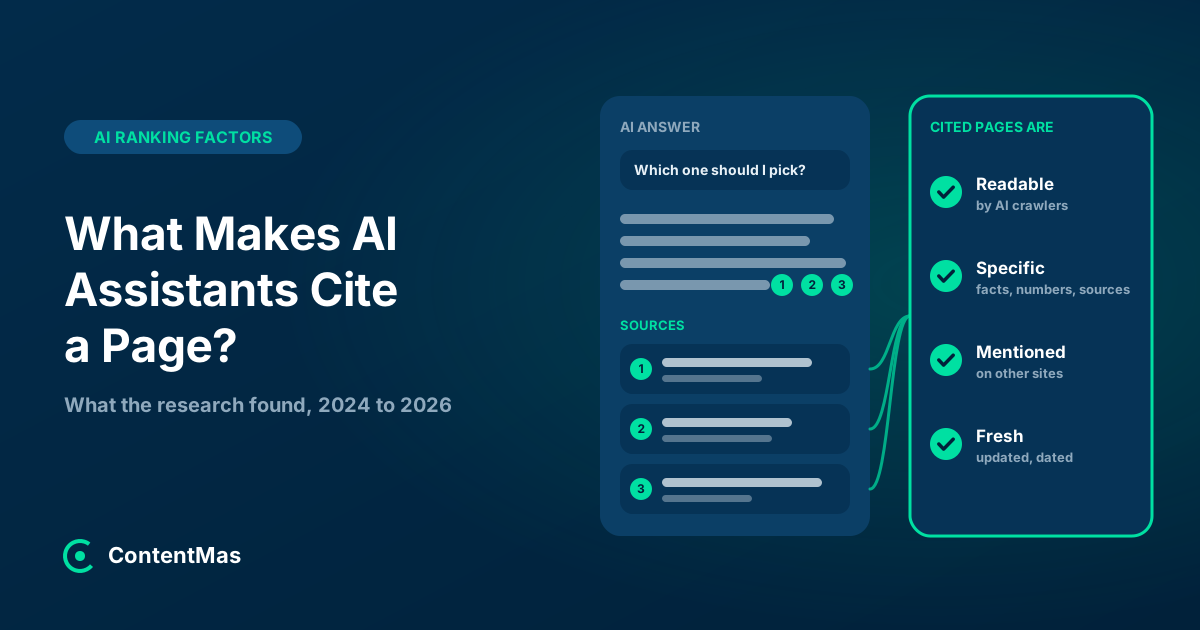
No list of AI ranking factors exists, but the studies agree on what gets cited: pages AI crawlers can read, verifiable facts, outside mentions and freshness.

Summarize with AI
Short on time? Open this article in your AI assistant with a ready-made prompt.
- ChatGPT (opens in a new tab with a summary prompt)
- Perplexity (opens in a new tab with a summary prompt)
- Grok (opens in a new tab with a summary prompt)
Claude and Gemini open with the prompt copied: paste it to start.
On this page
- Are there AI ranking factors at all?
- Does ranking on Google get your page cited by AI?
- What do cited pages have in common?
- Why do AI assistants prefer third-party sources?
- Does fresh content get cited more?
- What should a website owner do about AI ranking factors?
- How does ContentMas help with AI ranking factors?
- Key takeaways
- Frequently asked questions
Short answer
In short: there is no published list of AI ranking factors: Google states there are "no additional requirements to appear in AI Overviews or AI Mode,"1 and OpenAI says "any public website can appear in ChatGPT search" as long as it does not block the OAI-SearchBot crawler.2 What the studies show is a pattern rather than a formula. Cited pages are readable by AI crawlers, answer a specific question with verifiable facts, numbers and sources,3 come mostly from third-party sites rather than brands' own pages,4 and are on average newer than the pages in classic search results.5 Ranking on Google helps but is not the same thing: only about 38% of AI Overview citations come from the top 10 results,6 and for ChatGPT, Gemini and Copilot the overlap is about 12%.7
You have asked ChatGPT or Perplexity about your own industry and watched it recommend three competitors and a Reddit thread. The natural question is which AI ranking factors your site is missing.
This guide collects what is actually known: what Google, OpenAI and Microsoft say in their own documentation, what the studies from 2024 to 2026 found when they measured millions of citations, and what that means for a company website.
Are there AI ranking factors at all?
Not as a list, and not as a stable ranking. The providers describe eligibility rules and good practice, not weighted factors, and the measurements show citations changing from one day to the next.
Google's documentation is explicit: "There are no additional requirements to appear in AI Overviews or AI Mode, nor other special optimizations necessary."1 The one hard rule is eligibility: "To be eligible to be shown as a supporting link in AI Overviews or AI Mode, a page must be indexed and eligible to be shown in Google Search with a snippet, fulfilling the Search technical requirements."1 Google also explains why the links in an AI answer differ from the blue links: both features "may use a 'query fan-out' technique," which issues "multiple related searches across subtopics and data sources" to build the response.1
OpenAI says the same in fewer words: "Any public website can appear in ChatGPT search."2 The condition is access: "For your site content to be included in summaries and snippets in ChatGPT, make sure you aren't blocking OAI-SearchBot."2
Bing, which added AI citation reporting to Bing Webmaster Tools in February 2026, says its cited-pages metric "reflects overall citation patterns and does not indicate ranking, authority."8
Part of the churn is the search itself: ChatGPT "repeated exactly the same searches as the previous day, only 26% of the time."9 Most vanished citations came back: "roughly 75% of citations that disappeared at least once returned within the 20-day study."9 So the factors you can work on are the ones that make a page a repeat candidate, not the ones that win a single answer.
Does ranking on Google get your page cited by AI?
It helps, especially in Google's own AI features, but it is a weaker predictor than most people assume, and the overlap is falling.
In July 2025, Ahrefs found that 76% of the pages cited in AI Overviews ranked in the top 10 for the same query. By March 2026, across 863,000 keyword SERPs and 4 million cited URLs, that share had dropped to 37.9%, with the rest "almost evenly split between positions 11–100 (31.2%) and beyond the top 100 blocks (31.0%)."6
Outside Google, the link is weaker still. Running 15,000 long-tail queries through Google, Bing and four AI assistants, Ahrefs found that "only 12% of links cited by ChatGPT, Gemini, and Copilot appear in Google's top 10 results for the same prompt."7 Perplexity "is the outlier: nearly 1 in 3 of its citations point to pages that rank in the top 10 for the target query," while the others sit around 8%.7
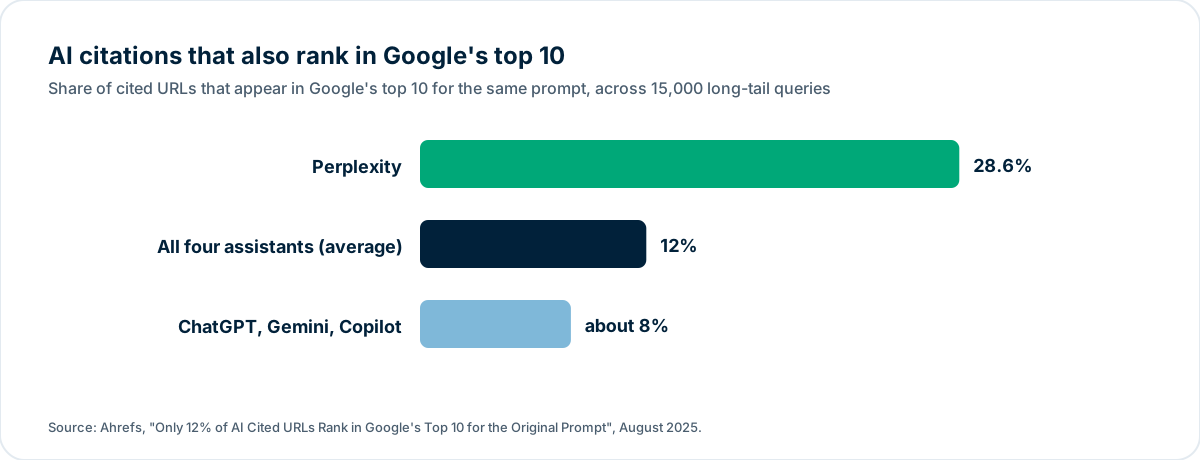
Source: Ahrefs study of 15,000 long-tail queries, August 2025.7
Ranking is a good start, since a page that ranks has passed the crawl, index and relevance tests the AI systems also apply. But two thirds of AI Overview citations and nearly nine in ten ChatGPT citations now come from outside the top 10.67 Something else is being selected for.
What do cited pages have in common?
Cited pages have one thing in common: they make a specific claim easy to find, verify and reuse. That is the finding of the controlled experiment that started the field and of the platform guidance that followed it.
The 2024 study by Aggarwal and colleagues at Princeton and partner universities built GEO-bench, a benchmark of 10,000 queries across 25 domains, and tested what happens to a page's visibility in generated answers when its content is rewritten in different ways. The methods "can boost visibility by up to 40% in generative engine responses."3 The three best were adding citations to sources, quotations and statistics, which "achieved a relative improvement of 30-40%" on the main visibility metric; better fluency and readability gave "a significant visibility boost of 15-30%."3 Keyword stuffing did nothing: the authors "find such methods offer little to no improvement on generative engine's responses."3
Bing's description of what its AI answers pick up matches the experiment: "Pages cited for specific grounding query phrases often reflect clear subject focus and domain expertise." "Clear headings, tables, and FAQ sections help surface key information." "Examples, data, and cited sources help build trust when content is reused in AI-generated answers."8
What the studies measured
| What the study measured | Sample | What it found |
|---|---|---|
| Content changes that raise visibility in generated answers (Aggarwal et al., 2024) | 10,000 queries, 25 domains | Citations, quotations and statistics: +30-40% visibility; keyword stuffing: little to none3 |
| Share of AI Overview citations from the top 10 (Ahrefs, March 2026) | 863,000 SERPs, 4M cited URLs | 37.9%, down from 76% in July 20256 |
| Share of AI assistant citations in Google's top 10 for the same prompt (Ahrefs, August 2025) | 15,000 queries | 12% across four assistants; Perplexity 28.6%, the others about 8%7 |
| Source type in AI recommendation answers (Chen et al., 2025) | 1,000 prompts, 4 engines, 2 countries | US consumer electronics: 92.1% third-party "earned" sources4 |
| Age of cited pages vs organic results (Ahrefs, July 2025) | About 17M citations | Cited pages 1,064 days old on average vs 1,432 for organic5 |
| Correlates of AI Overview brand visibility (Ahrefs, May 2025) | 75,000 brands (opens in a new tab) | Web mentions 0.664, backlinks 0.21810 |
| Day-to-day stability of citations (Ahrefs, October 2026) | 37,500 citations, 20 days | At least half gone the next day; about 75% return9 |
Source: compiled from the sources cited in each row.
The pattern is that AI systems retrieve passages, not pages. A sentence with a number, a named source and a clear subject can be lifted into an answer and attributed; a page of general claims with the keyword repeated cannot. That is why the content that matters for AI search engines answers a question in one place.
Why do AI assistants prefer third-party sources?
Because a recommendation needs a witness. When an assistant is asked which product or company to choose, it cites pages that compare or review options far more often than the options' own websites.
Researchers at the University of Toronto put numbers on this. They ran 1,000 consumer ranking prompts across ten categories in the United States and Canada through ChatGPT, Claude, Gemini and Perplexity. In US consumer electronics prompts, 92.1% of the sources AI search engines cited were "earned" media, meaning third-party sites such as reviews, publications and forums, rather than brand-owned or social pages.4 For prompts about well-known brands, ChatGPT's sources were "93.5% Earned, 6.5% Brand, and no Social," and for niche brands "95.1% Earned and only 4.9% Brand."4 The authors also found a size bias: on ChatGPT, "major brands account for 56.3% of all identified brand mentions (274 of 487)."4
Ahrefs' correlation study of 75,000 brands (opens in a new tab) points the same way for Google's AI Overviews. "Brand web mentions show the strongest correlation (0.664) with AI Overview brand visibility," against 0.392 for branded search volume and 0.218 for backlinks.10 The authors add the standard caveat that correlation is not causation.10
For a company website this changes the job. Your product page will rarely be the citation for "best X for Y." What gets you into the answer is being named, accurately, on review sites, publications, directories and forums. Your own site then confirms what those pages say, with the trust signals AI assistants look for: a named team, a real address, consistent company details and sourced claims.
Does fresh content get cited more?
Yes, by a measurable margin, though old pages that are kept current still dominate.
Ahrefs compared about 17 million URLs cited by ChatGPT, Perplexity, Gemini, Copilot and Google AI Overviews with the pages in organic results. "The average age of URLs cited by AI assistants is 1064 days, compared to 1432 days for URLs in organic SERPs," a 25.7% difference.5 Measured by last update, the gap was 909 days against 1,047, "a smaller difference of 13.1%."5 The preference is strongest in ChatGPT and absent in AI Overviews, which cited pages 16 days older than organic.5 The study's own summary is balanced: "Like traditional search, AI assistants still prefer citing long-lived content."5
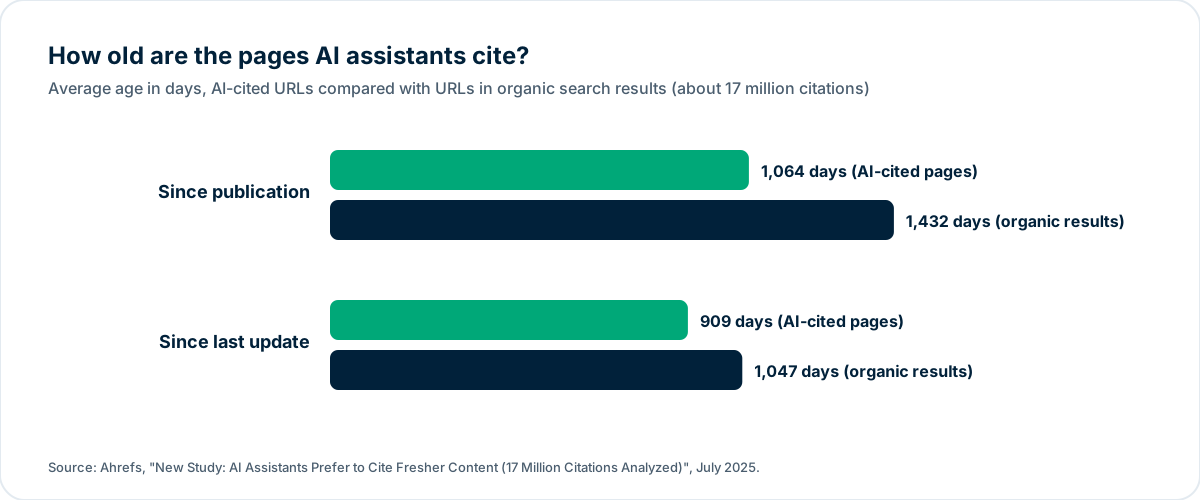
Source: Ahrefs analysis of about 17 million citations, July 2025.5
The Toronto study saw the same in fast-moving categories: for consumer electronics, "Claude's mean article age was about 117 days, with a median of 62 days."4 Bing's advice follows: "Regular updates help ensure AI systems reference the most current version of your content."8
Three years is the average, not the target. A page last touched in 2023 competes against pages updated this quarter, and the assistants can read the dates. The signs that a website looks out of date are the signs a retrieval system uses.
What should a website owner do about AI ranking factors?
Work on the five properties the evidence keeps selecting for. None requires a new tool, and all of them also help ordinary search.
1. Let the AI crawlers in
A blocked page cannot be cited. Check robots.txt, your CDN and your firewall for rules that stop OAI-SearchBot, PerplexityBot or Google's crawlers, and make sure the page is indexable and eligible for a snippet.12 The quick test is in can AI crawlers read your website.
2. Put one clear, verifiable answer near the top
Open each important page with the answer to the question it serves, then support it with a number, a named source or a quotation.3 Use headings that read as questions, tables for comparisons and a short FAQ where it fits.8 Skip keyword repetition; it measured as useless.3
3. Earn mentions on other sites
Get your company named, with the right details, on the review platforms, publications and directories your customers read. Mentions, not links, had the strongest correlation with AI Overview visibility, and third-party pages carry most product recommendations.410
4. Keep the page current and show it
Update statistics, prices, screenshots and dates, state the update date on the page, and keep structured data in line with the visible content.85
5. Give the assistant something to verify
Named authors, a real address, a working contact page, HTTPS and consistent company details across the web let a retrieval step confirm the page is what it claims to be.4
How does ContentMas help with AI ranking factors?
ContentMas is an AI-powered SEO tool that audits your website for Google and AI search engines, and shows exactly what to fix to rank higher and get cited. ContentMas cannot tell you which of your pages ChatGPT will cite tomorrow; the stability data above shows that nobody can.9 What it does is check your key pages for the properties the studies agree on, in six pillars: Content Freshness, Content Quality, Trust & Authenticity, SEO & GEO Readiness (visibility in Google and AI search engines; GEO means Generative Engine Optimization), Technical Readiness and Security. Its 600+ checks include whether AI crawlers are blocked, whether a page states and sources its claims, whether dates and statistics are outdated, and whether the author, company and contact details an assistant would verify are present.
The free plan reads up to 10 pages per scan, 3 scans per 24 hours; paid plans read 100, 200 or 500 pages. Each finding comes with a priority and a fix. See how we score or run an audit.
Key takeaways
- There is no published list of AI ranking factors. Google says there are "no additional requirements" beyond being indexed and snippet-eligible; OpenAI says any public site can appear if it does not block OAI-SearchBot.12
- Citations are unstable: at least half of the sites cited one day were gone the next across five AI tools, though about 75% returned within 20 days.9
- Ranking helps but does not decide it. About 38% of AI Overview citations come from the top 10, and about 12% of the citations from four AI assistants do, with Perplexity highest at 28.6%.67
- Adding citations, quotations and statistics raised visibility in generated answers by 30-40% in a controlled study; keyword stuffing did nothing.3
- AI assistants cite third-party sources for recommendations (over 90% in some categories), and brand web mentions correlate with AI visibility far more than backlinks (0.664 vs 0.218).410
- Cited pages are about 25.7% newer than organic results on average, and Bing advises regular updates.85
AI assistants select for what a careful reader does: a page they can open, a claim they can check, a source other people vouch for, and information that is still true. Those are properties of your pages, and they can be audited.
Related reading: How to Optimize Your Content for ChatGPT, Perplexity, and AI Overviews and Why AI Assistants Don't Recommend Your Business: The Trust Signals You're Missing
The six-pillar guides: Technical · Content quality · Trust · Freshness · Security · SEO and GEO · How ContentMas scores each pillar
Frequently asked questions
What are AI ranking factors?
The term is borrowed from SEO, and no AI provider publishes such a list. Google says there are "no additional requirements to appear in AI Overviews or AI Mode" beyond being indexed and eligible for a snippet,1 and OpenAI says "any public website can appear in ChatGPT search" if it does not block OAI-SearchBot.2 What research has found are properties cited pages share: crawlability, specific verifiable facts, third-party mentions and freshness.34510
Do you need to rank on Google to be cited by ChatGPT?
No, in Ahrefs' study of 15,000 long-tail queries (opens in a new tab), only 12% of the links cited by four AI assistants appeared in Google's top 10 for the same prompt; Perplexity was closest to Google at 28.6%, and ChatGPT, Gemini and Copilot sat around 8%.7 Ranking shows a page is crawlable and relevant, but most ChatGPT citations come from outside the top 10.7
Why does ChatGPT cite Reddit, Wikipedia and review sites instead of company websites?
Because recommendation prompts are answered from third-party sources. In the Toronto study, ChatGPT's sources for prompts about well-known brands were 93.5% earned media and 6.5% brand pages.4 The way into those answers is to be mentioned accurately on the sites that get cited.410
Does updating old content help with AI citations?
Yes, pages cited by AI assistants were on average 1,064 days old against 1,432 for organic results, and the gap holds when measured by last update (909 against 1,047 days).5 Bing says regular updates help AI systems reference the current version of a page.8
Does structured data or FAQ markup get a page cited?
Not by itself: Google sets no special markup requirement for AI features.1 Bing says clear headings, tables and FAQ sections help surface key information,8 and the controlled experiment found that what raised visibility was citations, quotations and statistics.3
References
Each numbered marker in the article links to its source below.
-
Google Search Central — AI features and your website (opens in a new tab), December 2025. ↩
-
OpenAI — Publishers and Developers FAQ (opens in a new tab), accessed November 2026. ↩
-
Aggarwal et al., arXiv — GEO: Generative Engine Optimization (opens in a new tab), June 2024. ↩
-
Chen et al., arXiv — Generative Engine Optimization: How to Dominate AI Search (opens in a new tab), September 2025. ↩
-
Ahrefs — New Study: AI Assistants Prefer to Cite "Fresher" Content (17 Million Citations Analyzed) (opens in a new tab), July 2025. ↩
-
Ahrefs — Update: 38% of AI Overview Citations Pull From The Top 10 (opens in a new tab), March 2026. ↩
-
Ahrefs — Only 12% of AI Cited URLs Rank in Google's Top 10 for the Original Prompt (opens in a new tab), August 2025. ↩
-
Bing Webmaster Blog — Introducing AI Performance in Bing Webmaster Tools Public Preview (opens in a new tab), February 2026. ↩
-
Ahrefs — How Stable Are AI Citations? 10 Things We Learned Tracking 37,500 Citations (opens in a new tab), October 2026. ↩
-
Ahrefs — An Analysis of AI Overview Brand Visibility Factors (75K Brands Studied) (opens in a new tab), May 2025. ↩
About this article
Written by Nasir Ali Joiya. Nasir Ali Joiya is a software engineer and the CEO and Co-Founder of ZAPTA Technologies, an AI-native software company in Lahore whose group has more than 150 engineers. Reviewed by the ContentMas Team, who build ContentMas, an AI-powered SEO audit tool that checks sites across six pillars for Google and AI search engines. Facts and figures link to their original sources in the References. Spotted something out of date? Tell us and we will correct it.
Free website audit
See how your site scores for search engines and AI assistants.
One score, six pillar scores and a ranked fix list in a few minutes. No credit card.
Start free audit