
Trust & Authenticity
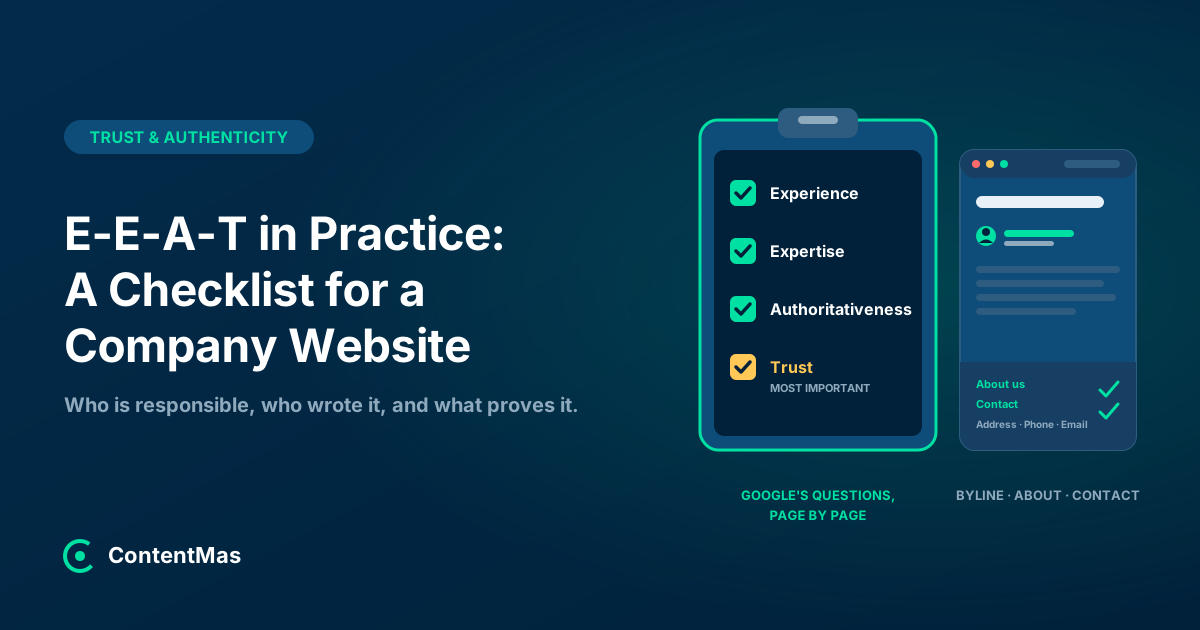
E-E-A-T in practice: a checklist for a company website
An E-E-A-T checklist for company websites: who is responsible, who wrote each page, what proves they know the topic, and what Google and AI search engines see.

Summarize with AI
Short on time? Open this article in your AI assistant with a ready-made prompt.
- ChatGPT (opens in a new tab with a summary prompt)
- Perplexity (opens in a new tab with a summary prompt)
- Grok (opens in a new tab with a summary prompt)
Claude and Gemini open with the prompt copied: paste it to start.
On this page
- What is E-E-A-T, and what does Google do with it?
- Why does a company website need an E-E-A-T checklist?
- The E-E-A-T checklist for a company website
- How do you run the checklist in an afternoon?
- What does E-E-A-T look like to AI search engines?
- How does ContentMas help with E-E-A-T?
- Key takeaways
- Frequently asked questions
Short answer
In short: E-E-A-T stands for experience, expertise, authoritativeness and trust, the four qualities Google's quality raters look for in a page and its creator, and Google says that "of these aspects, trust is most important."1 It is not a score: Google states that "E-E-A-T itself isn't a specific ranking factor," but that its systems use "a mix of factors that can identify content with good E-E-A-T."1 For a company website that means clear answers to who is responsible for the site, who wrote each page, what shows they know the topic, and how a visitor can contact you. The checklist below covers those answers in the order that matters most, for Google and for AI search engines, which read the same pages.
Most company websites fail E-E-A-T quietly. The blog posts are signed "Admin" or not at all. The About page is three sentences from the founding year. The contact page is a form with no address. Every page is accurate, and nothing shows a stranger, a Google system or an AI assistant why they should believe it. Google's advice for fixing this is a set of questions, not tags.1 This article turns them into a checklist you can run in an afternoon.
What is E-E-A-T, and what does Google do with it?
E-E-A-T comes from Google's Search Quality Rater Guidelines, the document its human raters use to judge whether search results are good. The guidelines define each part: "Experience: Consider the extent to which the content creator has the necessary first-hand or life experience for the topic"; "Expertise: Consider the extent to which the content creator has the necessary knowledge or skill for the topic"; "Authoritativeness: Consider the extent to which the content creator or the website is known as a go-to source for the topic"; and "Trust: Consider the extent to which the page is accurate, honest, safe, and reliable."2
The order of importance is explicit: "Trust is the most important member of the E-E-A-T family because untrustworthy pages have low E-E-A-T no matter how Experienced, Expert, or Authoritative they may seem."2 The first E was added in December 2022, when Google explained that some searches value "content produced by someone who has first-hand, life experience on the topic at hand."3
Two things are often misreported. First, the raters do not rank your site: "Search raters have no control over how pages rank," and "Rater data is not used directly in our ranking algorithms."1 Second, E-E-A-T is not a signal you can add. Google's systems "identify a mix of factors that can help determine which content demonstrates aspects of experience, expertise, authoritativeness, and trustworthiness."1 Reading the guidelines "may help you self-assess how your content is doing from an E-E-A-T perspective."1
Why does a company website need an E-E-A-T checklist?
Because the weakest point on most company sites is the easiest to fix: nobody can tell who is behind the pages. The rater guidelines have a section on "Finding Who is Responsible for the Website and Who Created the Content on the Page," and note that "Most websites have 'contact us' or 'about us' or 'about' pages that provide information about who owns the site."2 For topics that affect money, health or safety, which Google calls "Your Money or Your Life" or YMYL,2 "our systems give even more weight to content that aligns with strong E-E-A-T,"1 and the guidelines reserve the Lowest rating for "A complete lack of information about who is responsible for the website and its content for YMYL pages or other pages requiring trust."2
Any company that sells something is closer to YMYL than it thinks: "Contact information and customer service information are extremely important for websites that handle money, such as stores, banks, credit card companies, etc."2 A pricing page, a checkout and a quote form all handle money.
The second reason is AI search engines. What they say about a brand depends on what the web says about it. An Ahrefs study of 75,000 brands found that "Brand web mentions show the strongest correlation (0.664) with AI Overview brand visibility," and that "Web mentions (0.664) correlate much more strongly than backlinks (0.218)."4
The E-E-A-T checklist for a company website
Work through the items in order. Trust comes first because Google puts it first;12 the rest build on it.
1. Trust: who is responsible, and how to reach you
- An About page that names the company, the people who run it and what it does. The raters look for it first; the guidelines note that "Websites are usually very clear about who is responsible for the website,"2 so the ones that are not stand out.
- A Contact page with more than a form. A postal address, a phone number or support email, and a response time, because "Users need a way to ask questions or get help when a problem occurs."2 Use the same company name, address and legal entity in the footer, the policies and your Google Business Profile.
- Visible policies for anything you sell. Terms, privacy, refunds and cancellation, linked from the footer and from the pages where a visitor commits. Safe, in Google's definition of trust,2 includes HTTPS on every page (see the website security guide).
- No fabricated people. Google is blunt: "Fabricating creator profiles (such as by using AI-generated headshots, made-up names, or false credentials to make content appear as if it was written by human experts) is a form of deception," and any deception "is a signal of a low-quality page."1
2. Expertise: who wrote it, and what qualifies them
- A byline on every article, guide and case study. Google asks: "Is it self-evident to your visitors who authored your content? Do pages carry a byline, where one might be expected?"1
- Author pages with background. Google asks whether "bylines lead to further information about the author or authors involved, giving background about them and the areas they write about."1 Role, qualifications, a photo and a link to a professional profile.
- A named reviewer for technical, legal, financial or medical pages. The self-assessment asks: "Is this content written or reviewed by an expert or enthusiast who demonstrably knows the topic well?"1 A "Reviewed by" line with a name and date answers it.
- Author markup that matches the byline. For Article structured data Google says "we strongly recommend using the type and url (or sameAs) properties," and that
author.urlis "A link to a web page that uniquely identifies the author of the article."6 UsePersonfor people andOrganizationfor the company.6 - Sources on every factual claim, and no easy errors. Google asks whether the page presents information "in a way that makes you want to trust it, such as clear sourcing," and whether it has "any easily-verified factual errors."1
3. Experience: show that you have done the thing
- Case studies with a named client, a problem, what you did and a measured result. Experience means content "produced with some degree of experience, such as with actual use of a product, having actually visited a place or communicating what a person experienced."3
- Original photographs, screenshots and figures from your own work. For tests and reviews, Google says trust grows when readers understand "how the tests were conducted, all accompanied by evidence of the work involved, such as photographs."1
- First-person detail and original data. Google asks whether content "clearly demonstrate[s] first-hand expertise and a depth of knowledge" and whether it provides "original information, reporting, research, or analysis."1 Your own support-ticket data qualifies; a rewrite of someone else's post does not.
4. Authoritativeness: what the rest of the web says
- Mentions, listings and reviews on sites you do not control. Google asks: "If someone researched the site producing the content, would they come away with an impression that it is well-trusted or widely-recognized as an authority on its topic?"1 Spell the company name one way everywhere: brand-rich anchor text also correlates with AI visibility (0.527).4
- Reviews that are real and disclosed. The FTC rule "prohibits businesses from creating or selling" fake or AI-generated reviews and testimonials, and prohibits insider testimonials that "fail to clearly and conspicuously disclose the giver's material connection to the business."7 Testimonials on your site need a real name, company and permission.
5. Honesty about how pages are made
- Disclose automation where a reader would expect it. "AI or automation disclosures are useful for content where someone might think 'How was this created?'"1
- Fact-check anything a model drafted. "It is critical to manually factcheck and review all AI-generated content for accuracy and trustworthiness before publishing."8 Content "created at scale with no original content or added value for users should be rated Lowest, no matter how they are created."2
| Area | Pages to check | The one question to answer | Source |
|---|---|---|---|
| Trust | About, Contact, footer, policies | Can a stranger tell who runs this site and how to reach them? | 2 |
| Expertise | Every article, guide and service page | Who wrote this, what qualifies them, and where are the sources? | 16 |
| Experience | Case studies, reviews, how-to guides | Is there evidence this company has done the thing it describes? | 13 |
| Authoritativeness | Other websites, directories, reviews | Would research outside the site confirm it is a go-to source? | 14 |
| Honesty | Any page with AI help or testimonials | Is it clear how this was made, and are the people real? | 187 |
How do you run the checklist in an afternoon?
Pick the pages that matter, judge them as a stranger would, fix trust first, and give the changes time.
Step 1: Choose 10 pages
The home page, About, Contact, the top three service pages, the two most visited articles, one case study and the page that lost the most traffic this year (the guide to which pages to audit first explains how to pick).
Step 2: Ask Google's questions, and ask an outsider
Google's advice after a traffic drop is to "read through the self-assessment to check if your site overall (not just individual pages) is delivering content that's helpful, reliable, and people first," and to "ask others you trust (that are unaffiliated with your site) to do an assessment using the questions."9 Send the 10 pages to an outsider with three questions: who is behind this, do you believe it, and why.
Step 3: Fix in order
Trust items first (About, Contact, consistent details, policies), then bylines and author pages, then evidence on the pages that sell, then outreach for mentions. The content audit checklist shows how to fold this into a regular review.
Step 4: Avoid quick fixes, and wait
Google warns against "'quick fix' changes (like removing some page element because you heard it was bad for SEO)," and says improvements "may take time to see an effect in Search results."9
What does E-E-A-T look like to AI search engines?
The same pages, read by a different system. Google's advice for its AI features is its advice for Search: people-first content ("Our creating helpful, reliable, people-first content page may help you self-evaluate your content efforts") and structured data that matches the visible text.5 So the checklist above is also an AI visibility checklist, with one emphasis: the "A" matters more than many companies expect, because mentions of a brand across the web are what an AI assistant can measure.4
Readers are checking too. Pew found that 53% of Americans who have seen AI summaries "have at least some trust in the information from those summaries," but "only 6% say they trust it a lot."10 The visitor who clicks through from an AI answer wants to see who you are; the trust signals guide covers what AI assistants can verify.
How does ContentMas help with E-E-A-T?
ContentMas is an AI-powered SEO tool that audits your website for Google and AI search engines, and shows exactly what to fix to rank higher and get cited. Its Trust & Authenticity pillar checks the items on this list that a scanner can see: at least two real contact channels, the same business name, address and phone everywhere, legal entity details, dated privacy and terms pages, Organization schema with sameAs profiles, testimonials that name a real person, case studies with measurable outcomes and a team page with real people. The Content Quality pillar checks that every article names a person, that the byline leads to a real author page with Person schema, and that the author's stated expertise matches the topics they write about.
They sit alongside the SEO & GEO Readiness pillar (visibility in Google and AI search engines; GEO means Generative Engine Optimization), Content Quality, Content Freshness, Technical Readiness and Security, across 600+ KPIs, each with evidence and a fix ranked by impact. The free plan reads up to 10 pages per scan, 3 scans per 24 hours. See how we score or run an audit.
Key takeaways
- E-E-A-T is experience, expertise, authoritativeness and trust, and trust comes first: "untrustworthy pages have low E-E-A-T no matter how Experienced, Expert, or Authoritative they may seem."2
- It is not a ranking factor you can add. Google uses "a mix of factors that can identify content with good E-E-A-T."1
- The cheapest fixes are the trust basics: an About page that names people, a Contact page with an address, and visible policies; their absence can rate a page Lowest.2
- Every article needs a real byline, an author page, sources for claims and, for serious topics, a named reviewer; never fabricate authors or reviews.167
- For AI search engines the same checklist applies, and mentions on other sites correlate with AI visibility far more than backlinks do.4
Start with the About and Contact pages, then add bylines. Those two afternoons remove the most common reasons a company website is not believed.
Related reading: Why AI Assistants Don't Recommend Your Business: The Trust Signals You're Missing and The Content Audit Checklist Every Marketing Team Needs
The six-pillar guides: Technical · Content quality · Trust · Freshness · Security · SEO and GEO · How ContentMas scores each pillar
Frequently asked questions
Is E-E-A-T a Google ranking factor?
Not directly. Google says "E-E-A-T itself isn't a specific ranking factor," but that its systems use "a mix of factors that can identify content with good E-E-A-T," with "even more weight" on topics affecting health, money or safety.1
What is the most important part of E-E-A-T?
Trust. Google's documentation says "of these aspects, trust is most important,"1 and the rater guidelines say "Trust is the most important member of the E-E-A-T family."2 For a company website that is mostly the About page, the Contact page, visible policies and honest authorship.
Does every page need an author byline?
No. Google encourages bylines "where readers might expect it,"1 which means articles, guides, reviews and case studies. A pricing page does not need one, but the site still needs a clear owner on the About page.2 Where a byline exists, the author markup should name the same person.6
Can I use AI to write pages and still meet E-E-A-T?
Yes, if a person checks and stands behind the result. Google's guidance is that "It is critical to manually factcheck and review all AI-generated content for accuracy and trustworthiness before publishing,"8 and that disclosures are useful "where someone might think 'How was this created?'"1 Many pages with no added value are rated Lowest "no matter how they are created."2
Does E-E-A-T matter for ChatGPT, Gemini and Perplexity?
The framework is Google's, but the signals can be read by any AI search engine, and Google's own guidance for its AI features points to the same people-first content page.5 The measurable part is authority: in an Ahrefs study of 75,000 brands, web mentions correlated with AI Overview visibility at 0.664, against 0.218 for backlinks.4
References
Each numbered marker in the article links to its source below.
-
Google Search Central — Creating helpful, reliable, people-first content (opens in a new tab), October 2026. ↩
-
Google — Search Quality Rater Guidelines: General Guidelines (opens in a new tab), September 2025. ↩
-
Google Search Central Blog — Our latest update to the quality rater guidelines: E-A-T gets an extra E for Experience (opens in a new tab), December 2022. ↩
-
Ahrefs — An Analysis of AI Overview Brand Visibility Factors (75K Brands Studied) (opens in a new tab), May 2025. ↩
-
Google Search Central Blog — Top ways to ensure your content performs well in Google's AI experiences on Search (opens in a new tab), May 2025. ↩
-
Google Search Central — Article (Article, NewsArticle, BlogPosting) structured data (opens in a new tab), September 2026. ↩
-
Federal Trade Commission — Federal Trade Commission Announces Final Rule Banning Fake Reviews and Testimonials (opens in a new tab), August 2024. ↩
-
Google Search Central — Google Search's guidance on using generative AI content on your website (opens in a new tab), October 2026. ↩
-
Google Search Central — Google Search's core updates and your website (opens in a new tab), December 2025. ↩
-
Pew Research Center — Americans have mixed feelings about AI summaries in search results (opens in a new tab), October 2025. ↩
About this article
Written by Nasir Ali Joiya. Nasir Ali Joiya is a software engineer and the CEO and Co-Founder of ZAPTA Technologies, an AI-native software company in Lahore whose group has more than 150 engineers. Reviewed by the ContentMas Team, who build ContentMas, an AI-powered SEO audit tool that checks sites across six pillars for Google and AI search engines. Facts and figures link to their original sources in the References. Spotted something out of date? Tell us and we will correct it.
Free website audit
See how your site scores for search engines and AI assistants.
One score, six pillar scores and a ranked fix list in a few minutes. No credit card.
Start free audit