
Trust & Authenticity
Content credibility: how readers, Google and AI judge a page
Readers, Google and AI assistants each decide in seconds whether to trust a page. What each one checks, the research behind it, and how to pass all three.

Summarize with AI
Short on time? Open this article in your AI assistant with a ready-made prompt.
- ChatGPT (opens in a new tab with a summary prompt)
- Perplexity (opens in a new tab with a summary prompt)
- Grok (opens in a new tab with a summary prompt)
Claude and Gemini open with the prompt copied: paste it to start.
On this page
- What is content credibility?
- How do readers judge whether a page is credible?
- How does Google judge content credibility?
- How do AI assistants judge content credibility?
- What makes a page lose credibility?
- How do you make content credible?
- How does ContentMas help with content credibility?
- Key takeaways
- Frequently asked questions
Short answer
In short: content credibility is whether a page gives a reader, a search engine or an AI assistant enough reason to believe it. All three check similar things: who wrote the page, whether its claims can be verified, whether the facts are current and free of errors, and whether anyone independent vouches for the site. Google's rater guidelines define trust as "the extent to which the page is accurate, honest, safe, and reliable" and call it the most important part of E-E-A-T.1 Stanford's credibility research, built on more than 4,500 people, put "Make it easy to verify the accuracy of the information on your site" first on its list.2 And in a 2024 study of AI answer engines, adding cited sources, quotations and statistics was the most effective way to get a page used, a 30 to 40% relative improvement.3 Credibility is not a tone of voice. It is evidence, authorship and consistency that a stranger, a rater or a model can check.
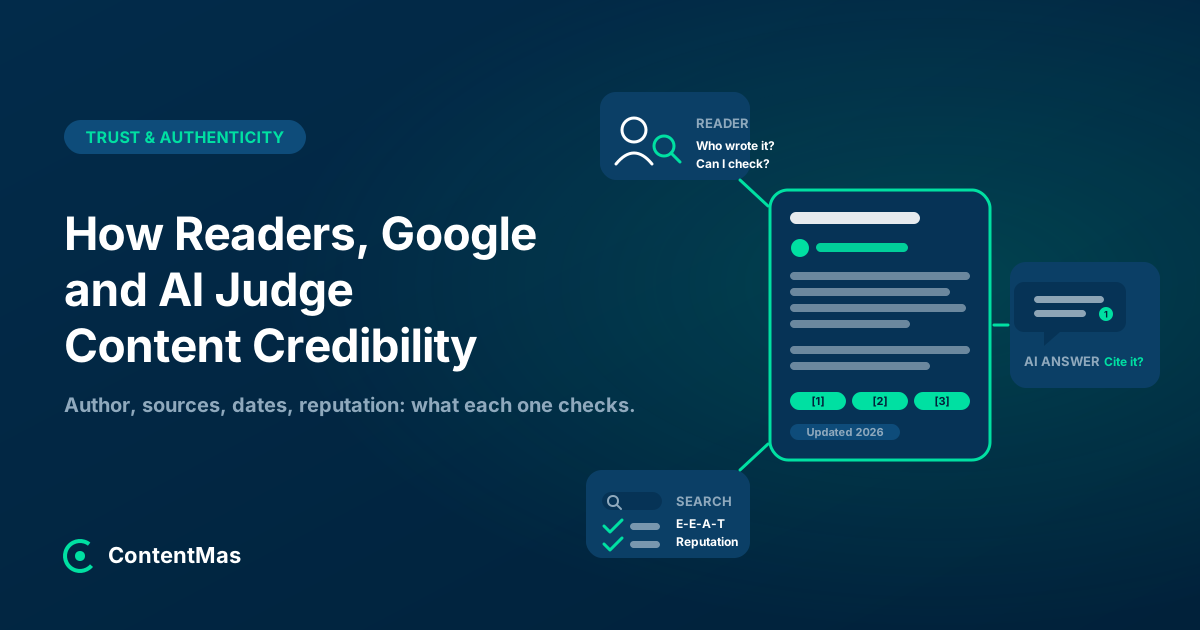
Someone lands on your page from Google, an AI answer or a link. Within a few seconds they decide whether to keep reading or go back and try the next result. They have not read your argument yet. They are judging whether you look like someone worth believing. Google does the same at scale, through systems built to reward what its guidelines call trust. AI assistants do it a third way: they retrieve several pages for one question, and a language model decides which of them deserve to be quoted and linked.
This guide explains what content credibility means, how each of the three judges makes the call, and what to change on a page so that it passes all of them.
What is content credibility?
Content credibility is the degree to which a page can be believed by someone who does not already trust you. It is different from popularity, from ranking and from how polished the writing is. A page is credible when its claims are checkable, its author is identifiable, its facts are current and nothing on it contradicts what the rest of the web says about the site.
Google's quality rater guidelines, the document its human evaluators use to assess search results, define trust as "the extent to which the page is accurate, honest, safe, and reliable," and rank it above experience, expertise and authoritativeness: "Trust is the most important member of the E-E-A-T family because untrustworthy pages have low E-E-A-T no matter how Experienced, Expert, or Authoritative they may seem."1
That order matters. A page can show expertise and still fail if a reader cannot tell who wrote it, if the numbers have no source, or if the company behind it cannot be found. Credibility is the floor the other qualities stand on.
How do readers judge whether a page is credible?
Readers judge credibility fast and from the surface: whether they can verify the claims, whether real people and a real organization stand behind the page, whether it looks professional, and whether it contains errors.
The clearest list still comes from Stanford's Persuasive Technology Lab, whose Guidelines for Web Credibility "are based on three years of research that included over 4,500 people."2 They read like an audit checklist: "Make it easy to verify the accuracy of the information on your site," "Show that there's a real organization behind your site," "Show that honest and trustworthy people stand behind your site," "Make it easy to contact you," "Update your site's content often (at least show it's been reviewed recently)," and "Avoid errors of all types, no matter how small they seem."2 The list dates from 2002, but the behavior has not changed, and the trust signals AI assistants look for today are largely the same items.
What has changed is how much reading now happens inside an AI answer, and how little of that readers trust. Pew Research Center surveyed 5,153 US adults in August 2025: 65% at least sometimes see AI summaries in search results, and among those who have, about half (53%) have at least some trust in the information, "But only 6% say they trust it a lot."4 The Reuters Institute's 2026 Digital News Report, covering 48 markets and 97,520 respondents, found the same gap for news: "Trust in answers from AI chatbots is 20% globally (relative to trust in news overall at 37%)."5 Low trust in the summary pushes readers toward the source: 42% of people who use AI chatbots for news say they always or often click through to the original news sources.5 When they arrive, your page has to hold up on its own.
The lesson for a page is simple. Readers reward visible evidence, and a growing share of them click it. Link to the primary source, make sure it says what you say it says, and keep the link alive.
How does Google judge content credibility?
Google judges credibility through automated systems designed to reward content with strong E-E-A-T, tuned with feedback from human raters who are told to put trust first and to check what independent sources say about a site.
Google's guidance on helpful content says it plainly: "Of these aspects, trust is most important."7 E-E-A-T "isn't a specific ranking factor," but Google's systems "give even more weight to content that aligns with strong E-E-A-T," while "Search raters have no control over how pages rank."7
The same guidance gives website owners a self-assessment. On authorship: "Is it self-evident to your visitors who authored your content?" and "Do pages carry a byline, where one might be expected?"7 On production: "Is the use of automation, including AI-generation, self-evident to visitors through disclosures or in other ways?"7 On the content: "Does the content have any easily-verified factual errors?" and does it present information in a way that makes you want to trust it, with clear sourcing and evidence of the expertise involved.7
The rater guidelines add the check most sites forget: reputation. "Reputation research is especially important for detecting untrustworthy websites and content creators," and it "is required for all PQ rating tasks."1 Raters are told, "Be skeptical of claims that websites make about themselves, particularly when there is a clear conflict of interest," and, "When there is disagreement between what the website or content creators say about themselves and what reputable independent sources say, trust the independent sources."1 At the bottom of the scale, "Lowest quality pages are untrustworthy, deceptive, harmful to people or society, or have other highly undesirable characteristics."1
So Google's version of credibility has two halves. On the page: a named author, clear sourcing, no verifiable errors, honest disclosure of how the content was made. Off the page: what reviews, news and experts say about you, which should match what you say about yourself.
How do AI assistants judge content credibility?
AI assistants judge credibility twice: once when a search system retrieves candidate pages, and again when the language model decides which of them to quote and cite. Research on that second step shows that models respond to evidence on the page and to the authority of the source, and that conflicts between sources can confuse them.
The first study to measure it was the Generative Engine Optimization paper from Princeton, IIT Delhi and collaborators, accepted at KDD 2024. On a benchmark of 10,000 queries across 25 domains, the authors tested ways of rewriting a page so that an answer engine used more of it: "our top-performing methods, Cite Sources, Quotation Addition, and Statistics Addition, achieved a relative improvement of 30-40% on the Position-Adjusted Word Count metric and 15-30% on the Subjective Impression metric."3 Keyword stuffing, "widely used for Search Engine Optimization," offered "little to no improvement."3 What the model rewarded was what readers reward: checkable evidence.
Newer work asks whether a model can tell an authoritative source from a weak one. AuthorityBench, published in March 2026 by researchers at the Chinese Academy of Sciences, tested five language models on 10,000 web domains and 22,000 entities with known authority and concluded that "LLMs may have already developed a preliminary ability for authority perception."8 Two findings matter for website owners. First, "incorporating webpage text consistently degrades judgment performance, suggesting authority is distinct from textual style."8 Confident, fluent writing does not make a model think a site is authoritative. Second, when retrieved documents were filtered by authority before answering, accuracy rose, for one model from 53.33% to 66.67%, so systems have a reason to prefer sources with a reputation.8
The weak spot is conflict. A 2025 study presented at IJCAI found that retrieval-augmented models' "reliability decreases when confronted with conflicting evidence from sources of varying credibility," and that "effectively incorporating source credibility significantly enhances the ability of RAG models to resolve conflicting evidence."9 If your page disagrees with better-known sources without explaining why, a model has no way to take your side. Microsoft's guidance for Bing and Copilot citations puts the practical side in one line: "Examples, data, and cited sources help build trust when content is reused in AI-generated answers."10
Readers, Google and AI assistants, side by side
| What is checked | Readers | AI assistants | |
|---|---|---|---|
| Who wrote it | Real people and a real organization behind the site2 | Bylines and accurate authorship information where readers expect them7 | Source authority, which models can partly perceive8 |
| Can the claims be verified | The first Stanford guideline2; readers who check citations lose trust when they fail6 | Clear sourcing, no easily verified factual errors7 | Cited sources, quotations and statistics raised use of a page by 30 to 40%3 |
| Is it current | "Update your site's content often"2 | Part of the helpful-content self-assessment7 | Accurate, up-to-date content matters for inclusion and citation10 |
| What others say about you | Shapes expectations before the visit | Reputation research is required; independent sources win1 | Conflicts are resolved better when source credibility is known9 |
| Does style fake it | Professional design helps2 | No: trust is about accuracy and honesty1 | No: authority is "distinct from textual style"8 |
Source: compiled from the sources cited in each cell.
What makes a page lose credibility?
A page loses credibility when any of the checks above fails: an anonymous author, a number with no source, a date that is obviously old, a claim about the company that independent sources do not support, or a small error a reader can catch.
The failures compound. One wrong figure casts doubt on every other figure on the page, which is why Stanford's last guideline is to "Avoid errors of all types, no matter how small they seem."2 A citation that does not support its claim does the same once a reader checks it.6 Self-praise without backing fails because raters are told to trust independent sources over a site's own claims.1 And thin pages, which restate what other sites say without adding evidence or experience, give a reader nothing to verify and an AI assistant nothing worth citing.3
How do you make content credible?
Make content credible by giving every reader, rater and model the same things to check: a named author, linked primary sources, specific evidence, current facts, a findable organization and an outside reputation that matches your own claims. Six steps cover it.
Step 1: Source every claim, and link the primary source
Every statistic, quote and policy statement should point to the page it came from, ideally the original study or documentation rather than a blog that summarized it. Google asks for clear sourcing,7 the GEO study found citing sources among the three most effective changes for AI visibility,3 and Bing says cited sources "help build trust when content is reused in AI-generated answers."10 Check that each link opens and supports the sentence it is attached to.6
Step 2: Show who wrote it and how
Add a byline with a real name and a short bio that explains why this person knows the subject. Google asks whether authorship is self-evident and whether the use of automation, including AI generation, is "self-evident to visitors through disclosures or in other ways."7 If AI tools helped produce or edit the page, say so and name who reviewed it.
Step 3: Be specific
Replace general statements with numbers, quotations, named examples and dates. In the GEO benchmark, statistics and quotations were two of the three top-performing additions, and keyword repetition did nothing.3 Specific content is easier for a reader to verify, for a rater to judge, and for an answer engine to lift.
Step 4: Keep facts current and remove errors
Review the pages that matter on a schedule, fix anything that has aged, and show a visible, honest date. Stanford's advice is to update content often or "at least show it's been reviewed recently,"2 and Microsoft states that "Accurate and up to date content is important for inclusion and citation in AI-generated answers."10 Proofread for the small mistakes too; they are the ones readers catch.
Step 5: Make the organization findable
A real address, a working contact route, a clear about page and policies that match the business answer Stanford's "Show that there's a real organization behind your site" and "Make it easy to contact you."2 The same facts, repeated consistently in structured data and on third-party profiles, are what the trust signals guide covers in detail.
Step 6: Earn mentions you do not control
Because raters trust independent sources over a site's own claims,1 and because models resolve conflicts better when they know a source's standing,9 reputation built elsewhere protects the page itself. Reviews on independent platforms, mentions in trade press and citations from other sites all count. Say about yourself only what those sources will confirm.
How does ContentMas help with content credibility?
ContentMas is an AI-powered SEO tool that audits your website for Google and AI search engines, and shows exactly what to fix to rank higher and get cited. ContentMas reads your key pages the way a visitor, a search engine and an AI assistant do, and reports on six pillars: Content Freshness, Content Quality, Trust & Authenticity, SEO & GEO Readiness (visibility in Google and AI search engines; GEO means Generative Engine Optimization), Technical Readiness and Security. The Trust & Authenticity and Content Quality pillars cover the checks in this guide: missing or inconsistent author information, claims without sources, outbound links that are broken, contact and company details that are hard to find, and pages whose facts and dates have aged. Each finding comes with a priority and a fix.
The free plan reads up to 10 pages per scan, 3 scans per 24 hours; paid plans read 100, 200 or 500 pages. See how we score or run an audit.
Key takeaways
- Credibility is the floor. Google's rater guidelines define trust as "accurate, honest, safe, and reliable" and say untrustworthy pages have low E-E-A-T no matter how expert they seem.1
- Readers check what they checked in 2002: verifiable claims, real people, a real organization, current content and no errors.2 Only 6% of Americans who see AI summaries trust them a lot, so many still click through to the source.45
- Citations work both ways. They raised trust in a chatbot experiment even when random, and trust fell once participants checked them.6
- AI assistants reward evidence, not style. Cited sources, quotations and statistics improved a page's use in AI answers by 30 to 40%; keyword stuffing did nothing.3 Fluent text does not change a model's judgment of authority.8
- Google checks you from outside. Raters must research reputation and trust independent sources over a site's own claims.1
- The fix list is short: source every claim, name the author and the method, be specific, keep facts current, make the organization findable, and earn independent mentions.7210
Readers, Google and AI assistants arrived at the same definition of a credible page from three directions, so one set of changes satisfies all three. The work is not persuasion. It is making your page easy to check, and then making sure it passes.
Related reading: Why AI Assistants Don't Recommend Your Business: The Trust Signals You're Missing and Why Thin Pages Don't Rank or Get Cited by AI (and How to Fix Them)
The six-pillar guides: Technical · Content quality · Trust · Freshness · Security · SEO and GEO · How ContentMas scores each pillar
Frequently asked questions
What is the difference between content credibility and E-E-A-T?
E-E-A-T is Google's framework of experience, expertise, authoritativeness and trust, used by its quality raters and reflected in its ranking systems.7 Content credibility is the broader quality that readers and AI assistants also judge: whether a page can be believed by someone who does not already trust you. Google ranks trust as the most important of the four, so a credible page and a page with strong E-E-A-T look very similar.1
Is content credibility a Google ranking factor?
Not as a single signal. Google says E-E-A-T "isn't a specific ranking factor," but its systems "give even more weight to content that aligns with strong E-E-A-T," and raters trained to assess trust provide feedback on those systems.7 The visible parts of credibility, such as bylines, sourcing and the absence of factual errors, are the things Google asks site owners to self-assess.7
Do citations really help a page get cited by AI assistants?
Yes, according to the research so far. In the GEO benchmark of 10,000 queries, citing sources, adding quotations and adding statistics were the three best-performing changes, with a 30 to 40% relative improvement in how much of a page an answer engine used.3 Bing's guidance for AI answers also lists "Examples, data, and cited sources" among the things that build trust when content is reused.10
Can good writing make a page look more authoritative to an AI?
Not by itself. The AuthorityBench study found that giving a model the page text "consistently degrades judgment performance, suggesting authority is distinct from textual style."8 Models judge authority from the source and its standing more than from fluency, so the way to look authoritative is to be identifiable, specific and corroborated elsewhere.
What should I fix first on a page with low credibility?
Start with the two failures a reader catches fastest: claims without sources and an anonymous author. Add links to primary sources and check that each one supports its sentence,6 then add a byline and a short bio.7 After that, fix outdated facts and small errors, make the organization easy to find and contact,2 and bring your claims about the company in line with what independent sources say.1
References
Each numbered marker in the article links to its source below.
-
Google — Search Quality Rater Guidelines: General Guidelines (opens in a new tab), September 2025. ↩
-
Stanford Persuasive Technology Lab — Stanford Guidelines for Web Credibility (opens in a new tab), June 2002. ↩
-
Aggarwal et al., arXiv — GEO: Generative Engine Optimization (opens in a new tab), June 2024. ↩
-
Pew Research Center — Americans have mixed feelings about AI summaries in search results (opens in a new tab), October 2025. ↩
-
Reuters Institute for the Study of Journalism — Overview and key findings of the 2026 Digital News Report (opens in a new tab), June 2026. ↩
-
Ding et al., arXiv — Citations and Trust in LLM Generated Responses (opens in a new tab), January 2025. ↩
-
Google Search Central — Creating helpful, reliable, people-first content (opens in a new tab), October 2026. ↩
-
Yao et al., arXiv — AuthorityBench: Benchmarking LLM Authority Perception for Reliable Retrieval-Augmented Generation (opens in a new tab), March 2026. ↩
-
Ge et al., arXiv — Resolving Conflicting Evidence in Automated Fact-Checking: A Study on Retrieval-Augmented LLMs (opens in a new tab), May 2025. ↩
-
Bing Webmaster Blog — Introducing AI Performance in Bing Webmaster Tools Public Preview (opens in a new tab), February 2026. ↩
About this article
Written by Nasir Ali Joiya. Nasir Ali Joiya is a software engineer and the CEO and Co-Founder of ZAPTA Technologies, an AI-native software company in Lahore whose group has more than 150 engineers. Reviewed by the ContentMas Team, who build ContentMas, an AI-powered SEO audit tool that checks sites across six pillars for Google and AI search engines. Facts and figures link to their original sources in the References. Spotted something out of date? Tell us and we will correct it.
Free website audit
See how your site scores for search engines and AI assistants.
One score, six pillar scores and a ranked fix list in a few minutes. No credit card.
Start free audit