
Content Freshness
Content freshness matters more in AI search engines than in Google
AI assistants cite pages 25.7% newer than Google results, re-pick their sources almost daily and read dates as a signal. Here is why, and what to update.

Summarize with AI
Short on time? Open this article in your AI assistant with a ready-made prompt.
- ChatGPT (opens in a new tab with a summary prompt)
- Perplexity (opens in a new tab with a summary prompt)
- Grok (opens in a new tab with a summary prompt)
Claude and Gemini open with the prompt copied: paste it to start.
On this page
- What does content freshness mean?
- How does Google use content freshness?
- Why does content freshness matter more in AI search engines?
- Does changing the date count as content freshness?
- How do you keep content fresh for AI search engines?
- How does ContentMas help with content freshness?
- Key takeaways
- Frequently asked questions
Short answer
In short: content freshness matters more in AI search engines because AI assistants retrieve pages at the moment of the question, pick only a handful of them, and treat the date as a signal. Pages cited by AI assistants are on average 1,064 days old against 1,432 days for pages in Google's organic results, a 25.7% difference, and ChatGPT cites pages 393 to 458 days newer than Google.1 In a 2025 study, adding a recent date to a passage was enough to reverse up to 25% of an AI model's preferences between equally relevant passages.2 Google's own freshness systems only step in for queries where recency is expected,3 and its AI Overviews cite pages 16 days older than organic results.1 The fix is not a new date on an old page: it is current facts, a visible and consistent date, and a way to tell the engines the page changed.45
Your best page about your product was written in 2023. It still ranks on Google, so nobody has touched it. Then someone asks ChatGPT or Perplexity the question that page answers, and the answer cites three other sites, all updated this year.
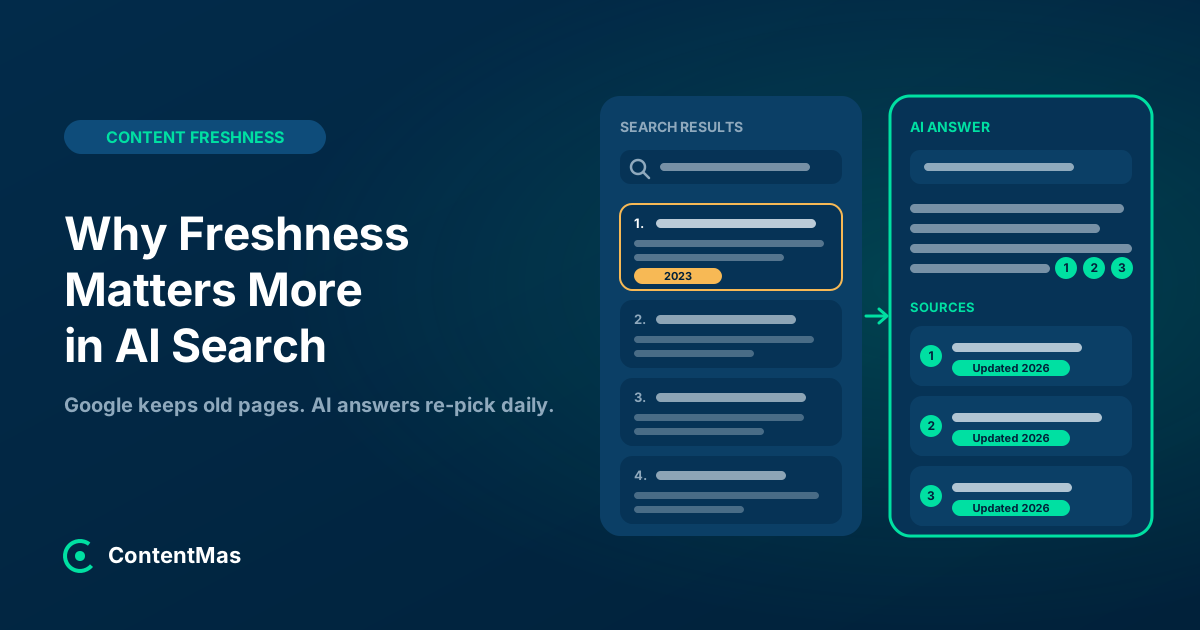
That is not bad luck. Google was built to keep a good page in place for years and to prefer new pages only when the query calls for them. AI assistants work differently: they search while the person waits, keep a handful of sources, and read the dates on them. The same page that holds a Google ranking can quietly disappear from AI answers.
This guide explains what content freshness means, how Google uses it, why AI assistants weigh it more heavily, what the studies measured, and what to update so your pages stay cited. Every number comes from a source you can open.
What does content freshness mean?
Content freshness is how current a page's facts, dates and claims are, not how recently someone edited it. A page from 2019 whose prices, screenshots and statistics are still true is fresh. A page edited last week that still quotes a 2021 survey is not.
Search engines and AI assistants read freshness through signals: the publication and modification dates in the page and its structured data, the dates in sitemaps, the age of the facts in the text, and the last time their crawler saw a change.45 Google's guidance is that the visible date and the datePublished and dateModified structured data should match, and that a page should get a new date only when it changes significantly.4
So freshness has two layers: what is true on the page, and how clearly the page tells machines when it changed. The second only helps when the first is real.
How does Google use content freshness?
Google uses freshness selectively. It has a dedicated freshness system, but it applies to queries where people expect recent results, not to every search.
When Google announced its freshness update in November 2011, it said the change "impacts roughly 35 percent of searches and better determines when to give you more up-to-date relevant results."3 It gave three kinds of queries where recency wins: "Recent events or hot topics," "Regularly recurring events," and "Frequent updates," meaning information that changes often without being news.3 A clarification added a few days later narrowed the headline figure: "when we say this algorithm impacted 35% of searches, we mean at least one result on the page was affected," and the change "noticeably impacts 6 - 10% of searches, depending on the language and domain you're searching on."3
That logic has held. For "how to write a privacy policy," Google will show a page from 2018 if it is still the most helpful one. For "iPhone price," it will not. Google's AI features follow the same ranking: its documentation states that "There are no additional requirements to appear in AI Overviews or AI Mode, nor other special optimizations necessary."6
The measurement agrees. In Ahrefs' study of about 17 million cited URLs, every AI assistant preferred newer pages than Google's organic results, with one exception: Google's AI Overviews, "which cites content that is 16 days older, on average."1 The authors' summary: "Google is the least influenced by content freshness, and Google is still where the majority of searches happen."1
The signs that a website is out of date still cost Google rankings over time, through content decay, but the loss is gradual and depends on the query. In AI search engines it is faster and broader.
Why does content freshness matter more in AI search engines?
Content freshness matters more in AI search engines for three reasons: the assistant searches at the moment of the question, it keeps only a few sources, and the model that picks those sources reads dates as a relevance signal. Each one is measurable.
1. AI assistants retrieve pages live, and they do it again every time
Google's documentation describes how its generative features work: the systems "retrieve relevant, up-to-date web pages from our Search index" to "improve the quality, accuracy, and freshness of AI responses."7 AI Mode and AI Overviews may use a technique Google calls "query fan-out," issuing multiple related searches across subtopics while the answer is being written, and "While responses are being generated, our advanced models identify more supporting web pages."6 Perplexity goes a step further: its documentation says that when "users ask Perplexity a question, it might visit a web page to help provide an accurate answer and include a link to the page in its response."8
Because retrieval happens per question, the set of cited pages is rebuilt constantly. Ahrefs tracked about 37,500 citations "across five AI tools, every day for 20 days" in 2026.9 By the second day, 50% of the citations in Google AI Overviews were gone, 58% in AI Mode, 59% in ChatGPT, 81% in Gemini and 83% in Copilot.9 Only 4% to 7% of the day-one citations in ChatGPT and Google's tools lasted all 20 days.9 Part of the churn is the search itself: "ChatGPT repeated exactly the same searches as the previous day, only 26% of the time."9 But the authors found that "much of the churn happens after the search, when the AI decides which pages to cite."9
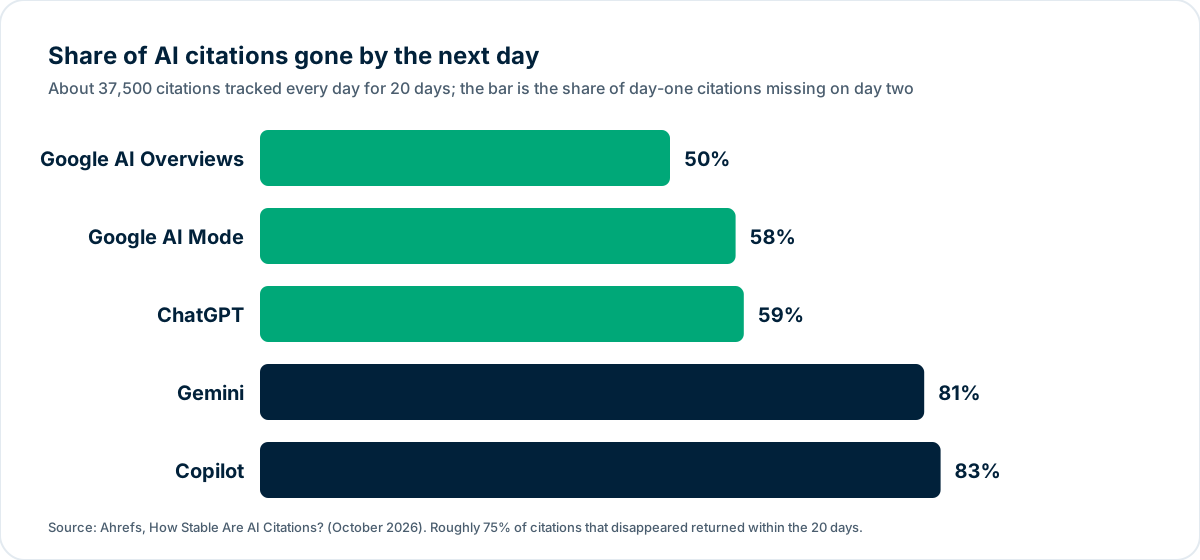
Source: Ahrefs, 37,500 citations tracked daily for 20 days, October 2026.9
A Google ranking is re-evaluated slowly. An AI citation is re-decided every day, and every new decision is a chance for a newer page to win.
2. Only a few sources are kept, so a tie-breaker becomes a filter
A Google results page lists ten links. An AI answer cites a handful. When the candidate set is that small, a mild tie-breaker becomes a filter.
The Ahrefs citation study shows the size of that preference. Pages cited by AI assistants had an average age of 1,064 days against 1,432 days in organic results, and measured by last update the gap was 909 against 1,047 days, "a smaller difference of 13.1%."1 The effect varied by platform: "ChatGPT shows the strongest preference for new content, preferring to cite URLs that are 393 days newer than organic Google results in their in-text references, and a whopping 458 days newer in their citations."1 The study also noted that "Perplexity and ChatGPT order their in-text references from newest to oldest."1
In categories where facts move quickly, the cited pages are far younger. A University of Toronto analysis of AI search engine results found that for consumer electronics "Claude's mean article age was about 117 days, with a median of 62 days."10
3. The model itself favors recent dates
The third reason is the one that separates AI search engines from everything before them. The component that decides which retrieved pages to use is a language model, and language models show a measurable recency bias.
Researchers at Waseda University and Hong Kong Polytechnic University tested this directly in 2025. They asked whether "LLMs systematically prefer newer content when acting as search rerankers," and they isolated the date: "We isolate timestamps as the sole manipulated variable, injecting artificial publication dates to measure how strongly temporal signals distort LLM-based reranking."2 Across GPT-3.5, GPT-4, GPT-4o, two LLaMA 3 models and two Qwen2.5 models, "'fresh' passages are consistently promoted," with the date tag "moving individual items by as many as 95 ranks."2
The researchers describe the date as "a strong, largely monotonic relevance signal that overrides other term-based and semantics-based evidence," and they warn that "if temporal cues go unchecked, LLM-based rerankers may undervalue authoritative yet older material."2 For a website owner the lesson is direct: an undated or old-dated page is handing the model a reason to prefer somebody else's.
Google search and AI answers, side by side
| Classic Google results | AI assistants and AI answers | |
|---|---|---|
| When recency matters | For queries where it is expected; the 2011 system noticeably changed 6 to 10% of searches3 | For most questions; cited pages are 25.7% newer than organic results on average1 |
| How often sources are re-picked | Rankings move gradually | Half or more of citations change by the next day9 |
| How many sources are shown | Ten results on the first page, more below | A few citations per answer; Perplexity and ChatGPT order them newest first1 |
| Who weighs the date | Ranking systems, selectively3 | Ranking systems plus a language model with a measured recency bias2 |
| Weakest freshness effect | Google organic results1 | Google AI Overviews: 16 days older than organic1 |
| Strongest freshness effect | Not applicable | ChatGPT: 393 to 458 days newer than organic1 |
Source: compiled from the sources cited in each cell.
Does changing the date count as content freshness?
No. Changing the date without changing the content does little for AI assistants and is discouraged by Google.
The Ahrefs numbers show the difference between the two measures. Measured by publication date, AI-cited pages were 25.7% newer than organic results; measured by last update, the gap was only 13.1%.1 If a date bump alone drove citations, the second figure would be the larger one. The study itself points to John Mueller of Google, who "has warned against updating publish dates without any corresponding changes in the page content."1
Google's guidance on dates is clear about what a new date is for: "If you update a page significantly, also update the visible date (and time, if you display that)," and "don't artificially freshen a story without adding significant information."4 Bing's advice for AI answers is about substance too: "Accurate and up to date content is important for inclusion and citation in AI-generated answers."5
The Ahrefs authors also caution against over-reading freshness: "Content freshness is one among many factors that influence visibility."1 It earns its place when the facts on the page have moved. For a page whose facts have not changed, the honest date is the old one.
How do you keep content fresh for AI search engines?
Keep content fresh by fixing what is out of date on the pages that matter, showing the change clearly, and telling the engines about it. Five steps cover it.
Step 1: Find the pages where facts have moved
List the pages that answer the questions you want AI assistants to cite you for, usually the product, pricing, comparison and how-to pages. On each one, check the statistics, prices, versions, screenshots, names and years. Google's 2011 categories still describe where recency wins: recurring events, topics in the news and "information that changes often, but isn't really a hot topic or a recurring event."3 Pricing, integrations, regulations and tool comparisons sit in that third group.
Step 2: Update the substance, not the paragraph order
Replace old numbers with current ones and name the source, add what changed since the page was written, and remove claims you can no longer stand behind. Bing lists what helps when content is reused: "Examples, data, and cited sources help build trust when content is reused in AI-generated answers," and "Clear headings, tables, and FAQ sections help surface key information."5
Step 3: Show the date, once, everywhere
Follow Google's date guidance: "Show a clear date: Show a visible date prominently on the page," use datePublished and dateModified structured data, and "Be consistent in usage. Within a page, make sure to use exactly the same date" in the visible text and in the structured data.4 A page with three different dates in its HTML gives a reranker nothing to trust.
Step 4: Tell the engines the page changed
Bing and Copilot support IndexNow, which "helps keep information fresh across search and AI experiences by notifying participating search engines whenever content is added, updated, or removed."5 For Google, keep your sitemap's modification dates accurate. Bing's reasoning applies to both: "Regular updates help ensure AI systems reference the most current version of your content."5
Step 5: Measure over weeks, not days
Citations churn by design, so one check tells you nothing. Bing Webmaster Tools now has an AI Performance report that shows total citations, average cited pages and the grounding queries behind them.5 Ahrefs' advice from its 20-day study: "Treat citation volatility as normal," "Don't credit a page edit for a single comeback," and "Count how many of the last seven days you were cited."9 Roughly 75% of citations that disappeared came back within the study, so judge a page by its share of days cited, not by a single day.9
How does ContentMas help with content freshness?
ContentMas is an AI-powered SEO tool that audits your website for Google and AI search engines, and shows exactly what to fix to rank higher and get cited. ContentMas reads your key pages the way a visitor, a search engine and an AI assistant do, and reports on six pillars: Content Freshness, Content Quality, Trust & Authenticity, SEO & GEO Readiness (visibility in Google and AI search engines; GEO means Generative Engine Optimization), Technical Readiness and Security. The Content Freshness pillar flags the signals covered in this guide: old years in copy, statistics that have aged, mismatched visible and structured dates, and pages whose last real change is long past. Each finding comes with a priority and a fix.
The free plan reads up to 10 pages per scan, 3 scans per 24 hours; paid plans read 100, 200 or 500 pages. See how we score or run an audit.
Key takeaways
- AI assistants cite newer pages than Google: 1,064 days old on average against 1,432 for organic results, a 25.7% difference, with ChatGPT the most freshness-sensitive at 393 to 458 days newer.1
- Citations are re-decided daily. Half or more of AI citations disappear by the next day, and only 4% to 7% last 20 days in ChatGPT and Google's AI tools.9
- The model reads dates. A date tag alone reversed up to 25% of preferences between equally relevant passages, across every model tested.2
- Google is the exception, not the rule: its freshness system targets queries where recency is expected, and its AI Overviews cite pages slightly older than organic results.13
- A new date on unchanged content is not freshness. Google says not to "artificially freshen a story without adding significant information," and the update-date gap in the data is half the size of the publication-date gap.14
- Keep facts current, show one consistent date, notify the engines, and measure citations over weeks.945
AI search engines did not invent the preference for current information. They made the preference apply to more questions, more often, and with fewer winners. A page that was allowed to age on Google needs a maintenance schedule now.
Related reading: Is Your Website Out of Date? 7 Signs Google and AI Assistants Notice and Why Content Decay Is Silently Killing Your SEO Rankings
The six-pillar guides: Technical · Content quality · Trust · Freshness · Security · SEO and GEO · How ContentMas scores each pillar
Frequently asked questions
Is content freshness a ranking factor for AI search engines?
There is no published list of AI ranking factors, and Google says there are "no additional requirements to appear in AI Overviews or AI Mode."6 But the measurements show a consistent preference: pages cited by AI assistants are on average 25.7% newer than those in Google's organic results,1 and controlled tests show that language models used as rerankers promote passages with recent dates.2
How often should I update content for AI assistants?
Update a page when its facts change, not on a calendar. Pages about prices, tools, regulations and other fast-moving topics need a check every quarter; evergreen explanations need one a year. Ahrefs found that AI assistants "still prefer citing long-lived content" with an average cited age of 2.9 years, so a well-maintained old page competes well.1
Does updating the date on a page help it get cited by AI?
Not on its own. Measured by last update, AI-cited pages were only 13.1% newer than organic results, against 25.7% measured by publication date,1 and Google advises against artificially freshening a page without adding significant information.4 Change the content, then change the date.
Why do my AI citations appear and disappear?
Because AI assistants search again for every question and re-pick their sources. In a 20-day study, 50% to 83% of citations were gone by the next day, depending on the platform, and about 75% of those came back later.9 Judge your visibility by how many days in a week you are cited, not by one check.9
Do Google's AI Overviews prefer fresh content too?
Less than the other assistants. Ahrefs measured AI Overviews citing pages 16 days older than Google's organic results on average, while ChatGPT, Perplexity, Gemini and Copilot all cited newer pages.1 That fits Google's own position that there are no additional requirements to appear in AI Overviews or AI Mode.6
References
Each numbered marker in the article links to its source below.
-
Ahrefs — New Study: AI Assistants Prefer to Cite "Fresher" Content (17 Million Citations Analyzed) (opens in a new tab), July 2025. ↩
-
Fang et al., arXiv — Do Large Language Models Favor Recent Content? A Study on Recency Bias in LLM-Based Reranking (opens in a new tab), September 2025. ↩
-
Google Inside Search blog — Giving you fresher, more recent search results (opens in a new tab), November 2011. ↩
-
Google Search Central Blog — Help Google Search know the best date for your web page (opens in a new tab), March 2019. ↩
-
Bing Webmaster Blog — Introducing AI Performance in Bing Webmaster Tools Public Preview (opens in a new tab), February 2026. ↩
-
Google Search Central — AI features and your website (opens in a new tab), December 2025. ↩
-
Google Search Central — Optimizing your website for generative AI features on Google Search (opens in a new tab), July 2026. ↩
-
Perplexity — Perplexity crawlers (opens in a new tab), accessed November 2026. ↩
-
Ahrefs — How Stable Are AI Citations? 10 Things We Learned Tracking 37,500 Citations (opens in a new tab), October 2026. ↩
-
Chen et al., arXiv — Generative Engine Optimization: How to Dominate AI Search (opens in a new tab), September 2025. ↩
About this article
Written by Nasir Ali Joiya. Nasir Ali Joiya is a software engineer and the CEO and Co-Founder of ZAPTA Technologies, an AI-native software company in Lahore whose group has more than 150 engineers. Reviewed by the ContentMas Team, who build ContentMas, an AI-powered SEO audit tool that checks sites across six pillars for Google and AI search engines. Facts and figures link to their original sources in the References. Spotted something out of date? Tell us and we will correct it.
Free website audit
See how your site scores for search engines and AI assistants.
One score, six pillar scores and a ranked fix list in a few minutes. No credit card.
Start free audit