
Content Freshness
How often to update website content: a schedule by page type
How often to update website content depends on the page: pricing when it changes, guides every 6 to 12 months, news never rewritten. A schedule, with the evidence.

Summarize with AI
Short on time? Open this article in your AI assistant with a ready-made prompt.
- ChatGPT (opens in a new tab with a summary prompt)
- Perplexity (opens in a new tab with a summary prompt)
- Grok (opens in a new tab with a summary prompt)
Claude and Gemini open with the prompt copied: paste it to start.
On this page
- Does updating content more often help rankings?
- What does Google do with an updated page?
- Why does the update schedule matter more for AI search engines?
- How often should you update each type of page?
- What counts as an update, and what does not?
- How do you tell Google and AI search engines that a page changed?
- How do you run the schedule without a content team?
- How does ContentMas help with a content update schedule?
- Key takeaways
- Frequently asked questions
Short answer
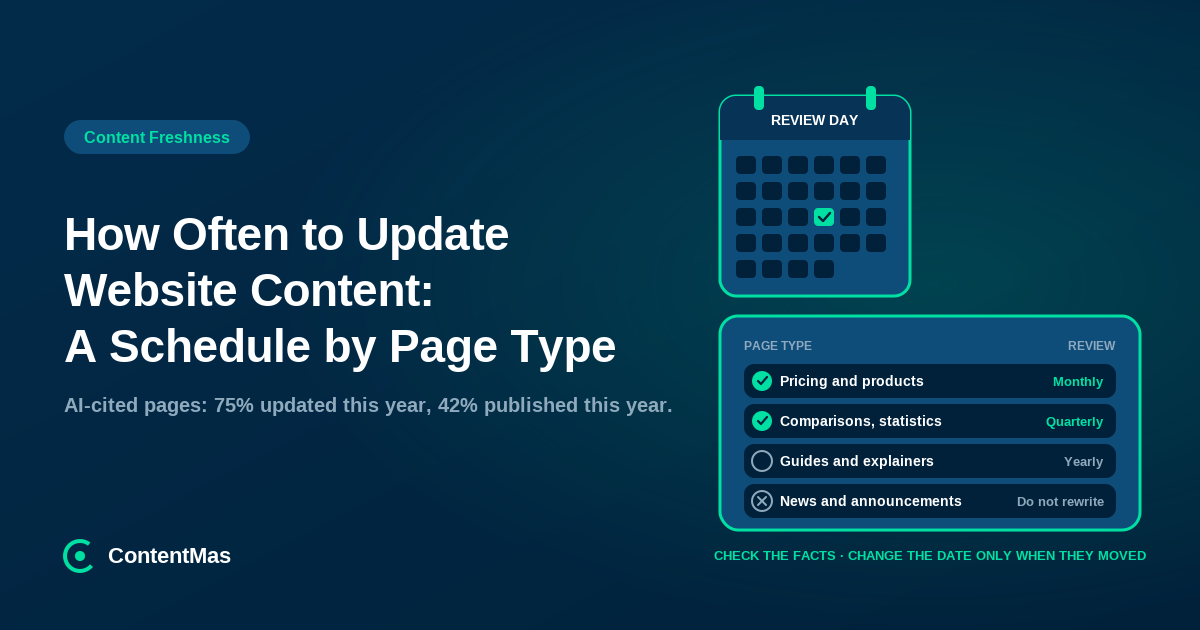
In short: how often to update website content depends on how fast the facts on each page change, not on a site-wide rule. Pricing, product and availability pages change the day the facts do; comparison and "best of" pages need a check every quarter; how-to guides every 6 to 12 months; policies and company pages once a year; news is never rewritten, only annotated.12 The evidence favors maintenance over volume: in a 2026 study of 47,097 AI citations, 75% of cited pages had been updated within the last year, and where both dates were known only 42% had been first published that recently.1 Google trusts a sitemap lastmod date only when it is "consistently and verifiably" accurate, and asks outright whether you are "changing the date of pages to make them seem fresh when the content has not substantially changed."34 So the schedule below is a review schedule: open the page, fix what has moved, and change the date only when the content did.
A small business website has forty pages. Three of them earn most of the traffic, one shows prices that changed in March, and the "last updated" line on the about page still says 2022. Nobody is sure which pages to touch, so nothing gets touched.
The question "how often should I update my website content?" usually gets a single answer: monthly, quarterly, whenever you can. A single answer is wrong for every page. A pricing page that is a week out of date is misleading visitors; a how-to guide from last year is probably fine. The useful question is "how often does this type of page go stale?", and that has a measurable answer.
This guide gives a schedule by page type, explains what Google and AI search engines do with an updated page, draws the line between an update and a date change, and ends with a routine a one-person team can keep.
Does updating content more often help rankings?
Not by itself. Google rewards a page that is current when the query calls for currency, and it treats date changes without content changes as a signal of search-engine-first content, not as freshness.
Google's own description of freshness, from 2011, names three kinds of searches where recency matters: "recent events or hot topics," "regularly recurring events" such as an annual conference, and "frequent updates," defined as "searches for information that changes often, but isn't really a hot topic or a recurring event," with the examples "best slr cameras" and "subaru impreza reviews."2 A later clarification put the change at 6 to 10% of searches noticeably affected.2 For the rest, the most helpful page wins whatever its date.
The same guidance that explains what Google rewards also explains what it ignores. Its page on helpful content lists the questions to ask about search-engine-first content, and two of them are about freshness: "Are you changing the date of pages to make them seem fresh when the content has not substantially changed?" and "Are you adding a lot of new content or removing a lot of older content primarily because you believe it will help your search rankings overall by somehow making your site seem 'fresh?' (No, it won't)."4
So the rule for Google is: update when the facts on the page changed, show the new date when you do, and leave the date alone otherwise. The signs that a website is out of date are facts a visitor can see, and those are the ones to fix.
What does Google do with an updated page?
It recrawls it when it notices, and it uses your dates only when they have earned trust.
Google's crawl documentation says its systems "want to recrawl documents frequently enough to pick up any changes," and that crawl demand "varies based on a site's size, update frequency, page quality, and relevance."5 For most sites that is enough: if your pages "seem to be crawled the same day that they are published," you do not need to manage crawling at all.5
Dates are where sites go wrong. In the sitemap, Google says the lastmod value "should reflect the date and time of the last significant update to the page," that "an update to the main content, the structured data, or links on the page is generally considered significant, however an update to the copyright date is not," and that it uses the value only "if it's consistently and verifiably" accurate.3 It "ignores <priority> and <changefreq> values," so a sitemap that promises daily changes does nothing.3 On the page itself, Google's guidance is to "show a visible date prominently on the page," to update that date "if you update a page significantly," and to "use exactly the same date" in the visible text and in the datePublished and dateModified structured data.6
A site whose dates move only when the content moves gets its dates believed. A site that bumps every date each month trains Google to ignore all of them.
Why does the update schedule matter more for AI search engines?
Because AI assistants re-pick their sources for every question and lean toward recently updated pages, and the updated date is what they read.
The clearest measurement is a July 2026 study by Seer Interactive of every page cited in non-branded answers from ChatGPT, Gemini and Perplexity for four brands over four months, 7,683 pages carrying 47,097 citations.1 Of the cited pages that could be dated, 75% had been updated within the last year and 88% within two; by engine, the one-year share was 78% for Gemini, 73% for ChatGPT and 65% for Perplexity.1 Pages that stayed cited every month of the study had a median update age of 0.47 years.1
The Ahrefs study of 17 million citations from 2025 points the same way from the other side. Pages cited by AI assistants were on average 1,064 days old against 1,432 days for Google's organic results, yet the authors' summary was that "AI assistants still prefer citing long-lived content," with an average cited age of 2.9 years.7 They added a caution that belongs in every update plan: "Low-quality, irrelevant content that's updated every day will not have a magic positive effect on your visibility in AI search."7
The practical reading: an old page that is maintained competes well in AI search engines; an old page that is abandoned drops out of the handful of citations an answer has room for. The guide to content freshness in AI search engines covers the mechanism; this one covers the calendar.
How often should you update each type of page?
As often as its facts change, with a fixed review date so that nothing waits for someone to notice. The table gives a review interval (when to open the page and check it) and the update trigger (what makes a change due before the next review).
| Page type | Review | Update trigger | Why |
|---|---|---|---|
| Pricing, plans, availability | Monthly | The day a price, plan or stock status changes | Google's "frequent updates" category; Bing asks to be told of "any significant changes to existing content"82 |
| Product and service pages | Monthly | A feature, specification, image or policy changes | The most recently updated group among AI-cited pages: 78% updated within a year1 |
| Comparison, "best of", reviews | Quarterly | A competitor, version or price in the table changes | Google's own example of searches that change often; 77% of cited comparison pages updated within a year12 |
| Statistics and research round-ups | Quarterly | A cited source publishes a new edition | Old figures are the most visible sign of an abandoned page; replace them, do not re-date them4 |
| How-to guides and explainers | Every 6 to 12 months | A step, tool, screenshot or rule changes | The least recently updated cited group at 67% within a year; cited pages average 2.9 years old17 |
| Documentation and help pages | With every release | A feature changes or is removed | A wrong instruction costs support time the same day |
| Home page | Monthly glance | Offer, positioning, team or proof points change | Most visited, most linked, first page a crawler reads |
| About, team, contact | Every 6 months | A person, address, phone number or opening time changes | A wrong name, address or opening time is repeated by every visitor and assistant that reads it |
| Legal and policy pages | Yearly | Your data practices, payment terms or the law change | Copyright-date edits are not significant updates; practice changes are3 |
| Campaign landing pages | At campaign end | The offer ends | Expired offers mislead; redirect or archive them |
| News, announcements, case studies | Never rewritten | Add a dated note if facts change | Google: "don't artificially freshen a story without adding significant information"; only 45% of cited news pages were updated within a year, by design16 |
Sources: compiled from the sources cited in each row; the intervals are this guide's recommendations.
Three notes on reading the table.
1. The review interval is a floor, not a promise of change
Opening the pricing page every month does not mean editing it every month. It means someone looks, compares it with reality, and closes it again when nothing has moved. The date on the page stays where it was. Among the pages cited most often in Seer's study, 75% had been updated in the last year, but only 40% had been first published that recently: maintenance, not rewriting, produced those citations.1
2. Triggers beat intervals
The interval exists for the changes nobody told you about. Most real updates should come from a trigger: a price change, a new product version, a changed phone number, a source publishing a new edition. Bing's guidance for notifying search engines is organized the same way: new listings, "significant changes to existing content," and removals.8
3. Links age even when the text does not
A guide with correct steps and six dead links is out of date to a reader. Pew Research Center checked a random sample of just under a million web pages and found that 38% of pages that existed in 2013 were no longer accessible a decade later, and that 23% of news pages and 21% of government pages contained at least one broken link.9 A yearly link check on every page, not just the ones you rewrite, belongs on the schedule.
What counts as an update, and what does not?
An update changes what a reader learns from the page. Everything else is housekeeping, and housekeeping should not move the date.
Google's sitemap guidance draws the line: a change to "the main content, the structured data, or links on the page is generally considered significant," while "an update to the copyright date is not."3 Apply the same test to the visible date and to dateModified. These count as updates: a replaced statistic with its new source, a changed price or step, a new section, a removed claim, a corrected fact. These do not: a new year in the footer, a reworded intro, swapped images, a new call to action, a fixed typo.
The reason to be strict is that the date is a claim. Google asks whether you are "changing the date of pages to make them seem fresh when the content has not substantially changed," and the Ahrefs study notes that Google's John Mueller "has warned against updating publish dates without any corresponding changes in the page content."74 An AI assistant reads the same date. A page that says "updated this week" and still quotes a 2021 survey has told the model something false.
Two habits make the line easy to hold. Show both dates when a page has been updated, "Published" and "Last updated," as Google's guidance allows.6 And add a short "What changed" note to a substantially updated page: it tells returning readers what to re-read and gives the engines a reason to believe the new date.
How do you tell Google and AI search engines that a page changed?
With one accurate date in three places, a sitemap that tells the truth, and a notification for the engines that accept one.
Step 1: Change the date in three places, identically
Update the visible "Last updated" line, the dateModified value in the page's structured data, and the lastmod value for that URL in the sitemap, all to the same date.36 Google's wording is "use exactly the same date," and a mismatch gives the engines a reason to distrust all three.6
Step 2: Keep the sitemap honest
Google recommends including lastmod when a site has updated content, but trusts the value only when it is "consistently and verifiably" accurate.53 A content system that rewrites every lastmod on every build, or stamps today's date on pages nobody touched, throws that trust away for the whole site. Check one: open the sitemap, find a page you have not edited in a year, and confirm its date says so.
Step 3: Notify the engines that take notifications
Bing, and the other search engines in the IndexNow protocol, accept a ping when content is added, updated or removed, and Bing's guidance is to send one for "any significant changes to existing content," not for every small engagement.8 For Google, the honest sitemap and the normal recrawl are the path, and if new pages are crawled the same day they appear, nothing more is needed.5 Bulk date bumps and republishing old posts at new URLs spend crawl attention without earning anything.4
How do you run the schedule without a content team?
With a list, a calendar and one hour a month.
Step 1: Sort your pages into the table above
Export the URL list from your sitemap or content system and give each page a type. Most sites have far fewer types than pages: a few money pages, a set of guides, the company pages, the policies and an archive of news. The checklist for deciding which pages to audit first helps with the ordering.
Step 2: Put the review dates in a calendar
Monthly for pricing, products and the home page; quarterly for comparisons and statistics; every 6 to 12 months for guides; yearly for policies and a site-wide link check. A calendar entry means the review happens on a day, not "when someone has time." Marketers publish less than they did (the share posting 2 to 6 times a week fell from 28% in 2014 to 12% by 2022, while updating older articles peaked at 73%), and a review calendar is how the smaller output stays accurate.10
Step 3: On review day, check facts, not prose
Open the page as a visitor. Check every number, price, date, name, screenshot and link against reality. Fix what is wrong. If nothing is wrong, close the page; the date stays. If something substantial changed, change the content, then the date in all three places, then notify.368
Step 4: Watch for decay between reviews
A page can lose rankings or citations between two review dates because a competitor updated and you did not. Search Console's performance report shows pages whose clicks are falling, and a quarterly look at the top 20 pages by traffic catches most content decay before it costs much. For AI search engines, steady citations are the goal: in Seer's study the pages cited in every one of the four months had a median update age of about six months.1
Step 5: Retire what you will not maintain
Every page on the schedule is a promise to keep it true. A page you will not review should be merged into one you will, redirected, or removed. A smaller site where every page is current is easier to crawl and easier to trust than a large one where a third of the pages are quietly wrong.
How does ContentMas help with a content update schedule?
ContentMas is an AI-powered SEO tool that audits your website for Google and AI search engines, and shows exactly what to fix to rank higher and get cited. Its Content Freshness pillar reads each page the way this guide asks you to on review day: it flags years and statistics that have aged in the copy, visible dates that disagree with the datePublished and dateModified structured data, sitemap dates that do not match the page, and pages whose last real change is long past, and it reports broken links alongside them. Each finding comes with a priority and a fix, so a monthly scan turns the schedule above into a list of the pages that are actually due.
The Content Freshness pillar runs alongside Content Quality, Trust & Authenticity, SEO & GEO Readiness (visibility in Google and AI search engines; GEO means Generative Engine Optimization), Technical Readiness and Security, across 700+ KPIs. The free plan reads up to 10 pages per scan, 3 scans per 24 hours; paid plans read 100, 200 or 500 pages. See how we score or run an audit.
Key takeaways
- There is no site-wide update frequency. Pricing and availability change the day the facts do, comparisons every quarter, guides every 6 to 12 months, policies yearly, and news is never rewritten.162
- Maintenance beats volume. Of pages cited by AI assistants, 72% looked fresh by last update but only 42% by first publication; AI-cited pages still average 2.9 years old.17
- Google rewards currency only where the query expects it (6 to 10% of searches noticeably affected) and asks whether you change dates "when the content has not substantially changed."42
- Dates are trusted only when they are honest:
lastmodmust reflect "the last significant update," a copyright-year change does not count, and the visible date,dateModifiedand the sitemap must match.36 - Links decay on their own. 38% of 2013 pages were gone by 2023 and 23% of news pages have a broken link, so a yearly link check belongs on every page's schedule.9
- Notify Bing and IndexNow engines of significant changes; for Google, an honest sitemap and the normal recrawl are enough on most sites.58
A website does not go out of date all at once. It goes out of date one price, one statistic and one phone number at a time, on the pages nobody opened. A schedule by page type is a way of making sure someone opens them.
Related reading: Is Your Website Out of Date? 7 Signs Google and AI Assistants Notice and Why Content Decay Is Silently Killing Your SEO Rankings
The six-pillar guides: Technical · Content quality · Trust · Freshness · Security · SEO and GEO · How ContentMas scores each pillar
Frequently asked questions
How often should a small business update its website?
Review pricing, products, availability and the home page every month, comparisons and statistics every quarter, guides every 6 to 12 months, and company and policy pages once a year, and update any page the day a price, person or policy actually changes. The review is a check, not an obligation to edit; most reviews end with no change and the date left alone.34
Does updating old blog posts help SEO?
It helps when the update changes what the page teaches: current figures, correct steps, working links. Google's freshness system affects queries where recency is expected, and its guidance warns against changing dates or adding content just to seem fresh.42 For AI search engines the effect is larger: 75% of pages cited by ChatGPT, Gemini and Perplexity in a 2026 study had been updated within the last year, many of them older pages kept current.1
Should I change the published date when I update an article?
Keep the published date and add or change a "Last updated" date, and only when the content changed significantly.6 Set dateModified in the structured data and the sitemap lastmod to the same date.36 Google asks directly whether a site is "changing the date of pages to make them seem fresh when the content has not substantially changed," and treats that as a sign of search-engine-first content.4
What is the difference between a content update and a content refresh?
In practice both mean making an existing page correct and complete again. The useful distinction is between a substantial update (facts, steps, sources, new sections) and housekeeping (typos, wording, design, the footer year). Google counts changes to "the main content, the structured data, or links" as significant and a copyright-date edit as not significant, which is a good test for whether the date should move.3
Do AI assistants prefer new pages or updated pages?
Updated ones. In Seer Interactive's 2026 study, dating cited pages by last update made 72% of them look fresh, but dating them by first publication dropped that to 42%, and more than a quarter of the fresh pages were over two years old.1 Ahrefs found that AI-cited pages average 2.9 years since publication and that AI assistants "still prefer citing long-lived content."7 An old page that is kept current is the best position to be in.
References
Each numbered marker in the article links to its source below.
-
Seer Interactive — Study: Content Recency's Impact on AI Visibility in 2026 (opens in a new tab), July 2026. ↩
-
Google Inside Search blog — Giving you fresher, more recent search results (opens in a new tab), November 2011. ↩
-
Google Search Central — Build and submit a sitemap (opens in a new tab), July 2026. ↩
-
Google Search Central — Creating helpful, reliable, people-first content (opens in a new tab), October 2026. ↩
-
Google Search Central — Optimize your crawl budget (opens in a new tab), July 2026. ↩
-
Google Search Central Blog — Help Google Search know the best date for your web page (opens in a new tab), March 2019. ↩
-
Ahrefs — New Study: AI Assistants Prefer to Cite "Fresher" Content (17 Million Citations Analyzed) (opens in a new tab), July 2025. ↩
-
Bing Webmaster Blog — IndexNow: When and How Websites Should Notify Search Engines (opens in a new tab), September 2024. ↩
-
Pew Research Center — When Online Content Disappears (opens in a new tab), May 2024. ↩
-
Orbit Media — Blogging Statistics 2026: What 1,042 Content Marketers Told Us About What Works (opens in a new tab), September 2026. ↩
About this article
Written by Nasir Ali Joiya. Nasir Ali Joiya is a software engineer and the CEO and Co-Founder of ZAPTA Technologies, an AI-native software company in Lahore whose group has more than 150 engineers. Reviewed by the ContentMas Team, who build ContentMas, an AI-powered SEO audit tool that checks sites across six pillars for Google and AI search engines. Facts and figures link to their original sources in the References. Spotted something out of date? Tell us and we will correct it.
Free website audit
See how your site scores for search engines and AI assistants.
One score, six pillar scores and a ranked fix list in a few minutes. No credit card.
Start free audit