
Security
AI and website security: what changes for site owners
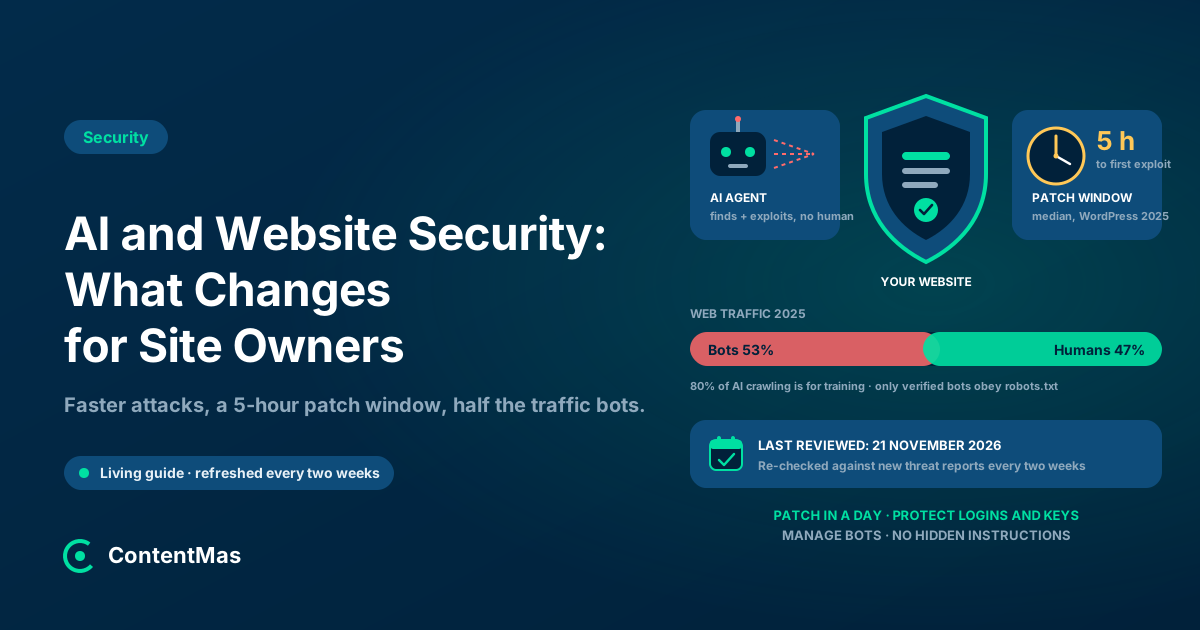
AI made attacks on websites faster, not smarter: exploitation is now the top way in, the patch window is hours, half of traffic is bots. Refreshed twice a month.

Summarize with AI
Short on time? Open this article in your AI assistant with a ready-made prompt.
- ChatGPT (opens in a new tab with a summary prompt)
- Perplexity (opens in a new tab with a summary prompt)
- Grok (opens in a new tab with a summary prompt)
Claude and Gemini open with the prompt copied: paste it to start.
On this page
- How is AI changing attacks on websites?
- Why does the patch window matter more than before?
- What is all this AI traffic hitting my website?
- Can my website be used to attack an AI assistant?
- Which security mistakes are new in the AI era?
- What should a website owner do now?
- What does AI do for the defenders?
- How does ContentMas help with AI and website security?
- Key takeaways
- What changed in this guide
- Frequently asked questions
Short answer
In short: AI has not invented new ways to break into websites; it has made the old ways faster, cheaper and available to more people. In 2025, vulnerability exploitation became the top way breaches start (31%), overtaking stolen credentials for the first time in 19 years, and AI is cited for "shrinking the window for defense from months to mere hours."1 Google's threat team reported in November 2026 that attackers now use AI frameworks to find and exploit vulnerabilities "without a human in the loop," including one system that diffed WordPress plugin patches and attacked websites automatically.2 Half of all web traffic is now automated, and 80% of AI crawling is for model training.34 For a website owner the response is practical: patch within a day, protect logins and keys, manage bot traffic, and keep your pages clean of anything an AI assistant could mistake for instructions.567
Last reviewed: 21 November 2026. This is a living guide: it is re-checked against new reports and advisories about every two weeks, and the "What changed in this guide" section at the end records each update.
Your website has not changed much this year. What arrives at it has. The scanner that tries every known plugin exploit against your login page used to be run by a person with a list; it is now a program that writes its own exploits from the patch notes. The visitor on your pricing page may be an AI agent comparing you with three competitors. The comment on your blog may be written for a machine, not a reader.
This guide keeps the facts in one place: what the measured data says about AI and attacks, what the new traffic is, which mistakes are new, and what a website owner should do. It is written for the people who own and run websites, not for security teams.
How is AI changing attacks on websites?
It changes who can attack, and how fast. The mechanics are the same as before, which matters for the fix list later.
The clearest data point comes from Verizon's 2026 Data Breach Investigations Report, built on 2025 data: "Nearly a third (31%) of all breaches start with vulnerability exploitation in an AI world," which the report calls "the first time in 19 years that it has surpassed stolen credentials as the biggest point of entry." Its explanation is direct: "AI is being leveraged by threat actors to accelerate the time to exploit known vulnerabilities, shrinking the window for defense from months to mere hours."1 Third parties were involved in 48% of breaches, so the plugin, host or agency you rely on is part of your attack surface.1
Google Threat Intelligence Group described the next step in November 2026: "In the past quarter, GTIG identified threat actors using LLM frameworks to fully automate vulnerability discovery and exploitation without a human in the loop for the first time."2 The example is close to home for anyone running a content site. An exposed staging server was hosting a framework, named exploit_agent, "set up to conduct continuous differential analysis of popular web application software. It compares code before and after patch announcements, analyzes findings to identify potential vulnerabilities, drafts exploits, and automatically executes them without human intervention." Its targets were French media, entertainment and education websites, and one screenshot shows it inspecting access controls in a WordPress plugin.2 Google's summary: the mechanics "remain the same, such as using compromised credentials and targeting unpatched systems," but "the speed and scale at which frameworks can exploit these known weaknesses introduces a new defensive challenge."2
Anthropic's September 2026 threat report adds who is behind the keyboard. Its heading is "Sophisticated attacks no longer require sophisticated attackers": AI "has collapsed the labor and tooling gap" between state operations and individuals, so "sophistication has stopped being a reliable signal of who is behind an operation."8 In its cases, "Most intrusions began from compromised credentials," and in one extortion campaign AI agents collected "over 2,100 Azure AD token sets spanning more than 40 corporate tenants in about 34 hours."8
One piece of good news sits in the same reports: Google notes that today's automated frameworks "currently trade stealth for velocity," generating "forensic traffic" and leaving "distinct code-level traces."2 Fast is also loud, and loud can be logged.
Why does the patch window matter more than before?
Because the time between a fix being published and an attack being automated is now measured in hours, and most small websites patch in weeks.
Patchstack's State of WordPress Security in 2026 counted 11,334 new vulnerabilities in the WordPress ecosystem in 2025, "a 42% increase compared to 2024"; 91% were in plugins and 9% in themes, with only 6 low-priority issues in core.5 Of those, "1,966 (17%) vulnerabilities had a high severity score, meaning they were likely to be exploited in automated mass-scale attacks," and "more high-severity vulnerabilities were discovered in the WordPress ecosystem in 2025 than in the previous two years combined."5 Nearly half, 46%, "did not receive a fix from the developer in time for public disclosure."5
Patchstack's reading of the AI side is balanced: "attackers are being equipped with AI that is increasingly capable of autonomously finding and exploiting security vulnerabilities," and "The same tools are also available to the defending side."5 It also reports a "significant increase of AI generated 'slop' vulnerability reports in 2025," noise that slows the queue of real fixes.5
The practical consequence is that "update plugins monthly" is no longer a security policy. Automatic updates, a short list of plugins you actually use, and a host or firewall that applies virtual patches are what close a 5-hour window on a site nobody watches at 3 a.m.
What is all this AI traffic hitting my website?
Most of it is machines, and most of the machine traffic is not trying to buy anything.
Imperva's Bad Bot Report 2026 puts automated traffic at "more than 53% of all web traffic in 2025, up from 51% the year before," with human activity down to 47%.3 It describes a new kind of visitor: AI agents "don't just scan websites; they interact with them, retrieve data, execute workflows, and increasingly act on behalf of users," so "what looks like a customer interaction may not be a customer at all."3 Bots also go around the page: "In 2025, 27% of bot attacks targeted API endpoints."3 Verizon adds the growth rate: "AI Bot Internet Crawlers are experiencing a massive 21% month-over-month growth" against "entirely flat (0.3%) human-led traffic growth."1
Cloudflare's crawler data shows what the AI bots are doing. "Over the past 12 months, 80% of AI crawling was for training, compared with 18% for search and just 2% for user actions."4 Among AI and search crawlers, Googlebot was 39% of traffic in July 2025; "GPTBot's share grew from 4.7% in July 2024 to 11.7% in July 2025," and ClaudeBot went "from 6% to nearly 10%."4 The crawl-to-refer ratio, pages crawled per visit sent back, explains why many owners feel they give more than they get:
| Platform | Pages crawled per referred visit, July 2025 | Change since January 2025 | Source |
|---|---|---|---|
| Anthropic | 38,065.7 | Down 86.7% | 4 |
| OpenAI | 1,091.4 | Down 10.4% | 4 |
| Perplexity | 194.8 | Up 256.7% | 4 |
| Microsoft | 40.7 | Up 5.7% | 4 |
| 5.4 | Up 43% | 4 |
Source: Cloudflare Radar, January to July 2025.4
Two details matter for security rather than traffic. First, "most leading AI crawlers are on our verified bots list, meaning their IP addresses match published ranges and they respect robots.txt."4 Second, where a crawler is not verified, "it makes it easier for bad actors to spoof its crawler and ignore robots.txt."4 A request that says it is ClaudeBot or GPTBot proves nothing; a scraper or a vulnerability scanner can send the same user agent. Bot management has to look at behavior and verified IP ranges, not names. The guide to checking whether you block AI crawlers covers the allow side; this one is about the deny side.
Can my website be used to attack an AI assistant?
Yes, in a specific way, and it changes what "clean content" means.
OWASP's 2025 list of risks for applications built on language models puts prompt injection first. "Indirect prompt injections occur when an LLM accepts input from external sources, such as websites or files," and the content can alter the model's behavior "in unintended or unexpected ways."6 Its second example scenario is a user who asks an assistant "to summarize a webpage containing hidden instructions," which make the assistant leak the conversation to an attacker's URL.6 The listed impacts run from "Disclosure of sensitive information" to "Executing arbitrary commands in connected systems," and OWASP says plainly that "it is unclear if there are fool-proof methods of prevention for prompt injection."6
The assistants are building defenses on their side. Google described a layered approach for Gemini in June 2025: content classifiers that "detect malicious prompts and instructions within various formats," security instructions around untrusted content, a markdown sanitizer that "identifies external image URLs and will not render them," URL checks against Safe Browsing, and user confirmation for risky actions.9 OWASP's list includes "Segregate and identify external content" and "Require human approval for high-risk actions."6
For a website owner, three things follow.
1. Hidden text is now a liability, not a trick
White-on-white text, off-screen blocks and comments aimed at crawlers were always a spam risk. Now they are also the exact shape of an indirect prompt injection. If an assistant reading your page finds instructions, you own the result.
2. User-generated content is an input to other people's AI
Comments, reviews, forum posts and profile fields are read by assistants and agents as part of your page. Moderation, length limits and stripping of hidden markup protect your readers and the assistants that quote you.
3. Your own AI features inherit the risk
A chat widget or search assistant on your site that reads pages, documents or emails is an LLM application in OWASP's sense. It needs the same controls: least privilege, output validation, and a human confirmation step before it sends, deletes or pays.6
Which security mistakes are new in the AI era?
Mostly one: keys. AI tools run on API keys, and keys are leaking at record rates.
GitGuardian's 2026 report counted "28.65 million new hardcoded secrets" added to public GitHub commits in 2025, "a 34% increase year over year and the largest single-year jump we've recorded."7 Secrets for AI services "reached 1,275,105, up 81% year over year."7 Code written with an AI assistant was not exempt: "Claude Code-assisted commits showed a 3.2% secret-leak rate, versus a 1.5% baseline across all public GitHub commits," which GitGuardian says "still happens through a human workflow."7 Leaked keys stay useful: "nearly 70% of credentials confirmed as valid in 2022 were still valid in January 2025," and above 64% in January 2026.7
Attackers want these keys for compute as much as for data. Anthropic's report describes actors who stole "AI API keys" from victims to run their own operations, and Google describes "LLMjacking" where "single-day fraudulent charges exceeded $100,000 USD."28 A key pasted into a page's JavaScript to power a chat widget is readable by anyone who views the source.
The older mistakes have become cheaper to exploit at scale, and one new leak path is people. Verizon reports that employees' frequent use of AI tools jumped "from 15% to 45% of employees in a single year," with unapproved "shadow AI" now "the third most common non-malicious data leakage related activity."1 Content pasted into a public assistant to "tidy up" can include customer data, credentials or unpublished pages.
What should a website owner do now?
Seven steps, in the order that closes the most risk per hour of work. None needs a security team.
1. Patch within 24 hours, automatically
Turn on automatic updates for plugins, themes and the CMS core; remove every plugin you do not use; keep premium components licensed so they update. Half of high-impact WordPress vulnerabilities are exploited within a day.5
2. Put a firewall with virtual patching in front of the site
A web application firewall from your host, CDN or security plugin blocks known exploit patterns before the developer ships a fix, which matters when 46% of vulnerabilities had no patch at disclosure.5 In Patchstack's tests, hosting providers on their own blocked only 12% to 26% of the exploits tried.5
3. Protect every login and rotate every key
Multi-factor authentication on the CMS, the host, the registrar and the email domain; no shared admin accounts; API keys and AI service keys on the server, never in front-end code, rotated when anyone leaves. Most intrusions in the 2026 reports began with stolen credentials.8
4. Manage bot traffic by behavior, not by name
Use your CDN or host's bot management to allow verified crawlers, rate-limit the rest, and watch API endpoints, which took 27% of bot attacks.3 Decide in robots.txt which AI crawlers you welcome, knowing that only verified bots are bound by it.4
5. Keep your pages free of hidden instructions
Remove hidden text, off-screen keyword blocks and HTML comments aimed at machines; moderate and sanitize user-generated content; give any AI chat or search feature read-only access and a confirmation step for anything that changes data.69
6. Read your logs for machine-speed patterns
A burst of requests to /wp-login.php, /xmlrpc.php, /.env or /.git/ within seconds, or hundreds of plugin paths probed in a minute, is an automated framework at work. Today's tools are fast and noisy; a weekly look at the top 404s and top IPs catches them.2
7. Set the basics that every scanner reads first
HTTPS with a valid certificate, HSTS, security headers, and no exposed .env, backup or .git files. The guide to security headers and HSTS has the exact values.
What does AI do for the defenders?
The same things, in the other direction. Firewalls and security plugins now ship protection rules within hours of a disclosure; Patchstack's 5-hour median is measured from the moment such a rule went live.5 Google's Gemini defenses show what AI-assisted detection looks like inside an assistant: classifiers that flag malicious instructions, sanitizers that strip dangerous URLs, and a human in the loop for anything consequential.9 And because automated attack frameworks "trade stealth for velocity," the logs they leave are exactly what anomaly detection is good at.2 None of this replaces the seven steps above; it makes them cheaper to keep up.
How does ContentMas help with AI and website security?
ContentMas is an AI-powered SEO tool that audits your website for Google and AI search engines, and shows exactly what to fix to rank higher and get cited. Its Security pillar reads your site from the outside, the way a scanner and an AI agent do: HTTPS and certificate validity, mixed content, HSTS and the other security headers, exposed files such as .env, backups and .git, secrets or API keys visible in front-end JavaScript, cookie flags, and server version headers that tell an attacker what to target. The SEO & GEO Readiness pillar (visibility in Google and AI search engines; GEO means Generative Engine Optimization) checks robots.txt and which AI crawlers are allowed or blocked, whether AI user agents get the same HTML as browsers (bot-specific content looks like cloaking), and how much of a page is hidden text; Content Quality and Trust & Authenticity flag thin or unsourced content that an assistant should not be quoting.
Each finding comes with evidence and a fix, ranked by impact, across 700+ KPIs in six pillars. It is not a malware scanner or a penetration test, and it does not patch anything for you; it tells you what an outside machine can see. The free plan reads up to 10 pages per scan, 3 scans per 24 hours. See how we score or run an audit.
Key takeaways
- Vulnerability exploitation started 31% of breaches in 2025, overtaking stolen credentials for the first time; AI is shrinking the defense window "from months to mere hours."1
- Attackers now run frameworks that find and exploit vulnerabilities "without a human in the loop," including one that diffed WordPress plugin patches and attacked websites automatically.2
- WordPress vulnerabilities rose 42% to 11,334 in 2025; the median time to first exploit for heavily exploited ones is 5 hours, and 46% had no patch at disclosure.5
- Automated traffic is 53% of the web, 80% of AI crawling is for training, and only verified crawlers can be held to robots.txt.34
- Hidden instructions on a page are an indirect prompt injection risk for the assistants that read it; OWASP ranks prompt injection first and says there is no fool-proof prevention.6
- AI service secrets leaked on public GitHub rose 81% in 2025; keys belong on the server, rotated, never in page code.7
The attack surface of a small website in 2026 is the same list it was in 2020: unpatched software, weak logins, exposed files, and too much trust in whoever sends a request. AI changed the clock on all four. The owners who do well let their updates, firewall and monitoring run at machine speed too.
Related reading: How Website Security Affects Rankings and Customer Trust and Is your website blocking AI crawlers? A 10-minute check
The six-pillar guides: Technical · Content quality · Trust · Freshness · Security · SEO and GEO · How ContentMas scores each pillar
What changed in this guide
- 21 November 2026: first version, built on the Verizon 2026 DBIR, Google Threat Intelligence Group's November 2026 AI Threat Tracker, Anthropic's September 2026 threat report, Patchstack's 2026 WordPress report, Imperva's 2026 Bad Bot Report, Cloudflare's crawler data, OWASP's LLM01:2025, Google's prompt injection defenses and GitGuardian's 2026 secrets report.
Frequently asked questions
Is AI making websites easier to hack?
It is making known weaknesses faster to exploit. Verizon's 2026 report found vulnerability exploitation started 31% of breaches, now ahead of stolen credentials, and credits AI with shrinking the defense window "from months to mere hours."1 Google reported attackers using AI frameworks to find and exploit vulnerabilities "without a human in the loop."2 The fixes are unchanged: patch fast, protect logins, expose nothing sensitive.
How quickly do I need to patch a WordPress plugin?
Within a day. For heavily exploited WordPress vulnerabilities, "the weighted median time to first exploit is 5 hours" and about half of high-impact ones are exploited within 24 hours.5 Automatic updates plus a firewall with virtual patching cover the gap while you sleep.
Should I block AI crawlers to protect my website?
Blocking is a traffic decision, not a security one. Verified crawlers respect robots.txt; unverified ones, and anything pretending to be them, do not.4 Protect the site with bot management, rate limits and a firewall, then decide in robots.txt which AI search engines and training crawlers you welcome.
What is prompt injection and why does it involve my website?
Prompt injection is content that changes what an AI assistant does. The indirect form happens "when an LLM accepts input from external sources, such as websites or files."6 Hidden text on your pages, including in comments and reviews, can be read by an assistant as commands. Keep pages free of hidden text and sanitize user content.
Where do leaked AI keys come from?
Mostly from code and configuration. GitGuardian counted 1,275,105 AI service secrets on public GitHub in 2025, up 81%, and found commits made with an AI coding assistant leaked at 3.2% against a 1.5% baseline.7 On a website, the common leak is a key pasted into front-end JavaScript for a chat widget. Keep keys on the server and rotate them.
References
Each numbered marker in the article links to its source below.
-
Verizon — Vulnerability exploitation top breach entry point, 2026 industry-wide DBIR finds (opens in a new tab), May 2026. ↩
-
Google Threat Intelligence Group — GTIG AI Threat Tracker: Agentic Threat Activity Crosses a Significant Threshold (opens in a new tab), November 2026. ↩
-
Imperva — Bad Bot Report 2026: Bots in the Agentic Age (opens in a new tab), April 2026. ↩
-
Cloudflare — The crawl-to-click gap: Cloudflare data on AI bots, training, and referrals (opens in a new tab), August 2025. ↩
-
Patchstack — State of WordPress Security in 2026 (opens in a new tab), February 2026. ↩
-
OWASP GenAI Security Project — LLM01:2025 Prompt Injection (opens in a new tab), April 2025. ↩
-
GitGuardian — The State of Secrets Sprawl 2026 (opens in a new tab), March 2026. ↩
-
Anthropic — Detecting and countering misuse of AI: September 2026 (opens in a new tab), September 2026. ↩
-
Google — Mitigating prompt injection attacks with a layered defense strategy (opens in a new tab), June 2025. ↩
About this article
Written by Nasir Ali Joiya. Nasir Ali Joiya is a software engineer and the CEO and Co-Founder of ZAPTA Technologies, an AI-native software company in Lahore whose group has more than 150 engineers. Reviewed by the ContentMas Team, who build ContentMas, an AI-powered SEO audit tool that checks sites across six pillars for Google and AI search engines. Facts and figures link to their original sources in the References. Spotted something out of date? Tell us and we will correct it.
Free website audit
See how your site scores for search engines and AI assistants.
One score, six pillar scores and a ranked fix list in a few minutes. No credit card.
Start free audit