
SEO
Zero-click search: how much traffic is lost and what still clicks
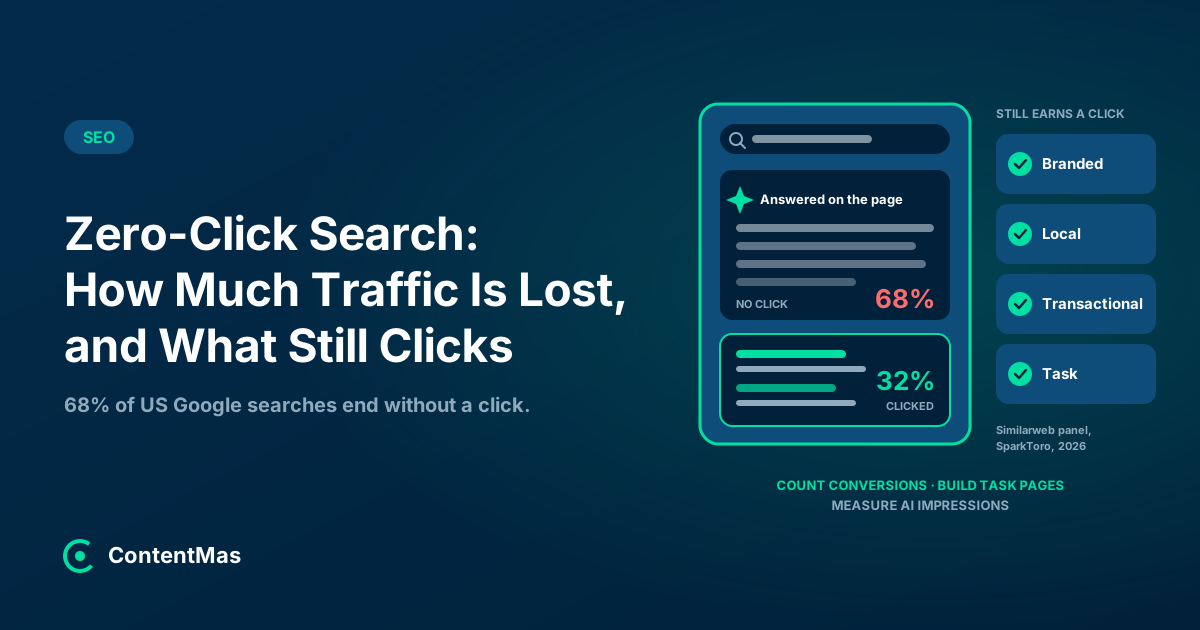
Zero-click search ended 68% of US Google searches in early 2026 and AI Overviews cut the top result's clicks by 58%. Branded, local and task pages still click.

Summarize with AI
Short on time? Open this article in your AI assistant with a ready-made prompt.
- ChatGPT (opens in a new tab with a summary prompt)
- Perplexity (opens in a new tab with a summary prompt)
- Grok (opens in a new tab with a summary prompt)
Claude and Gemini open with the prompt copied: paste it to start.
On this page
Short answer
In short: zero-click search is a Google search that ends without a click on any result. In the first four months of 2026, 68.01% of US Google searches ended that way, up from 60.45% in 2024 and about 45% ten years ago.1 Where an AI Overview appears, the click-through rate of the top organic result fell from 0.073 in December 2023 to 0.016 in December 2025, a 58% loss once the general decline is taken out.2 The clicks that remain go to branded, local and transactional searches, pages that let the visitor finish a task, and pages Google's AI features quote.345 So count conversions rather than clicks alone, build the pages that still earn visits, and measure your presence in AI features where Google now reports it.67
Your Search Console report shows impressions going up and clicks going down. The ranking did not move. The page is still number one for the query that used to bring 7 visits out of every 100 people who searched; it now brings fewer than 2.
That gap has a name, and since 2026 it has a measured size. This article puts the numbers side by side, separates what AI Overviews did from what Google was already doing, and lists the searches and pages that still send people to a website.
What is a zero-click search?
A zero-click search is a Google search that ends without a click on an organic result, an ad or a Google property: the searcher reads the answer on the results page, runs another search, or leaves. SparkToro's 2026 study, built on Similarweb's US desktop and mobile clickstream panel for January to April 2026, found that "In the first four months of 2026, a whopping 68.01% of Google searches ended without a click."1
The trend is long and steady. "In 2024, US zero click searches on Google stood at 60.45%," and "Ten years ago, ~45% of Google searches were zero-click. Today it's 68%."1 Sessions with at least one click of any kind fell 9.51 points, "a 22.9% decline", while sessions that ended with another search rose 7.2 points.1 One caveat matters: the panel covers browser searches, not the Google mobile app, so "it's likely the percentage of zero-click searches is even higher than what we've found here."1
Not every zero-click search is lost business. Someone checking the weather, a spelling or a store's opening hours got what they wanted and was never going to click. The question for a website owner is narrower: how many of the clicks that used to reach your pages are gone, and which pages still get them.
How much traffic is really lost?
Two measurements give the same answer: a large share of the clicks that reached websites a few years ago no longer do, and far more on queries with an AI Overview.
The first is clicks per thousand searches. In SparkToro's country comparison, from the same Similarweb panel, the open web received 231 clicks per 1,000 Google searches in the US and 232 in the UK; Germany was highest at 287, with Italy at 280, France at 271 and Canada at 268. Rand Fishkin's summary: "No country still sends 300+ clicks to the open web per thousand searches."8 Zero-click rates ran from 62.1% in Germany to 69.5% in the UK.8
The second is click-through rate at a fixed position. Ahrefs compared 300,000 keywords in aggregated Search Console data, December 2023 against December 2025, on desktop: 150,000 with an AI Overview and 150,000 informational keywords without one. "In December 2023, the average position one CTR for informational keywords was 0.076." "In December 2025, this had dropped to 0.039."2 With an AI Overview, the top result went from 0.073 to 0.016. Against a forecast of 0.037 built from the general decline, "As of December 2025, AI Overviews reduce the organic click-through rate for position one content by 58%."2 The April 2025 version of the study had found 34.5%, so the loss grew as the feature spread.2
| Measure | Sample | Finding | Source |
|---|---|---|---|
| US Google searches ending without a click | Similarweb panel, January to April 2026 | 68.01%, up from 60.45% in 2024 | 1 |
| Clicks to the open web per 1,000 searches | Similarweb panel, six countries | 231 (US), 232 (UK), 268 (Canada), 271 (France), 280 (Italy), 287 (Germany) | 8 |
| Position 1 CTR on informational keywords | 150,000 keywords, Search Console, desktop | 0.076 in December 2023, 0.039 in December 2025 | 2 |
| Position 1 CTR with an AI Overview | 150,000 keywords, Search Console, desktop | 0.073 to 0.016; 58% below the forecast without AI Overviews | 2 |
| Clicks on results when an AI summary appears | 900 US adults, March 2025 | 8% of visits, against 15% without a summary | 9 |
| Searches that reach AI Mode | Similarweb panel, January to April 2026 | 0.34% | 1 |
Source: compiled from the studies cited in each row.
Put together: an informational page that ranked first and received about 7 clicks per 100 searches in 2023 now receives about 4 without an AI Overview and fewer than 2 with one.2 The ranking is unchanged. The traffic is not.
Are AI Overviews the cause?
They are the largest recent cause, not the only one. Zero-click rates were rising for a decade before AI Overviews existed: about 45% ten years ago, 60.45% in 2024.1 AI Overviews added a step change: SparkToro cites Ahrefs' finding that they appear on 20% or more of searches and cut click-through rate by nearly 60% when present, and calls them the likely main driver of the growth since 2024.1
Pew Research Center measured the behavior directly in the browsing data of 900 US adults in March 2025. "Some 18% of all the Google searches in our study generated an AI summary as part of the search results." "Users who encountered an AI summary clicked on a traditional search result link in 8% of all visits." "Those who did not encounter an AI summary clicked on a search result nearly twice as often (15% of visits)."9 Pew also found which searches get a summary: "Just 8% of one- or two-word searches resulted in an AI summary," rising to 53% for searches of 10 words or more.9 Long, question-shaped searches, the ones informational articles are written for, are the searches most likely to be answered on the page.
Google's own figures explain the scale: "AI Overviews now has over 2.5 billion monthly active users, while AI Mode has surpassed one billion monthly users."6 AI Mode is still a small share of searches, "Only 0.34% of searches made their way to AI Mode from January–April 2026" in SparkToro's panel, but Rand Fishkin expects it to drive the next decade of zero-click growth.1 Google describes the features as "designed to help people find and visit great websites" and says that when people do click from a page with an AI Overview, "these clicks are higher quality, where users are more likely to spend more time on the site."610 Both can be true: fewer clicks, and more intent behind each one.
Which searches still earn a click?
The searches where the result page cannot finish the job. Three sources, with different methods, point to the same set.
1. Branded, local and transactional searches
SparkToro's June 2026 follow-up names them directly: the high-intent, ready-to-act searches that still convert are "branded, local, and transactional queries," and it puts branded terms at about 44% of Google searches.3 Someone who types your company name, a service plus a town, or a product they intend to buy still needs a page to land on.
2. Pages that let the visitor finish a task
Cyrus Shepard analyzed over 400 winning and losing websites, measured by 12-month traffic change from the Ahrefs API, and coded each for five features. "Allows Task Completion" was present on 83.7% of winning sites and 50.2% of losing sites; "Offers a Product or Service" on 70.2% against 34.6%; proprietary assets on 92.9% against 57.1%; a tight topical focus on 75.9% against 61.3%; a strong brand on 32.6% against 16.1%.5 The features are additive: sites with one won 15.4% of the time, sites with four 68.1%, sites with five 69.7%.5 A task does not have to be a purchase: "sites don't need to sell anything to allow task completion," and the examples are a math practice site and a lottery site where people check tickets.5 SparkToro's reading of the same data: "The losing sites were the ones that explain something and then point you elsewhere to act on it."3
3. Tools and utilities
Ahrefs checked its own Search Console keywords whose click-through rate held or rose after AI Overviews doubled in March 2025. The pattern: "utility pages like our Website Traffic Checker and our Free Keyword Generator still caused users to click," because "Utility-driven queries (like 'free tools') compel clicks".4 The same check found click parity or growth when the AI Overview sat below position one, about 8.5% of the time, and that moving up the rankings still raised clicks on AI-dominated result pages.4
What does not hold up is the general explainer that answers a question and sends the reader elsewhere. That is the page an AI Overview replaces, and the pages Zyppy describes as "commodity content" were the losers.5
How do you measure what you still get?
With two reports, read over weeks, not days.
The first is Search Console's Search Generative AI performance report, introduced in June 2026 as "dedicated views of your impressions within generative AI features on Search, such as AI Overviews and AI Mode", by page, country, device and date; "As of August 31, 2026, we've rolled out these insights to all websites worldwide."7 It reports impressions, not clicks or queries, so it tells you which URLs Google's AI features showed, not what people asked or whether they visited.67
The second is your own conversion data. Google's advice is to look at "various indicators of conversion on your site, be it sales, signups, a more engaged audience" and warns that "you might not optimize for these if you focus too much on clicks instead of the overall value of your visits from Search."10 A page that lost half its clicks and kept its sign-ups has lost readers who were never going to act.
One control is new and should be used with care. Search Console now has a toggle that lets a site opt out of appearing in generative AI features. Google states the cost plainly: "Sites that opt out will not receive traffic or impressions from our generative AI features."6 Opting out removes the citation and the click together.
What should a website do about zero-click search?
Five changes, in order of effect.
1. Count visits by what they do, not how many there are
Add conversions, sign-ups, form sends and tool use to the monthly report next to clicks.10 Compare clicks per query with the same month two years earlier where you have the history, so an AI Overview loss is not mistaken for a ranking loss.2
2. Make the pages that complete a task
For every service, add the page where the visitor acts: a quote form, a calculator, an availability check, a comparison with your own prices. Task completion was present on 83.7% of winning sites and 50.2% of losing sites.5
3. Protect the branded and local searches
Your company name, your product names and "service plus town" searches still click.3 Make sure the home, location and product pages answer them in the title, the first paragraph and the structured data, and that nothing (a slow page, a redirect chain, a leftover noindex) stands between the search and the page.
4. Keep the answers open to AI features
Pages quoted in AI Overviews and AI Mode keep a measurable presence, and the Search Console report now shows it.7 Check that public pages carry no nosnippet, no short max-snippet and no data-nosnippet around the main answer, since "More restrictive permissions will limit how your content is featured in our AI experiences."10 The guide to AI Overviews citations covers what the cited pages look like.
5. Narrow the topic and own the assets
Winners were niche and owned something: data, tools, products, a community.5 A small site that covers one subject deeply, with a tool or dataset of its own, matches the winners' profile better than a broad site with more pages.
How does ContentMas help with zero-click search?
ContentMas is an AI-powered SEO tool that audits your website for Google and AI search engines, and shows exactly what to fix to rank higher and get cited. For the searches that still click, it checks the pages that receive them: titles and first paragraphs that name the product, service and place, Organization and LocalBusiness schema that match the visible details, a working contact path, redirect chains and noindex tags left on public pages, and page speed on mobile. For the searches that are answered on the results page, it checks whether your page can be the one quoted: question headings answered in the first sentence, FAQ answers in the server HTML, no snippet restrictions on the main content, and a robots.txt that Google's AI features can read.
Those checks sit in the SEO & GEO Readiness pillar (visibility in Google and AI search engines; GEO means Generative Engine Optimization), Technical Readiness and Content Quality, alongside Trust & Authenticity, Content Freshness and Security, across 700+ KPIs, each with evidence and a fix ranked by impact. The free plan reads up to 10 pages per scan, 3 scans per 24 hours. See how we score or run an audit.
Key takeaways
- 68.01% of US Google searches ended without a click in January to April 2026, up from 60.45% in 2024 and about 45% ten years ago.1
- No country sends more than 300 clicks to the open web per 1,000 searches; the US sends 231, the UK 232, Germany 287.8
- Where an AI Overview appears, the top organic result's click-through rate fell from 0.073 to 0.016, a 58% loss against the forecast; informational keywords without one fell from 0.076 to 0.039.2
- People click a result in 8% of visits with an AI summary and 15% without; summaries appear on 53% of searches of 10 words or more.9
- Branded, local and transactional searches, task-completing pages, tools and pages cited in AI features still earn clicks; task completion was present on 83.7% of winning sites against 50.2% of losers.345
- Search Console now shows impressions in AI Overviews and AI Mode for every site, and Google advises measuring conversions, not clicks alone.6107
Zero-click search is not a penalty. It is the results page doing more of the work. The websites that keep their traffic are the ones the results page cannot replace: the brand people search for, the place they want to visit, the task they need to finish, and the source the answer quotes.
Related reading: SEO vs GEO: What Changes When AI Answers Instead of Google and What Type of Content Really Matters for AI Search Engines?
The six-pillar guides: Technical · Content quality · Trust · Freshness · Security · SEO and GEO · How ContentMas scores each pillar
Frequently asked questions
What percentage of Google searches are zero-click?
68.01% of US Google searches in January to April 2026, according to SparkToro's analysis of Similarweb's clickstream panel, up from 60.45% in 2024.1 Other countries ranged from 62.1% in Germany to 69.5% in the UK.8
How much traffic do AI Overviews take from a page one result?
About 58%. Ahrefs compared 300,000 keywords in Search Console data and found the top result's click-through rate on AI Overview queries fell from 0.073 in December 2023 to 0.016 in December 2025, against a forecast of 0.037 without the feature.2 Lower positions lost less, down to 19.4% at position 10.2
Which searches still send clicks to websites?
Branded, local and transactional searches, pages that let the visitor complete a task, tools and utilities, and pages cited in AI features.345 In Cyrus Shepard's analysis of over 400 sites, task completion was present on 83.7% of winners and 50.2% of losers.5
Should I opt my site out of AI Overviews to get clicks back?
Opting out does not return the clicks. Google says "Sites that opt out will not receive traffic or impressions from our generative AI features," and the searcher still sees an overview built from other sites.6 Keeping the page quotable and measuring its AI impressions in Search Console is the usual choice.7
How do I see whether my pages appear in AI Overviews?
In Search Console's Search Generative AI performance report, available to all sites since 31 August 2026, which shows impressions in AI features by page, country, device and date.7 It does not show clicks or queries, so pair it with your conversion data.107
References
Each numbered marker in the article links to its source below.
-
SparkToro — In 2026, Less than One Third of Google Searches Still Send a Click (opens in a new tab), June 2026. ↩
-
Ahrefs — Update: AI Overviews Reduce Clicks by 58% (opens in a new tab), February 2026. ↩
-
SparkToro — When Google Stops Sending Clicks, What Still Works? (opens in a new tab), June 2026. ↩
-
Ahrefs — What We Learned From Studying Our Own "AI Proof" Keywords (opens in a new tab), July 2025. ↩
-
Zyppy — 5 Data-Backed Features Of Websites Winning Google in 2026 (opens in a new tab), April 2026. ↩
-
Google — New opportunities, control and insights for website owners (opens in a new tab), June 2026. ↩
-
Google Search Central Blog — Introducing Search Generative AI performance reports in Search Console (opens in a new tab), June 2026. ↩
-
SparkToro — Zero-Click Searches: Highest in the UK, Lowest in Germany, and France has the Most Efficient Searchers (opens in a new tab), June 2026. ↩
-
Pew Research Center — Google users are less likely to click on links when an AI summary appears in the results (opens in a new tab), July 2025. ↩
-
Google Search Central Blog — Top ways to ensure your content performs well in Google's AI experiences on Search (opens in a new tab), May 2025. ↩
About this article
Written by Nasir Ali Joiya. Nasir Ali Joiya is a software engineer and the CEO and Co-Founder of ZAPTA Technologies, an AI-native software company in Lahore whose group has more than 150 engineers. Reviewed by the ContentMas Team, who build ContentMas, an AI-powered SEO audit tool that checks sites across six pillars for Google and AI search engines. Facts and figures link to their original sources in the References. Spotted something out of date? Tell us and we will correct it.
Free website audit
See how your site scores for search engines and AI assistants.
One score, six pillar scores and a ranked fix list in a few minutes. No credit card.
Start free audit