
SEO
Google ranking factors: how many does Google really use?
Google has never published a count of its ranking factors, and it has stopped using the "200" figure. What its documentation, a 2024 leak and a US court say.
 By Nasir Ali Joiya, CEO and Co-Founder of ZAPTA TechnologiesPublished Updated 16 min read 11 sources cited
Summarize with AI
Short on time? Open this article in your AI assistant with a ready-made prompt.
- ChatGPT (opens in a new tab with a summary prompt)
- Perplexity (opens in a new tab with a summary prompt)
- Grok (opens in a new tab with a summary prompt)
Claude and Gemini open with the prompt copied: paste it to start.
On this page
- Where does the "200 ranking factors" number come from?
- What does Google say about ranking factors today?
- What did the 2024 Google API leak actually show?
- What did the US antitrust ruling reveal about how Google ranks?
- So how many ranking factors does Google use?
- What should a website owner do with this?
- How does ContentMas help with Google ranking factors?
- Key takeaways
- Frequently asked questions
Short answer
In short: nobody outside Google knows how many ranking factors Google uses, and Google says a number would mislead you. Its own guide describes "many factors and signals" and names 17 notable ranking systems, not a list of 200 factors.1 The "200" figure goes back to a 2010 statement by Google's Matt Cutts, who added that many signals have more than 50 variations each,2 and in 2021 Google's John Mueller said the company had "moved away from the over 200 ranking signals number" because a sortable list of signals "is definitely not the case."3 Leaked API documentation in 2024 contained 14,014 attributes but showed nothing about which ones are used or how they are weighted,4 and the US antitrust ruling of 2024 describes a handful of named systems, led by the click-data system Navboost, combined with language models.5
You have seen the lists. "Google's 200 ranking factors", numbered, sometimes ranked by importance, often with a year in the title. If you own a website, the natural question is which of the 200 to work on first.
The better question is whether the list exists at all. This guide follows the evidence: where the number came from, what Google documents today, what a 2024 leak did and did not show, and what a US federal court found when it examined Google's ranking under oath.
Where does the "200 ranking factors" number come from?
The number is a 2010 conference remark, repeated for 15 years. In November 2010, after Bing had said it used more than 1,000 ranking signals, Google's Matt Cutts told the Pubcon (opens in a new tab) audience that Google used over 200 signals and that many of them had more than 50 variations within a single factor.2 Search Engine Land did the arithmetic in its headline: 200 times 50 gives a claim to 10,000.2 Even in 2010, the "200" was a count of categories, not of individual checks.
The number survived because it is easy to turn into a list. Backlinko's "Google's 200 Ranking Factors: The Complete List", last updated in May 2025, opens with "You might already know that Google uses over 200 ranking factors in their algorithm" and then admits: "Some are proven. Some are controversial. Others are SEO nerd speculation."6 That is an honest description of every such list: a format, filled in from Google statements, patents and guesswork.
Google itself has stopped using the number. Asked in a September 2021 office-hours session which of the 200 signals mattered most, John Mueller answered that Google had "moved away from the over 200 ranking signals number, because it feels like even having a number like that is kind of misleading," and that the idea of "a spreadsheet with all of the ranking signals" sorted by importance is "definitely not the case."3
What does Google say about ranking factors today?
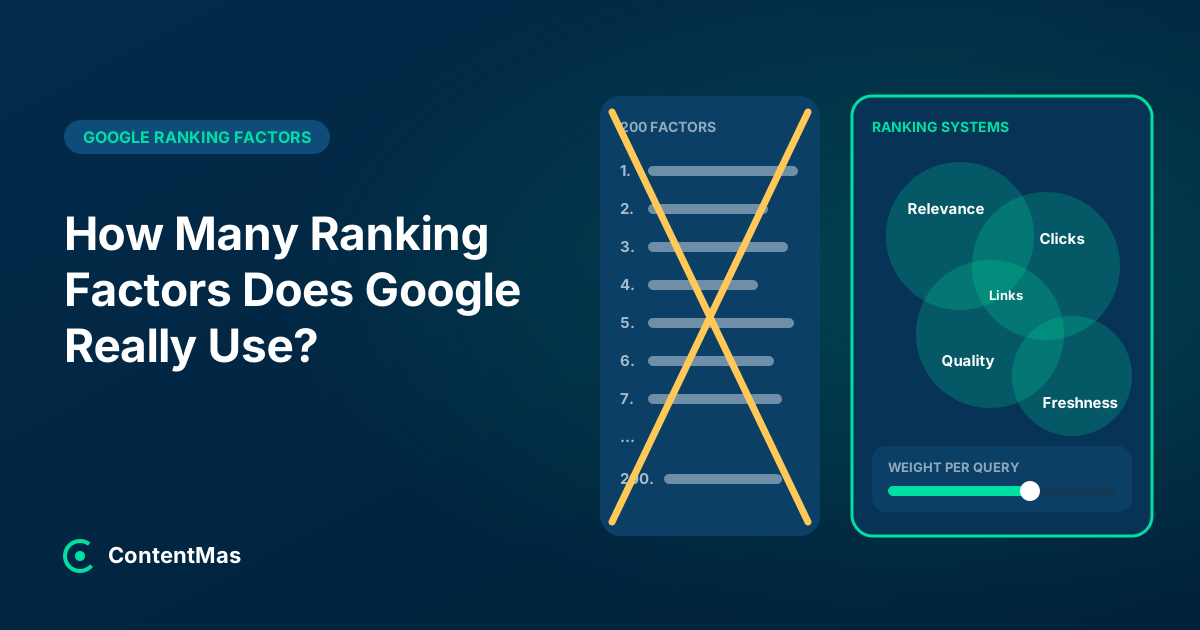
Google describes systems, not factors, and gives no count. Its guide to ranking systems, last updated in December 2025, opens with: "Google uses automated ranking systems that look at many factors and signals about hundreds of billions of web pages and other content in our Search index to present the most relevant, useful results, all in a fraction of a second."1 It then names 17 notable systems, plus 4 retired ones folded into the core.
| System (December 2025 guide) | What Google says it does |
|---|---|
| BERT (Bidirectional Encoder Representations from Transformers), RankBrain, neural matching, MUM (Multitask Unified Model) | AI systems that understand how words relate to concepts and what queries mean1 |
| Passage ranking | Identifies individual sections of a page to understand it better1 |
| Link analysis and PageRank | Understands how pages link to each other to determine what they are about and which are helpful1 |
| Freshness systems | "Query deserves freshness" systems that show fresher content where it would be expected1 |
| Reliable information systems | Surface more authoritative pages and demote low-quality content1 |
| Original content systems | Show original reporting and content ahead of pages that merely cite it1 |
| Reviews system | Rewards in-depth, insightful reviews1 |
| Spam detection systems | Including SpamBrain, to deal with content that violates the spam policies1 |
| Deduplication, site diversity, exact match domain | Shape the result set: remove duplicates, limit a site to about two listings, stop domain names from counting too much1 |
| Crisis information, local news, removal-based demotion | Special needs: crisis queries, local news sources, sites with many removal requests1 |
| Retired: Panda (2011), Penguin (2012), Hummingbird (2013), helpful content system (2022) | "Incorporated into successor systems or made part of our core ranking systems"1 |
Source: Google Search Central, A guide to Google Search ranking systems.1
Why Google gives no single list of factors
Several famous "ranking factors" are no longer separate systems: the helpful content system "evolved and became part of our core ranking systems" in March 2024, as Panda did in 2015 and Penguin in 2016.1 And every system considers many things at once; the exact match domain entry says Google's systems "consider the words in domain names as one of many factors."1
Google's plain-language explanation uses the same framing: "Search algorithms look at many factors and signals, including the words of your query, relevance and usability of pages, expertise of sources, and your location and settings. The weight applied to each factor varies depending on the nature of your query."7 It lists five key signals: meaning of the query, relevance, quality, usability, and context and settings.7 If the weight changes with the query, there is no single ranked list to optimize against.
The same applies to the most-cited "factors." Google says that "while E-E-A-T itself isn't a specific ranking factor, using a mix of factors that can identify content with good E-E-A-T is useful," and that "trust is most important."8 Asked whether there is a single page experience signal, it answers: "There is no single signal. Our core ranking systems look at a variety of signals that align with overall page experience."9 Core Web Vitals "are used by our ranking systems," but a good score "doesn't guarantee that your pages will rank at the top."9 Counting each of these as 1 factor, or as 30, is a choice the list-maker made. In 2025, 48% of mobile websites and 56% of desktop websites had good Core Web Vitals (opens in a new tab).10
What did the 2024 Google API leak actually show?
The leak showed the size of Google's internal vocabulary, not its ranking formula. In May 2024, Rand Fishkin published an analysis of documentation an anonymous source had shared with him: "more than 2,500 pages of API documentation containing 14,014 attributes (API features) that appear to come from Google's internal 'Content API Warehouse.'"4 The material had sat in a public GitHub repository from March 27 to May 7, 2024.4
The attributes are data fields Google's systems can store about a page, a site or a query; some relate to ranking, others to indexing, testing or products outside web search. The most discussed finding concerned clicks: the documentation names a system called NavBoost and features such as "goodClicks," "badClicks" and "lastLongestClicks," which Fishkin read as evidence that Google measures long and short clicks despite years of public statements that it does not use click-based signals in rankings.4 Turning the leak into "14,000 ranking factors" repeats the 2010 mistake at a larger scale.
What did the US antitrust ruling reveal about how Google ranks?
The court's findings are the most detailed public description of Google's ranking, and they describe a small set of named systems built on user data. In the August 2024 memorandum opinion in United States v. Google LLC, the court found that "scoring is done using a number of signals and ranking systems, which are technologies that attempt to discern the user's intent and thus identify the most relevant results for a particular query," and that "many of these signals, discussed below, rely on user data."5
The opinion names the systems. Navboost "is another signal that pairs queries and documents through memorizing user click data"; since 2017 Google has trained it on 13 months of user data, and a Google document quoted by the court calls it "one of the most power[ful] ranking components historically."5 QBST (Query-based Salient Terms) identifies the words that should appear prominently on relevant pages, also trained on about 13 months of user data.5 Newer systems, "RankBrain, DeepRank, RankEmbed, RankBERT, and MUM," are "generalization" systems "designed to fill holes in [click] data"; they "did not replace Navboost and QBST in ranking" and are "additional signals that get balanced both against each other as well as against other signals."5
The opinion also defines click data: "the search results on which a user clicks; whether the user returns to the SERP and how quickly; how long a user hovers over SERP results; and the user's scrolling patterns on the SERP," from which the search engine learns "the relevance of the search results and quality of the webpages that the user visits."5
Put the court findings next to Google's public guide and the picture is consistent: a few large systems, each trained on an enormous number of inputs, balanced against one another per query. Neither source counts factors.15
So how many ranking factors does Google use?
It depends on what you count, and the three honest answers are 5, about 17, and "thousands, unknown." None of them is a to-do list.
| Way of counting | Number | Where it comes from |
|---|---|---|
| Broad signal groups Google explains publicly | 5 | Meaning, relevance, quality, usability, context7 |
| Named ranking systems in Google's guide | 17 notable, plus the core | A guide to Google Search ranking systems, December 20251 |
| Named systems in the antitrust findings | A handful: Navboost, QBST, RankBrain, DeepRank, RankEmbed, RankBERT, MUM | Memorandum opinion, August 20245 |
| Attributes in the leaked API documentation | 14,014 | Content API Warehouse documentation, May 20244 |
| Signals Google claimed in 2010 | "Over 200," many with 50+ variations | Matt Cutts at Pubcon, November 20102 |
Source: compiled from the sources cited in each row.
The number also changes faster than anyone can document. Google reports that in 2023 it ran "over 700,000 experiments that resulted in more than 4,000 improvements to Search."11 A list written in January is, by Google's own account, out of date by December. The external Search Quality Raters who test those changes do not set rankings either: "these ratings do not directly impact ranking, but they do help us benchmark the quality of our results."11
This is why Mueller's answer matters more than any count. The systems "take into account so many different things, you can't just isolate them out."3 A page does not earn points for 200 items. It is scored by systems that ask whether it matches the query, whether the people who click it are satisfied, whether it is reliable, original and fresh when freshness matters, and whether it loads and reads well, with the weights shifting by query.157
What should a website owner do with this?
Work on the properties the systems are built to detect, not on the list. Five follow directly from the evidence above.
1. Match the question, in words and in substance
QBST looks for the terms that should appear prominently on a relevant page; the understanding systems map the query to concepts.15 Answer the question clearly, in the words people search with, and do not bury it. The same work makes a page usable in AI answers; see what type of content matters for AI search engines.
2. Satisfy the people who click
Navboost memorizes which results people click for a query and whether they come back quickly.5 Make the title promise what the page delivers, load fast, and get to the point on the first screen.
3. Be reliable, original and trustworthy
The reliable information and original content systems, and Google's note that "trust is most important," point the same way: cite sources, name authors, show who is behind the site, and publish your own reporting.18
4. Keep pages current where freshness is expected
The freshness systems show newer content for queries that deserve it.1 A 2022 statistic on a page about this year's rules is a ranking problem, not just an editorial one.
5. Keep the technical layer clean
Core Web Vitals are used by the ranking systems, and the spam detection, deduplication and removal-based demotion systems punish sites that break the basics.19 Good page experience will not lift a weak page to the top, but a slow, duplicated or blocked page never gets the chance.9
How does ContentMas help with Google ranking factors?
ContentMas is an AI-powered SEO tool that audits your website for Google and AI search engines, and shows exactly what to fix to rank higher and get cited. ContentMas does not know Google's weights either; nobody outside Google does. What it does is read your key pages and check them against the properties the evidence above keeps pointing to, organized in six pillars: Content Freshness, Content Quality, Trust & Authenticity, SEO & GEO Readiness (visibility in Google and AI search engines; GEO means Generative Engine Optimization), Technical Readiness and Security. Across those pillars it runs 600+ checks, from outdated years and unsourced claims to missing author and company details, crawl settings, Core Web Vitals and security headers.
The free plan reads up to 10 pages per scan, 3 scans per 24 hours; paid plans read 100, 200 or 500 pages. Each finding has a priority and a fix, so the report reads as "what to change on this page," not as 200 factors to tick. See how we score or run an audit.
Key takeaways
- Google has never published a count of ranking factors. Its guide describes "many factors and signals" and names 17 notable ranking systems as of December 2025.1
- The "200" figure is a 2010 remark by Matt Cutts; in 2021 John Mueller said Google had "moved away" from the number because it is misleading.23
- The 2024 leak listed 14,014 attributes but did not show "the weight of particular elements" or "which elements are used in the ranking systems."4
- The 2024 antitrust ruling found that Google scores results with "a number of signals and ranking systems," led by the click-data system Navboost and QBST, with RankBrain, DeepRank, RankEmbed, RankBERT and MUM balanced against them.5
- E-E-A-T is "not a specific ranking factor," there is "no single" page experience signal, and the weight of each factor "varies depending on the nature of your query."789
- Google ran over 700,000 experiments and shipped more than 4,000 improvements in 2023, so any fixed list is out of date within a year.11
The practical conclusion is the opposite of a checklist: make each important page answer its question, satisfy the visitor who clicks, earn trust, stay current and work technically. Those properties do not depend on knowing the count.
Related reading: SEO vs GEO: What Changes When AI Answers Instead of Google and What Type of Content Really Matters for AI Search Engines?
The six-pillar guides: Technical · Content quality · Trust · Freshness · Security · SEO and GEO · How ContentMas scores each pillar
Frequently asked questions
Does Google really use 200 ranking factors?
No official list of 200 exists. The number comes from a 2010 remark by Matt Cutts, who said Google used over 200 signals with more than 50 variations in many of them.2 In 2021 John Mueller said Google had "moved away from the over 200 ranking signals number" because it is misleading.3 Google's current guide names 17 notable ranking systems instead.1
What are the most important Google ranking factors?
Google says the weight of each factor "varies depending on the nature of your query," so there is no fixed order.7 The 2024 antitrust findings describe the click-data system Navboost as "one of the most power[ful] ranking components historically," balanced against language-model systems such as RankBrain and DeepRank.5 Relevance and satisfied visitors matter on every query; reliability is weighted more on health, financial and safety topics.8
Does Google use clicks as a ranking factor?
The 2024 antitrust ruling found that Navboost "pairs queries and documents through memorizing user click data," trained on 13 months of it, and that click data includes which results people click and whether they return to the results page and how quickly.5 The leaked 2024 API documentation also names click features such as "goodClicks" and "lastLongestClicks."4
Is E-E-A-T a Google ranking factor?
Not as a single factor. Google says "E-E-A-T itself isn't a specific ranking factor," but that its systems use "a mix of factors that can identify content with good E-E-A-T," that trust is the most important of the four, and that such content gets "even more weight" on topics affecting health, finances or safety.8
Are Core Web Vitals a ranking factor?
Yes, but a small one. Google says "Core Web Vitals are used by our ranking systems," that there is "no single" page experience signal, and that a good score "doesn't guarantee that your pages will rank at the top."9
References
Each numbered marker in the article links to its source below.
-
Google Search Central — A guide to Google Search ranking systems (opens in a new tab), December 2025. ↩
-
Search Engine Land — Dear Bing, We Have 10,000 Ranking Signals To Your 1,000. Love, Google (opens in a new tab), November 2010. ↩
-
Search Engine Journal — Google Has Moved Away From 200 Ranking Signals Number (opens in a new tab), September 2021. ↩
-
SparkToro — An Anonymous Source Shared Thousands of Leaked Google Search API Documents with Me; Everyone in SEO Should See Them (opens in a new tab), May 2024. ↩
-
FindLaw (U.S. District Court for the District of Columbia) — United States v. Google LLC, Memorandum Opinion (opens in a new tab), August 2024. ↩
-
Backlinko — Google's 200 Ranking Factors: The Complete List (opens in a new tab), May 2025. ↩
-
Google — How Search Works: Automatically generating and ranking results (opens in a new tab), accessed November 2026. ↩
-
Google Search Central — Creating helpful, reliable, people-first content (opens in a new tab), October 2026. ↩
-
Google Search Central — Understanding page experience in Google Search results (opens in a new tab), September 2026. ↩
-
HTTP Archive — Web Almanac 2025: Performance (opens in a new tab), January 2026. ↩
-
Google — How Search Works: Improving Search with rigorous testing (opens in a new tab), accessed November 2026. ↩
About this article
Written by Nasir Ali Joiya. Nasir Ali Joiya is a software engineer and the CEO and Co-Founder of ZAPTA Technologies, an AI-native software company in Lahore whose group has more than 150 engineers. Reviewed by the ContentMas Team, who build ContentMas, an AI-powered SEO audit tool that checks sites across six pillars for Google and AI search engines. Facts and figures link to their original sources in the References. Last reviewed November 8, 2026. Spotted something out of date? Tell us and we will correct it.
Free website audit
See how your site scores for search engines and AI assistants.
One score, six pillar scores and a ranked fix list in a few minutes. No credit card.
Start free audit