
Audits
Why use an SEO readiness audit tool instead of ChatGPT or Claude?
An SEO readiness audit tool checks a whole site for Google and AI search engines the same way every time. Why ChatGPT, Claude and crawlers cannot: the evidence.
 By Nasir Ali Joiya, CEO and Co-Founder of ZAPTA TechnologiesPublished Updated 15 min read 14 sources cited
Summarize with AI
Short on time? Open this article in your AI assistant with a ready-made prompt.
- ChatGPT (opens in a new tab with a summary prompt)
- Perplexity (opens in a new tab with a summary prompt)
- Grok (opens in a new tab with a summary prompt)
Claude and Gemini open with the prompt copied: paste it to start.
On this page
- Question one: if Claude or ChatGPT can do this, why use an audit tool?
- What happened when Claude audited a real website?
- Why does the same answer twice matter?
- Question two: with so many SEO tools, why use this one?
- What can each tool do, and what can it not?
- How should you use them together?
- How does ContentMas help as an SEO readiness audit tool?
- Key takeaways
- Frequently asked questions
Short answer
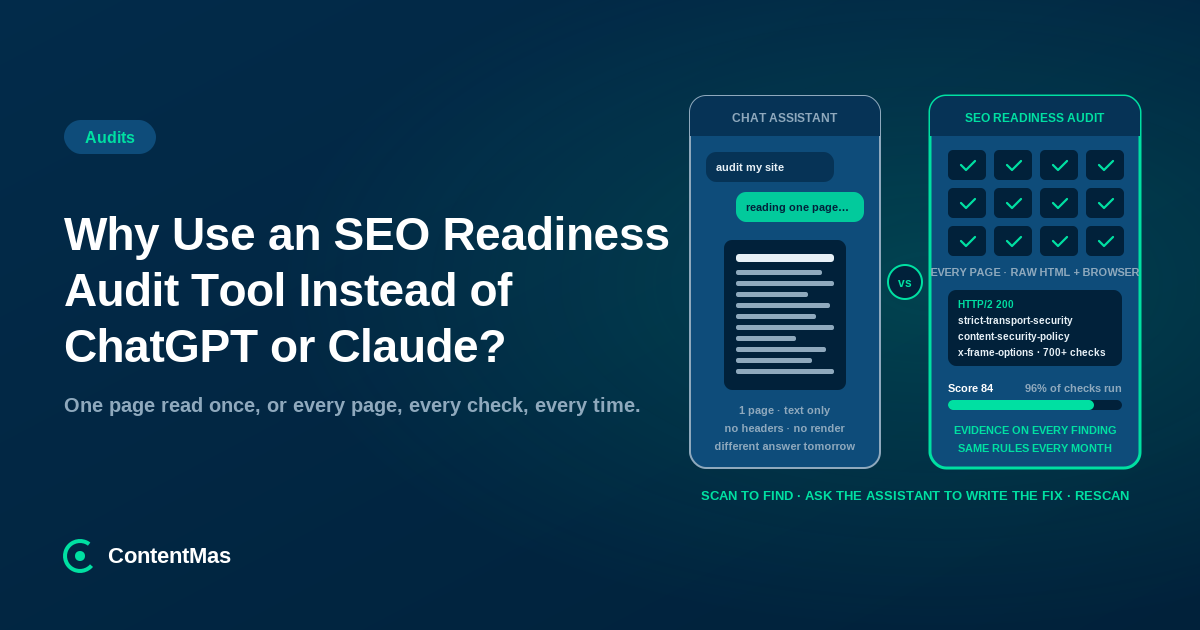
In short: an SEO readiness audit tool checks whether a whole website is ready to be found, understood and cited by Google and AI search engines, the same way every time, with evidence for each finding. A chat assistant does a different job: it reads the page you name, as text. Its own documentation says so. Gemini reads "only the URLs you provide, not any content from nested links," Claude's fetch tool "does not support websites dynamically rendered with JavaScript," and OpenAI's ChatGPT-User agent "is not used for crawling the web in an automatic fashion."123 None of them sees HTTP headers, renders a page, runs a fixed list of checks, says what it did not check, or gives the same answer twice.45 The classic SEO crawlers scan well but stop at technical SEO. Use the assistant to explain findings and write fixes; use an audit tool to find them.
Every time I present ContentMas, our SEO readiness audit tool, the same two questions come back. "Claude or any AI model can do this, so why use a tool?" And: "There are so many SEO tools, so why use this one?" Both deserve an answer with evidence, and this article is written to be shared with the people who ask.
The short answer: the first question mistakes a reader for an instrument, and the second mistakes a technical SEO crawler for a readiness audit, which checks everything Google and AI assistants now judge a site on, not only its technical SEO.
Question one: if Claude or ChatGPT can do this, why use an audit tool?
Because a chat assistant reviews a page and an audit tool audits a website, and the difference is written in the assistants' own documentation.
When you paste a URL, the assistant fetches that page, turns it into text and reasons about the text. OpenAI's ChatGPT-User agent "may visit a web page" when asked and "is not used for crawling the web in an automatic fashion."1 Claude's fetch tool retrieves "URLs that have previously appeared in the conversation," truncates long pages, caches results, and "does not support websites dynamically rendered with JavaScript."2 Gemini's URL tool handles "up to 20 URLs per request" and "will only retrieve content from the URLs you provide, not any content from nested links."3 Perplexity builds answers from the sources it cites.6 None of the four documents a crawl, a render, a measurement or a check list. That is not a flaw; it is not what the products are for.
| What an audit needs | What the assistants document | What goes missing |
|---|---|---|
| Discover every page (sitemap, links, orphans) | They fetch the URLs you name123 | The pages nobody named: orphans, duplicates, forgotten subdomains |
| See the response (status, redirects, headers, certificate) | No vendor documents returning them1236 | Security headers, redirect chains, soft 404s, expiring certificates |
| Render the page (JavaScript, layout, tap targets, speed) | Text retrieval; no JavaScript rendering2 | Core Web Vitals, mobile layout, consent banners, client-side content |
| Give the same answer twice | Training "reward[s] guessing"; inference is "not deterministic in practice"45 | A score that moves without the site moving |
| Say what was not checked | No check list, so no list of what did not run | The denominator: "no issues found" may mean "none looked for" |
Sources: the vendor documentation and research cited in each row, opened November 2026.
The limit is the instrument, not the intelligence. The same models, given a crawler, a browser and a rule set, would be a scanner. Agent modes that drive a browser close one gap (rendering) and leave the others open: one page at a time, no check list, no denominator.
What happened when Claude audited a real website?
It found real problems, missed whole categories, and said so. We gave Claude, with web search and fetch, our own company site, zaptatech.com, and asked for an audit "the way a professional site audit tool would," with the page, the check, the evidence and the fix for every finding, and a closing list of every page opened and every check not run.
In about eleven minutes Claude made 30 fetches, retrieved 15 pages and returned 30 findings, several of them good: an indexed staging copy of the site, duplicate article URLs under two paths, a tracking-parameter URL in Google's index, a projects page with 56 words, typos on six pages and a demo booking slot dated 2023.
Everything Claude listed as unreachable is what a scanner is built to measure. And the run is not repeatable: a second attempt would open different pages and notice different things, with no way to tell a change in the site from a change in the sample.
Why does the same answer twice matter?
Because an audit you cannot repeat cannot show progress, and the model makers themselves explain why a language model cannot promise repetition.
OpenAI's September 2025 research note says models hallucinate because training and evaluation "reward guessing over acknowledging uncertainty," and calls hallucinations "a fundamental challenge for all large language models."4 Thinking Machines showed the same month that "even when we adjust the temperature down to 0," production APIs "are still not deterministic in practice," because output depends on the server's batch at that moment.5 The same prompt about the same unchanged page can return a different list an hour later.
An audit tool is built the other way round. In ContentMas every check is a rule with a defined input and outcome. A check that could not run is recorded as unchecked and lowers the coverage shown under the score; it is never turned into a pass. Each report freezes the policy it was scored with, so the number moves only when the site does. Google's reminder applies to every tool, ours included: third parties "don't have access to our internal ranking data" and "can't guarantee performance."7 An audit tool does not promise rankings. It promises that the same checks ran and that every failed check shows its evidence.
Question two: with so many SEO tools, why use this one?
Because the established tools audit technical SEO, and a website is now judged on more than that. Each of them is good at its job; the table uses their own pages.
| Tool | Built for | Free tier | Stops at |
|---|---|---|---|
| Lighthouse / PageSpeed Insights | One URL, lab and field performance, with a few SEO audits89 | Free, unlimited | One page; "Lighthouse doesn't evaluate the quality of your description"9 |
| Screaming Frog SEO Spider | Desktop crawl data for technical SEO | "A maximum of 500 URLs in a single crawl"; £99 a year beyond10 | Data, not findings: an SEO interprets the spreadsheet |
| Semrush Site Audit | "Over 140+ website issues," technical and on-page11 | "Crawl up to 100 URLs per month"12 | Content quality, trust, freshness, AI search engine readiness |
| Ahrefs Site Audit (Ahrefs Free) | "170+ pre-defined technical and on-page SEO issues"13 | 5,000 crawl credits a month, verified sites only13 | Sites you cannot verify; Health Score ignores warnings by design14 |
| ContentMas | Whole-site readiness for Google and AI search engines: 700+ checks in six pillars | 10 pages per scan, 3 scans a day; paid plans 100, 200, 500 pages | Backlinks, rank tracking, keyword research |
Sources: each vendor's own page, cited per row, opened November 2026.
Three things in that table are the answer. First, scope: Semrush's and Ahrefs' lists are technical and on-page problems, and ContentMas checks those too, but it also scores what no technical crawler does, as six pillars: Content Freshness, Content Quality, Trust & Authenticity, SEO & GEO Readiness (visibility in Google and AI search engines; GEO means Generative Engine Optimization), Technical Readiness and Security. Does the page answer its question, did a real person write it, can the company be verified, are the facts current and sourced, is the site secure. The guide to why a website audit needs this many checks explains the number.
Second, findings rather than data. ContentMas is written for the website owner, not the SEO specialist: every failed check names the page, shows the evidence and states the fix, ranked by priority and by how many similar sites already pass. Third, honesty about coverage: it reads every page as raw HTML and in a real browser, and shows the share of applicable checks it completed under every score, so a 91 at 96% coverage and a 91 at 60% are not the same number. It also scans any public site on the free plan, which Ahrefs Free does not.13 Google Search Console stays open next to all of this; it is the only source of Google's own data, and no audit tool replaces it.7
What can each tool do, and what can it not?
The whole comparison in one table. "Yes" and "No" follow the vendors' documentation where a footnote is given; "Partly" names the condition.
| Capability | Chat assistants | Lighthouse / PSI | Technical crawlers | ContentMas |
|---|---|---|---|---|
| Crawl a whole site from one URL | No123 | No (one URL)8 | Yes, within free limits101213 | Yes, within the plan's pages |
| Audit a site you do not own | Yes, page by page | Yes | Partly (Ahrefs Free: verified sites only)13 | Yes |
| See status codes, redirects, headers | No123 | Partly | Yes | Yes |
| Check security headers and certificate expiry | No | No | Partly, by tool and plan | Yes |
| Render the page in a real browser | No; agent modes one page at a time2 | Yes, one page | Partly (paid tiers) | Yes, every page |
| Measure lab performance (Core Web Vitals) | No | Yes8 | Partly (paid integrations) | Yes |
| Classic on-page SEO (titles, canonicals, robots.txt, broken links) | Partly, from the text it saw | Partly9 | Yes1113 | Yes |
| Content quality, trust, freshness as fixed checks | Partly, as opinion | No | No | Yes |
| Readiness for AI search engines (GEO) | Opinions, no check list | No | Partly (an llms.txt notice)11 | Yes |
| Evidence and a ranked fix on every finding | Partly | Yes, per audit | Partly | Yes |
| Shows what was not checked | No | Partly | Partly | Yes, coverage under the score |
| Same answer on the same site tomorrow | No45 | Yes (lab) | Yes | Yes |
| Explain a finding, in your words | Yes, the best | No | No | Partly: a short "why" |
| Write the fix (title, copy, JSON-LD, redirect) | Yes, the best | No | No | No; it states the fix |
| Run from inside Claude, ChatGPT or Cursor | Not applicable | No | Partly (paid APIs) | Yes, MCP server and API |
Sources: vendor documentation cited per cell; ContentMas behavior as published on its how-we-score page. "Partly" for the crawlers describes the category; check the specific plan.
Two rows go to the assistant outright, explaining and writing, and both come after an audit. Every row that defines the audit (coverage, response data, rendering, fixed checks, evidence, a denominator, repeatability) goes to the scanner.
How should you use them together?
Scan first, with the audit tool, to get the list. Then give the findings, not the site, to Claude or ChatGPT and ask it to write the fixes: new titles, rewritten sections, JSON-LD, redirect rules; it does far better work from "the canonical on /pricing points to the staging host" than from "audit my site." Then rescan to prove the fixes landed, and read the result next to Search Console.7 If you do ask an assistant to look at a site, end the prompt the way our test did: ask for every page it opened and every check it could not run. In our run, that answer was the most useful part of the report.
How does ContentMas help as an SEO readiness audit tool?
ContentMas is an AI-powered SEO tool that audits your website for Google and AI search engines, and shows exactly what to fix to rank higher and get cited. It discovers pages from links and the sitemap, fetches each one as raw HTML and in a real browser, runs 700+ checks across Content Freshness, Content Quality, Trust & Authenticity, SEO & GEO Readiness (visibility in Google and AI search engines; GEO means Generative Engine Optimization), Technical Readiness and Security, and records the status code, headers and certificate of every response. Every failed check names the page, the evidence and the fix; a check that could not run is reported as unchecked and lowers the coverage under the score.
Each scan is compared with the previous one, a single fix can be re-verified without a full rescan, and the scanner identifies itself as ContentMasBot and respects robots.txt. The same audit runs from Claude, ChatGPT or Cursor through the ContentMas MCP server. The free plan reads up to 10 pages per scan, 3 scans per 24 hours; paid plans read 100, 200 or 500 pages. See how we score or run an audit.
Key takeaways
- A chat assistant fetches the pages you name as text; its own documentation describes no crawl, no headers, no rendering and no check list.123
- It cannot promise the same answer twice: training rewards guessing and inference is not deterministic, by the model makers' own account.45
- In a real run, Claude found 30 real issues on a company site and then listed everything it could not see.
- The classic crawlers audit technical SEO well; an SEO readiness audit adds content, trust, freshness, security and AI search engine readiness, with evidence and coverage.101113
- Use them in order: scan to find, ask the assistant to write the fixes, rescan to prove them, keep Search Console open.7
The next time someone asks why use a tool when Claude can do it, ask three questions back: which pages did it open, which checks did it run, and will it say the same thing tomorrow.
Related reading: Free SEO report tools: what each one checks and what none do and Website audit checks: why 700+, and what they cover
The six-pillar guides: Technical · Content quality · Trust · Freshness · Security · SEO and GEO · How ContentMas scores each pillar
Frequently asked questions
What is an SEO readiness audit tool?
A scanner that checks whether a whole website is ready to be crawled, understood, trusted and cited by Google and AI search engines, and reports fixed checks with evidence, a score and the share of checks completed. It is wider than a technical SEO crawler (content, trust, freshness, security, AI search engine readiness) and more rigorous than a chat assistant (every page, a real browser, the same rules every time).
Can ChatGPT or Claude do an SEO audit?
They can review the pages you give them, and they do it well for one page. Their documentation describes fetching a URL as text, with no crawl, no response headers, no rendering and no check list, and the same prompt can return a different list tomorrow.12345 For a whole site, treat the result as a sample and ask the assistant what it could not check.
What does ContentMas do that Semrush, Ahrefs or Screaming Frog do not?
Those tools audit technical and on-page SEO well.101113 ContentMas adds the pillars they leave to the human (content quality, trust, freshness, security headers, readiness for AI search engines), renders every page in a real browser, shows the coverage under the score, and scans any public site on the free plan.
Does any audit tool guarantee rankings?
No. Google says every third-party tool lacks "access to our internal ranking data" and "can't guarantee performance."7 A good tool guarantees that the same checks ran, that every failed check shows its evidence, and that the score moves only when the site does.
References
Each numbered marker in the article links to its source below.
-
OpenAI — Overview of OpenAI crawlers (opens in a new tab), accessed November 2026. ↩
-
Anthropic — Web fetch tool (opens in a new tab), Claude Platform documentation, accessed November 2026. ↩
-
Google AI for Developers — URL context (opens in a new tab), October 2026. ↩
-
OpenAI — Why language models hallucinate (opens in a new tab), September 2025. ↩
-
Thinking Machines Lab — Defeating Nondeterminism in LLM Inference (opens in a new tab), September 2025. ↩
-
Perplexity — How does Perplexity work? (opens in a new tab), accessed November 2026. ↩
-
Google Search Central — Google Search's guidance on third-party SEO tools and advice (opens in a new tab), June 2026. ↩
-
Google for Developers — About PageSpeed Insights (opens in a new tab), October 2024. ↩
-
Chrome for Developers — Lighthouse overview (opens in a new tab), June 2025, and Document does not have a meta description (opens in a new tab), SEO audits. ↩
-
Screaming Frog — SEO Spider Website Crawler (opens in a new tab), accessed November 2026. ↩
-
Semrush — What issues can Site Audit identify? (opens in a new tab), accessed November 2026. ↩
-
Semrush Blog — What can you do with a free Semrush account? (opens in a new tab), December 2025. ↩
-
Ahrefs — Ahrefs Free (formerly Ahrefs Webmaster Tools) (opens in a new tab), accessed November 2026. ↩
-
Ahrefs Help — What is Health Score and how is it calculated in Ahrefs Site Audit (opens in a new tab), September 2026. ↩
About this article
Written by Nasir Ali Joiya. Nasir Ali Joiya is a software engineer and the CEO and Co-Founder of ZAPTA Technologies, an AI-native software company in Lahore whose group has more than 150 engineers. Reviewed by the ContentMas Team, who build ContentMas, an AI-powered SEO audit tool that checks sites across six pillars for Google and AI search engines. Facts and figures link to their original sources in the References. Last reviewed November 27, 2026. Spotted something out of date? Tell us and we will correct it.
Free website audit
See how your site scores for search engines and AI assistants.
One score, six pillar scores and a ranked fix list in a few minutes. No credit card.
Start free audit