
Course highlights · Lesson 3 of 5
Entity disambiguation: making sure AI knows who you are
By Nasir Ali Joiya · Published · 4 min read
Entity disambiguation is the practice of making clear which person, company, product or idea a page is about. It stops search engines and AI search engines from mixing it up with something that has the same name. Five signals do most of the work: spelled-out acronyms, Organization markup, Wikidata, linked topics and one name used everywhere.
Key takeaways on entity disambiguation
- Spell out ambiguous acronyms such as GEO at first use, on every page.
- Describe your organization with url, sameAs, alternateName and disambiguatingDescription, and define key terms as DefinedTerms.
- Keep one exact name everywhere, and link article topics to Wikipedia or Wikidata.
What is an entity?
An entity is one specific thing: a person, a company, a product or an idea. Disambiguation tells it apart from other things with the same name. Google's Organization structured data guide says this markup helps Google disambiguate an organization in search results.
Why should acronyms be spelled out at first use?
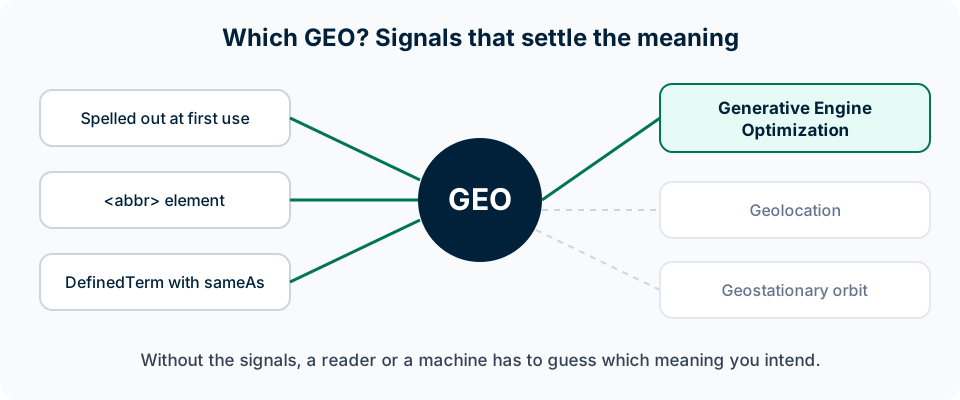
Acronyms should be spelled out at first use because one abbreviation can mean different things in different contexts, as the W3C Web Accessibility Initiative notes. GEO can mean Generative Engine Optimization, geolocation or a geostationary orbit. MDN Web Docs (MDN: Mozilla Developer Network) recommends the full expansion in plain text the first time, with the short form in an abbr element; a title attribute is the fallback. We learned this on our own site: in November 2026 an AI tool read GEO on the ContentMas website as geolocation, so ContentMas now spells out Generative Engine Optimization on every page. Other acronyms need the same care: CRM can mean customer relationship management or crew resource management.
Which structured data tells machines who you are?
Organization markup in JSON-LD (JavaScript Object Notation for Linked Data) on the home or About page tells machines who you are, with your name, url, logo and description. These properties do the disambiguation:
| Property | What it does |
|---|---|
| url | Helps Google uniquely identify the organization |
| sameAs | Links reference pages that confirm the identity: Wikipedia, Wikidata or official profiles |
| alternateName | Lists an alias, such as a longer or older form of the name |
| disambiguatingDescription | A short description that tells the entity apart from similar ones |
| DefinedTerm with termCode | Defines a key term or acronym, with a sameAs reference |
ContentMas, for example, describes itself in its disambiguatingDescription as an SEO audit and AI readiness tool, and defines GEO as a DefinedTerm linked to the Wikipedia article on Generative Engine Optimization.
How do Wikidata and topic links help?
Wikidata and topic links tie your pages to names machines already know. If your organization has a Wikidata item, its official website property, P856, should point to your domain, and the item URL belongs in your sameAs list. People connected to a subject suggest changes on the talk page instead of editing directly, as the conflict of interest guide explains. In Article markup, the about and mentions properties can point to the Wikipedia or Wikidata page of each main concept.
Where should the brand name be identical?
The brand name should be identical everywhere a machine reads it, and the registered legal name goes in legalName:
- Organization and WebSite markup
- og:site_name and the title suffix
- The alt text of your logo
- The footer
- One plain sentence near the top of the home or About page, such as "Example SaaS is a scheduling app for dental clinics."
Questions about entity disambiguation
- What is a disambiguatingDescription?
- It is a Schema.org property for a short description that tells an item apart from similar items, such as two companies with the same name.
- Do I need a Wikipedia article for entity disambiguation?
- No. sameAs can point to official profiles such as LinkedIn, Crunchbase or GitHub. A Wikidata item helps when it exists, and people connected to a subject should suggest edits rather than make them.
- Is an abbr title attribute enough to explain an acronym?
- It is a fallback. MDN Web Docs recommends writing the full expansion in plain text the first time the acronym appears, with the short form in an abbr element.
More on entity disambiguation
Sources for this lesson on entity disambiguation
- Organization structured data (Google Search Central)
- sameAs (Schema.org)
- disambiguatingDescription (Schema.org)
- Thing: alternateName, description, identifier (Schema.org)
- DefinedTerm and termCode (Schema.org)
- Geo, disambiguation page (Wikipedia)
- Generative engine optimization (Wikipedia)
- Understanding Success Criterion 3.1.4: Abbreviations (W3C Web Accessibility Initiative)
- The abbr element (MDN Web Docs)
- WikiProject Companies properties, P856 official website (Wikidata)
- Plain and simple conflict of interest guide (Wikipedia)
Free website audit
Check this on your site with a free ContentMas scan
One score, six pillar scores and a ranked fix list in a few minutes. No credit card.
Start free audit