
Course highlights · Lesson 2 of 5
GEO (Generative Engine Optimization): how pages get cited by AI search engines
By Nasir Ali Joiya · Published · 4 min read
GEO, short for Generative Engine Optimization, is the practice of making pages easy for AI search engines to quote and cite. GEO builds on SEO (search engine optimization): Google says its AI features have no extra requirements, so five writing habits that make a page easy to quote do most of the work.
Key takeaways on GEO and AI citations
- GEO stands for Generative Engine Optimization; spell it out at first use, because GEO has many meanings.
- Answer first, in self-contained sections with real lists and tables, on a solid SEO foundation.
- Back claims with numbers, quotations and linked sources, and keep content honestly fresh.
What does GEO stand for?
GEO stands for Generative Engine Optimization, a term from a research paper by Aggarwal and colleagues, first posted in 2023 and presented at the KDD (Knowledge Discovery and Data Mining) conference in 2024. The acronym is crowded: the Wikipedia Geo page lists Generative Engine Optimization next to a satellite orbit, a magazine and a car brand, and marketers often say geo when they mean location. Spell GEO out at first use on every page, so readers and machines read it the way you mean it.
How are AI search engines different from classic search?
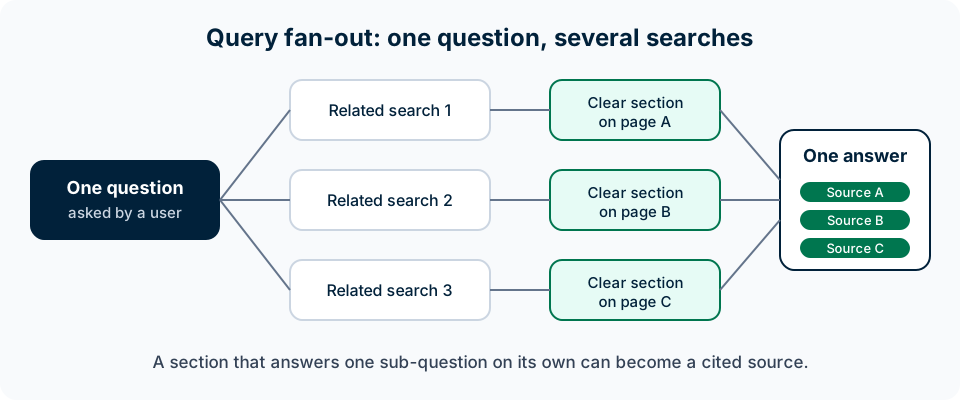
AI search engines answer with a written response and a few cited sources, so the goal is a citation as well as a position. Google explains in AI features and your website that AI Overviews and AI Mode may use query fan-out and show a wider set of supporting links. Google's guide to its generative AI features adds that optimizing for them is still SEO, so solid SEO stays the foundation.
Which five habits help a page get cited?
- Answer first: open each page and each section with one sentence that answers its heading, then add the detail.
- Self-contained sections: name the subject ("the clinic's cleaning service") instead of starting with "it" or "as mentioned above".
- Real lists and tables: steps in an ordered list and comparisons in an HTML table with header cells, with key answers in the page text rather than behind a click.
- Evidence: concrete numbers, named sources, links to them and attributed quotations.
- Honest freshness: update facts, prices and dates when they change, content first and the date second.
Google notes there is no need to break content into tiny pieces for its AI features. Each section only needs to make sense when it is read on its own.
What did the GEO study find?
The GEO study found that adding evidence raised visibility in generative engine answers by up to about 40%, while repeating keywords did not help. The full paper compares each method:
| Method | Result in the study |
|---|---|
| Cite sources | Among the best methods |
| Add quotations | Among the best methods |
| Add statistics | Among the best methods |
| Keyword stuffing | Little to no improvement |
Can snippet settings limit AI citations?
Yes, snippet settings can limit AI citations on Google. A nosnippet rule, a very short max-snippet value or a data-nosnippet attribute around the main text tells Google not to show that text in snippets. Google explains these settings in Control your snippets, and they also limit what its AI features can use.
Questions about GEO and AI citations
- Is GEO different from SEO?
- GEO builds on SEO. SEO helps a page get crawled, indexed and ranked; GEO adds habits that make the page easy for AI search engines to quote, such as answer-first sections and cited evidence.
- Should I split my pages into small chunks for AI?
- No. Google says there is no requirement to break content into small pieces for its AI features. Write each section so it can be understood on its own.
- Does keyword stuffing help with AI citations?
- No. In the GEO study, keyword stuffing offered little to no improvement, while citing sources, adding quotations and adding statistics worked best.
More on GEO and AI citations
Sources for this lesson on GEO and AI citations
- GEO: Generative Engine Optimization (Aggarwal et al., 2024)
- GEO: Generative Engine Optimization, full text with results tables (Aggarwal et al.)
- Geo, disambiguation page (Wikipedia)
- AI features and your website (Google Search Central)
- Google's guide to optimizing for generative AI features on Google Search (Google Search Central)
- Control your snippets in search results (Google Search Central)
- A guide to Google Search ranking systems (Google Search Central)
- Creating helpful, reliable, people-first content (Google Search Central)
Free website audit
Check this on your site with a free ContentMas scan
One score, six pillar scores and a ranked fix list in a few minutes. No credit card.
Start free audit