
Course highlights · Lesson 4 of 5
Core Web Vitals in plain words: loading, response and stability
By Nasir Ali Joiya · Published · 4 min read
Core Web Vitals are a set of three measurements of how real visitors experience a page: LCP (Largest Contentful Paint) for loading, INP (Interaction to Next Paint) for responsiveness and CLS (Cumulative Layout Shift) for visual stability. A page is good when its LCP is 2.5 seconds or less, its INP is under 200 milliseconds and its CLS is under 0.1.
Key takeaways on Core Web Vitals
- LCP is loading, INP is responsiveness and CLS is stability; good is 2.5 s or less, under 200 ms and under 0.1.
- Field data from the Chrome UX Report gives the verdict over 28 days; lab data helps you find the cause.
- First fixes: the main image in the HTML and not lazy-loaded, sizes on every image, and less JavaScript per tap.
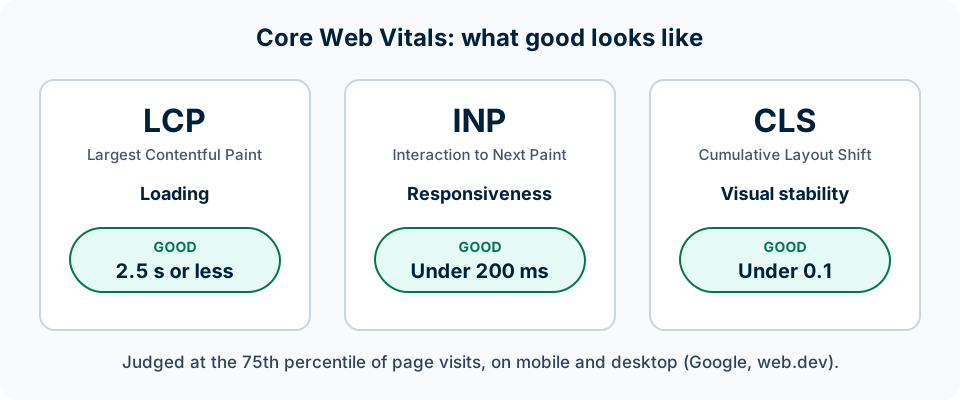
What does each Core Web Vital measure?
Each Core Web Vital answers one question a visitor would ask:
| Metric | Visitor question | Good |
|---|---|---|
| LCP (Largest Contentful Paint) | When does the main content appear? | 2.5 s or less |
| INP (Interaction to Next Paint) | How fast does the page react to a tap or click? | Under 200 ms |
| CLS (Cumulative Layout Shift) | Does the content stay still while it loads? | Under 0.1 |
These ranges are judged at the 75th percentile of page visits, and web.dev explains that the same ranges apply on mobile and desktop. INP replaced First Input Delay (FID) as a Core Web Vital on 12 March 2024.
Do Core Web Vitals affect rankings?
Core Web Vitals support rankings rather than decide them. Google says in Understanding Core Web Vitals that good scores on these metrics align with what its core ranking systems seek to reward, and it highly recommends achieving them. A fast, stable page lets strong content reach people, especially on phones.
How many websites have good Core Web Vitals?
About half of websites pass all three. The Web Almanac 2025 reports that 48% of mobile sites and 56% of desktop sites had good results on all three metrics. On mobile, LCP is the hardest: 62% of mobile sites had a good LCP, compared with 77% for INP and 81% for CLS.
Should you trust field data or lab data?
Field data gives the verdict and lab data finds the cause. Field data comes from real Chrome users through the Chrome UX Report over the previous 28 days. Lab data, such as Lighthouse, is one simulated load on a fixed device and network. PageSpeed Insights shows both.
Which fix should you try first?
The first fix to try depends on which metric needs work:
- LCP: put the main image in the HTML as a normal img tag with fetchpriority="high", never lazy-load it. Speed up the server response with caching or a CDN (content delivery network); web.dev found that image download time is rarely the bottleneck.
- CLS: set width and height on every image and video, and reserve space for embeds, banners and content that loads late.
- INP: run less JavaScript per tap, break long tasks into smaller ones and remove third-party scripts you do not need.
Questions about Core Web Vitals
- Is First Input Delay still a Core Web Vital?
- No. INP (Interaction to Next Paint) replaced First Input Delay as a Core Web Vital on 12 March 2024, so guides that still use FID are out of date.
- Why does PageSpeed Insights show no field data for my page?
- Field data comes from the Chrome UX Report, which needs enough real Chrome visits. Pages with less traffic show lab data only, which is still useful for finding causes.
- How long do Core Web Vitals fixes take to show?
- According to the PageSpeed Insights documentation, field data covers the previous 28 days, so an improvement appears gradually over about four weeks. Lab data shows the change right away.
More on Core Web Vitals
Sources for this lesson on Core Web Vitals
- Understanding Core Web Vitals and Google search results (Google Search Central)
- How the Core Web Vitals metrics thresholds were defined (web.dev)
- Interaction to Next Paint becomes a Core Web Vital on March 12 (web.dev)
- About PageSpeed Insights (Google for Developers)
- Web Almanac 2025, Performance chapter (HTTP Archive)
- Common misconceptions about how to optimize LCP (web.dev)
- Optimize Cumulative Layout Shift (web.dev)
- Optimize Interaction to Next Paint (web.dev)
Free website audit
Check this on your site with a free ContentMas scan
One score, six pillar scores and a ranked fix list in a few minutes. No credit card.
Start free audit